MCQ
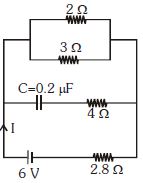
In the given figure the steady state current $I$ is ................. $\mathrm{A}$
  • A
    $0$
  • B
    $0.6$
  • C
    $0.9$
  • $1.5$

Answer

Correct option: D.
$1.5$
d
In steady state condition capacitor behave  as open circuit.

Need a full question paper?

Generate a complete, print-ready paper with questions like this in minutes — across 16+ boards, with answer keys.
Start Generating Free

Similar questions

A person uses spectacles of power $+2D.$ He is suffering from
There are two conductors $X$ and $Y$ carrying a current I and moving in the same direction. $p$ and $q$ are two electron beams also moving in the same direction. Will there be attraction or repulsion between the $ 2$ conductors and between the two electron beams separately?
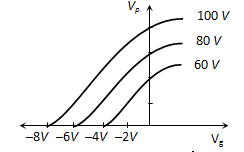
The value of amplification factor from the following graph will be
Consider a photon of a continuous $X-$ray coming from a Coolidge tube. Its energy comes from:
A point $Q$ lies on the perpendicular bisector of an electrical dipole of dipole moment $p$. If the distance of $Q$ from the dipole is $r$ (much larger than the size of the dipole), then electric field at $Q$ is proportional to
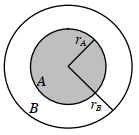
In the figure, the inner (shaded) region $A$ represents a sphere of radius $r_A=1$, within which the electrostatic charge density varies with the radial distance $r$ from the center as $\rho_A=k r$, where $k$ is positive. In the spherical shell $B$ of outer radius $r_B$, the electrostatic charge density varies as $\rho_{\bar{B}}=\frac{2 k}{r}$. Assume that dimensions are taken care of. All physical quantities are in their $SI$ units.

Which of the following statement($s$) is(are) correct?
A photoelectric surface is illuminated successively by monochromatic light of wavelength $\lambda$ and $\lambda /2$. If the maximum kinetic energy of the emitted photoelectrons in the second case is $3$ times that in the first case, the work function of the surface of the material is 
$(h =$ Planck's constant, $c =$ speed of light $)$ 
The dominant mechanisms for motion of charge carriers in forward and reverse biased silicon $P-N$ junctions are
Two cells of equal e.m.f. and of internal resistances $\mathrm{r}_1$ and $\mathrm{r}_2\left(\mathrm{r}_1>\mathrm{r}_2\right)$ are connected in series. On connecting this combination to an external resistance R, it is observed that the potential difference across the first cell becomes zero. The value of R will be
A current passes through a wire of nonuniform crosssection. Which of the following quantities are independent of the cross$-$section?