MCQ
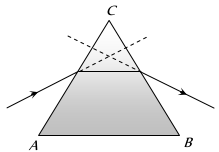
In the given figure, what is the angle of prism
Image
  • A
    $A$
  • B
    $B$
  • $\mathrm{C}$
  • D
    $D$

Answer

Correct option: C.
$\mathrm{C}$
Angle of prism is the angle between incident and emergent surfaces.

Need a full question paper?

Generate a complete, print-ready paper with questions like this in minutes — across 16+ boards, with answer keys.
Start Generating Free

Similar questions

$110 J$ of heat is added to a gaseous system, whose internal energy change is $40 \mathrm{~J}$, then the amount of external work done is
An astronomical telescope of ten-fold angular magnification has a length of $44 \mathrm{~cm}$. The focal length of the objective is
When the angle of incidence on a material is $60^{\circ}$, the reflected light is completely polarized. The velocity of the refracted ray inside the material is (in $m s$ )
In an interference arrangement similar to Young's double slit experiment, the slits $S$ and $S$ are illuminated with coherent microwave sources each of frequency $10 Hz$. The sources are synchronized to have zero phase difference. The slits are separated by distance $d=150 m$. The intensity $l(\theta)$ is measured as a function of $\theta$, where $\theta$ is defined as shown. If $l$ is maximum intensity, then $I(\theta)$ for $0 \leq \theta \leq 90^{\circ}$ is given by

Image

The pressure and density of a diatomic gas $(\gamma=7 / 5)$ change adiabatically from $(P, d)$ to $(P, d)$. If $\frac{d^{\prime}}{d}=32$, then $\frac{P^{\prime}}{P}$ should be
A particle free to move along the $x$-axis has potential energy given by $U(x)=k\left[1-\exp (-x)^2\right]$ for $-\infty \leq x \leq+\infty$, where $k$ is a positive constant of appropriate dimensions. Then
By Huygen's wave theory of light, we cannot explain the phenomenon of
The ratio of the speed of the electron in the first Bohr orbit of hydrogen and the speed of light is equal to (where $e, h$ and $c$ have their usual meanings)
In $P$-type semiconductor the majority and minority charge carriers are respectively
In an inelastic collision, what is conserved