MCQ
In the given potential energy diagram, the point X represents:
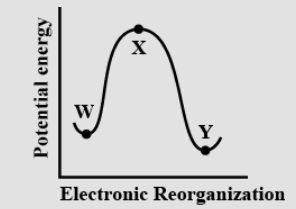
- AA transition state
- BA reaction intermediate
- CA resonance hybrid
- DA reactant
Explanation:
In the given potential energy diagram, the point XX represents the transition state.
It is the maximum energy state and below which reaction will not occur.
Generate a complete, print-ready paper with questions like this in minutes — across 16+ boards, with answer keys.
$(a)$ Photon is a positively charged nuclear particle
$(b)$ Size of nucleus is very small as compared to the size of atom
$(c)$ Photoelectric effect and diffraction show particle nature of light
$(d)$ Planck's constant has same dimensions as angular momentum
The correct statements is/are
Product $Z$ is
Statement $I :$ In 'Lassaigne's Test, when both nitrogen and sulphur are present in an organic compound, sodium thiocyanate is formed.
Statement $II :$ If both nitrogen and sulphur are present in an organic compound, then the excess of sodium used in sodium fusion will decompose the sodium thiocyanate formed to give $NaCN$ and $Na _{2} S$.
In the light of the above statements, choose the most appropriate answer from the options given below...