MCQ
In the nuclear reaction ${85^{X}}^{297} \rightarrow {Y}+4 \alpha, {Y}$ is
  • A
    ${76^Y}^{287}$
  • B
    ${77^Y}^{285}$
  • ${77^Y}^{281}$
  • D
    ${77^Y}^{289}$

Answer

Correct option: C.
${77^Y}^{281}$
(c) ${77^Y}^{281}$

Need a full question paper?

Generate a complete, print-ready paper with questions like this in minutes — across 16+ boards, with answer keys.
Start Generating Free

Similar questions

A silver and zinc voltameter are connected in series and a current $i$ is passed through them for a time $t$ liberating $W\, gm$ of zinc. The weight of silver deposited is nearly ..............$W$
A ray of light is incident on a $60^o$ prism at the minimum deviation position. The angle of refraction at the first face (i.e., incident face) of the prism is.......$^o$
Electric field lines of force:
A particle is fastened at the end of a string and is whirled in a vertical circle with the other end of the string being fixed. The motion of the particle is:
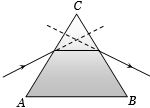
In the given figure, what is the angle of prism
. The electric potential inside a conducting sphere $......$?
The angular width of the central maximum in a single slit diffraction pattern is $60^o $ . The width of the slit is $1\ \mu m$. The slit is illuminated by monochromatic plane waves. If another slit of same width is made near it, Young's fringes can be observed on a screen placed at  distance $50\ cm$ from the slits. If the observed fringe width is $1\ cm$, what is slit separation distance?.........$\mu m$
(i.e. distance between the centres of each slit. )
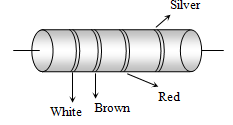
In the figure a carbon resistor has bands of different colours on its body as mentioned in the figure. The value of the resistance is

A $20 \,cm$ length of a certain solution causes right-handed rotation of $38^o $. A $30\,cm $ length of another solution causes left-handed rotation of $24^o $. The optical rotation caused by $30\,cm$ length of a mixture of the above solutions in the volume ratio $1 : 2$ is
The magnetic flux through a stationary loop with resistance $R$ varies during interval of time $T$ as $\phi =$ at $(T - t)$. The heat generated during this time neglecting the inductance of loop will be