MCQ
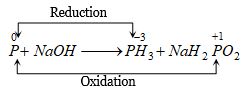
In the reaction $P + NaOH \to P{H_3} + Na{H_2}P{O_2}$
- A$P$ is oxidised only
- B$P$ is reduced only
- ✓$P$ is oxidized as well as reduced
- D$Na$ is reduced
Generate a complete, print-ready paper with questions like this in minutes — across 16+ boards, with answer keys.
$\left( 2 \right)\,{N_2}\left( g \right) + {O_2}\left( g \right) \rightleftharpoons 2NO\left( g \right)\,,\,{K_2}$
$\left( 3 \right)\,{H_2}\left( g \right) + \frac{1}{2}{O_2}\left( g \right) \rightleftharpoons {H_2}O\left( g \right)\,,\,{K_3}$
The equation for the equilibrium constart of the reaction
$2N{H_3}\left( g \right) + \frac{5}{2}{O_2}\left( g \right) \rightleftharpoons 2NO\left( g \right) + 3{H_2}O\left( g \right)$
$(K_4)$ in terms of $K_1 , K_2$ , and $K_3$ is
Statement $I :$ The presence of weaker $\pi$ - bonds make alkenes less stable than alkanes.
Statement $II :$ The strength of the double bond is greater than that of carbon-carbon single bond.
In the light of the above statements, choose the correct answer from the options given below.