MCQ
In the relation $n = \frac{{PV}}{{RT}},n = $
  • A
    Number of molecules
  • B
    Atomic number
  • C
    Mass number
  • Number of moles

Answer

Correct option: D.
Number of moles
d
$n=\frac{P V}{R T}$

Writing the units of all the terms of Right Hand Side, in $SI$ units

$n=\frac{(P a) \times\left(m^{3}\right)}{(J / mol / k) \cdot(k)}$

$n=\frac{\left(\frac{N}{m^{2}}\right) \cdot\left(m^{3}\right)}{\left(\frac{J}{\text { mol. K }}\right) \cdot(k .)}$

$n=\frac{\frac{ kgm }{ s ^{2} \cdot m ^{2}} \cdot m ^{3}}{\frac{ kg m ^{2}}{ s ^{2} \cdot mol \cdot K } \cdot K .}$

$n=\operatorname{mol}$. [All other terms cancel out]

Correct choice - option - $D$

Need a full question paper?

Generate a complete, print-ready paper with questions like this in minutes — across 16+ boards, with answer keys.
Start Generating Free

Similar questions

$M$ grams of steam at $100^{\circ} \mathrm{C}$ is mixed with $200\; \mathrm{g}$ of ice at its melting point in a thermally insulated container. If it produces liquid water at $40^{\circ} \mathrm{C}$ [heat of vaporization of water is $540 \;cal/\mathrm{g}$ and heat of fusion of ice is $80 \;\text { cal/g }]$ the value of $\mathrm{M}$ is
A $43\, m$ long rope of mass $5.0\, kg$ joins two rock climbers. One climber strikes the  rope and the second one feels the effect $1.4\, s$ later. What is the tension in the rope .... $N$ ?
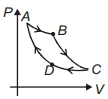
Carnot cycle is plotted in $P-V$ graph. Which portion represents an isothermal expansion?
On investigation of light from three different stars $A, B$ and $C$ , it was found that in the spectrum of $A$ the intensity of red colour is maximum, in $B$ the intensity of blue colour is maximum and in $C$ the intensity of yellow colour is maximum. From these observations it can be concluded that
If radius of earth becomes $n$ times its present value, without change in mass, then duration of day becomes
A body of density $\rho'$  is dropped from rest at a height $h$ into a lake of density $\rho$ , where $\rho > \rho '$ . Neglecting all dissipative forces, calculate the maximum depth to which the body sinks before returning to float on the surface.
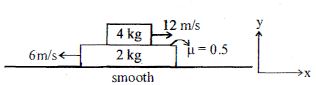
The blocks are given velocity in the direction shown in figure. Co-efficient of friction between two blocks shown in figure is $μ = 0.5$. Take $g = 10\  m/s^2$

(considering $4\ kg$ block doesn't fall on ground)

Consider the following statements

$(i)$  Time when relative motion between them is stopped is $1.4\  second$.

$(ii)$  Time when relative motion between them is stopped in $1.2\  second$

$(iii)$  The common velocity of the two blocks is $8\  m/s$, towards right.

$(iv)$  The displacement of the $4\, kg$ block when relative motion stopped is$10.8\  m$.

Which of the fstatements is/are correct
In SI system the fundamental units are
Two cars OF SAME LENGTH move in the same direction along parallel roads. One of them is a 100m long travelling with a velocity of 7.5 ms−1. How long will it take for the first car to overtake the second car?
When a long glass capillary tube of radius $0.015\;cm$ is dipped in a liquid, the liquid rises to a height of $15\, cm$ within it. If the contact angle between the liquid and glass to clase to $0^{\circ},$ the surface tension of the liquid, in $milli\,Newton \;m ^{-1}$ is $.....$

$\left[\rho_{\text {(liquid) }}=900\; kg\,m ^{-3}, g =10\, ms ^{-2}\right]$ (Give answer in closest integer)