MCQ
In the visible region the dispersive powers and the mean angular deviations for crown and flint glass prisms are $\omega, \omega^{\prime}$ and $d, d$ respectively. The condition for getting deviation without dispersion when the two prisms are combined is
  • A
    $\sqrt{\omega d}+\sqrt{\omega^{\prime} d^{\prime}}=0$
  • B
    $\omega^{\prime} d+\omega d^{\prime}=0$
  • $\omega d+\omega^{\prime} d^{\prime}=0$
  • D
    $(\omega d)^2+\left(\omega^{\prime} d^{\prime}\right)^2=0$
Answer

Correct option: C.
$\omega d+\omega^{\prime} d^{\prime}=0$
$\theta_{\text {net }}=\theta+\theta^{\prime}=0 \Rightarrow \omega d+\omega^{\prime} d^{\prime}=0$
$\left(\theta=\right.$ Angular dispersion $\left.=\omega \cdot \delta_y\right)$

Need a full question paper?

Generate a complete, print-ready paper with questions like this in minutes — across 16+ boards, with answer keys.

Start Generating Free

Similar questions

Continuous spectrum is not due to
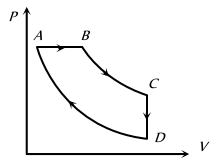
A cyclic process $A B C D$ is shown in the figure $P$ - $V$ diagram. Which of the following curves represent the same process
Image
A lens of focal power $0.5 D$ is
The displacement of a particle, moving in a straight line, is given by $s=2 t^2+2 t+4$ where $s$ is in metres and $t$ in seconds. The acceleration of the particle is
The momentum in mechanics is expressed as $m \times v$. The analogous expression in electricity is
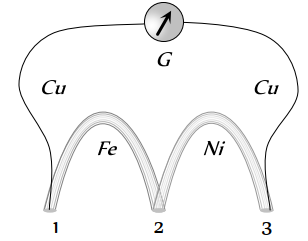
Three wires of copper, iron and nickel are joined to form three junctions as shown in Fig. When the temperature of junction 1 is kept $50^{\circ} C$ with the other two junctions at $0^{\circ} C$, the sensitive galvanometer gives a deflection of 14 divisions. When the temperature of junction 3 is kept $50^{\circ} C$, with the other two junctions at $0^{\circ} C$, the galvanometer gives a deflection of 11 divisions. Then the deflection given by the galvanometer, when temperature of the junction 2 is kept at $50^{\circ} C$, with the other two junctions at $0^{\circ} C$, will be

Image

If the velocity of sound in air is $350 \mathrm{~m} / \mathrm{s}$. Then the fundamental frequency of an open organ pipe of length $50 \mathrm{~cm}$, will be
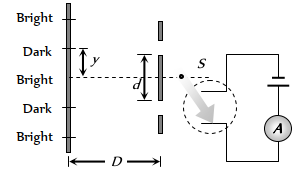
In the following arrangement $y=1.0 \mathrm{~mm}, d=0.24 \mathrm{~mm}$ and $D=1.2 \mathrm{~m}$. The work function of the material of the emitter is $2.2 \mathrm{eV}$. The stopping potential $V$ needed to stop the photo current will beImage
Newton's third law of motion leads to the law of conservation of
A moving coil sensitive galvanometer gives at once much more deflection. To control its speed of deflection