MCQ
In thermodynamics, heat and work are
  • Path functions
  • B
    Intensive thermodynamic state variables
  • C
    Extensive thermodynamic state variables
  • D
    Point functions

Answer

Correct option: A.
Path functions
a
Heat and work are treated as path functions in thermodynamics.

$\Delta Q =\Delta U +\Delta W$

Since work done by gas depends on type of

process i.e. path and $\Delta U$ depends just on initial

and final states, so $\Delta Q$ i.e. heat, also has to

depend on process is path.

Need a full question paper?

Generate a complete, print-ready paper with questions like this in minutes — across 16+ boards, with answer keys.
Start Generating Free

Similar questions

Let $A$ and $B$ the two gases and given : $\frac{{{T_A}}}{{{M_A}}} = 4.\frac{{{T_B}}}{{{M_B}}};$ where $T$ is the temperature and M is molecular mass. If ${C_A}$ and ${C_B}$ are the $r.m.s. $ speed, then the ratio $\frac{{{C_A}}}{{{C_B}}}$ will be equal to
If the velocities of three molecules of a gas are $\sqrt{7}, 4$ and $5 m / s$ respectively. If they are then the value of their square mean root velocity in $m / s$ will be :
A solid sphere, a hollow sphere and and a ring are released from top of an inclined plane (frictionless) so that they slid down the plane. Then maximum acceleration down the plane is for (no rolling)
Sound waves of wavelength $\pi$ travelling in a medium with a speed of v m/ s enter into another medium where its speed is 2v m/ s. Wavelength of sound waves in the second medium is:
A particle of mass $10\,g$ moves in a straight line with retarcation $2x$, where $x$ is the displacement in $SI$ units. Its loss of kinetic energy for above displacement is $\left(\frac{10}{x}\right)^{- n }\, J$. The value of $n$ will be $............$.
A rocket is fired upward from the earth's surface such that it creates an acceleration of $20\, m/s^2$. If after $5\, s$ its engine is switched off, the maximum height of the rocket  from the earth's surface would be......$m$
A point charge is brought in an electric field. The electric field at a nearby point.
  1. Will increase if the charge is positive.
  2. Will decrease if the charge is negative.
  3. May increase if the charge is positive.
  4. May decrease if the charge is negative.
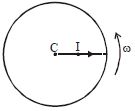
$A$ disc is rotating with constant angular velocity about an axis passing through centre $C$ and perpendicular to the plane of disc. An insect is moving over the disc along radial direction with constant velocity with respect to the disc. Acceleration of the insect at the instant when its distance from centre is $r$, will be :-
Water of volume $2$ litre in a container is heated with a coil of $1\ kW$ at $27^\circ C.$ The lid of the container is open and energy dissipates at the rate of $160 Js$ In how much time temperature will rise from $27^\circ C$ to $77^\circ C? [$Given specific heat of water $= \text{4.2kJ/kg]}$
Motion of an oscillating liquid column in a U-tube is: