MCQ
In thermodynamics, heat and work are
  • Path functions
  • B
    Intensive thermodynamic state variables
  • C
    Extensive thermodynamic state variables
  • D
    Point functions

Answer

Correct option: A.
Path functions
a
Heat and work are treated as path functions in thermodynamics.

$\Delta Q =\Delta U +\Delta W$

Since work done by gas depends on type of

process i.e. path and $\Delta U$ depends just on initial

and final states, so $\Delta Q$ i.e. heat, also has to

depend on process is path.

Need a full question paper?

Generate a complete, print-ready paper with questions like this in minutes — across 16+ boards, with answer keys.
Start Generating Free

Similar questions

Two ideal polyatomic gases at temperatures $T _{1}$ and $T _{2}$ are mixed so that there is no loss of energy. If $F _{1}$ and $F _{2}, m _{1}$ and $m _{2}, n _{1}$ and $n _{2}$ be the degrees of freedom, masses, number of molecules of the first and second gas respectively, the temperature of mixture of these two gases is
$A$ particle of mass $3m$ is projected from the ground at some angle with horizontal. The horizontal range is $R$. At the highest point of its path it breaks into two pieces $m$ and $2m$. The smaller mass comes to rest and larger mass finally falls at a distance $x$ from the point of projection where $x$ is equal to
A block of mass $5$ kg lies on a rough horizontal table. A force of $19.6\, N$ is enough to keep the body sliding at uniform velocity. The coefficient of sliding friction is
A projectile is fired from horizontal ground with speed $v$ and projection angle $\theta$. When the acceleration due to gravity is $g$, the range of the projectile is $d$. If at the highest point in its trajectory, the projectile enters a different region where the effective acceleration due to gravity is $g^{\prime}=\frac{g}{0.81}$, then the new range is $d^{\prime}=n d$. The value of $n$ is. . . . .
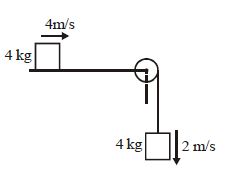
Two blocks of same mass $(4\ kg)$ are placed according to diagram. Initial velocities of bodies are $4\ m/s$ and $2\ m/s$ and the string is taut. Find the impulse on $4\ kg$ when the string again becomes taut  .......... $N-s$
A small solid ball is dropped from a height above the free surface of a liquid. It strikes the surface of the liquid at $t = 0$. The density of the material of the ball is $500\  kg/m^3$ and that of liquid is $1000\  kg/m^3$ If the ball comes momeritariiy at rest at $t = 2\  sec$ then initial height of the ball from surface of liquid was ..... $m$ (neglect viscosity)
A football player is moving southward and suddenly turns eastward with the same speed to avoid an opponent. The force that acts on the player while turning is :
A table tennis ball has radius $(3 / 2) \times 10^{-2} m$ and mass $(22 / 7) \times 10^{-3} kg$. It is slowly pushed down into a swimming pool to a depth of $d=0.7 m$ below the water surface and then released from rest. It emerges from the water surface at speed $v$, without getting wet, and rises up to a height $H$. Which of the following option(s) is (are) correct?

[Given: $\pi=22 / 7, g=10 ms ^{-2}$, density of water $=1 \times 10^3 kg m ^{-3}$, viscosity of water $=1 \times 10^{-3} Pa$-s.]

$(A)$ The work done in pushing the ball to the depth $d$ is $0.077 J$.

$(B)$ If we neglect the viscous force in water, then the speed $v=7 m / s$.

$(C)$ If we neglect the viscous force in water, then the height $H=1.4 m$.

$(D)$ The ratio of the magnitudes of the net force excluding the viscous force to the maximum viscous force in water is $500 / 9$.

A projectile fired at $30^{\circ}$ to the ground is observed to be at same height at time $3 s$ and $5 s$ after projection, during its flight. The speed of projection of the projectile is $.........\,ms ^{-1}$(Given $g=10\,m s ^{-2}$ )
A particle of mass $m$ is tied to string of length $l$ and whirled in vertical circle. The difference of tension and kinetic energy at highest and lowest position of circular path will be