MCQ
In traslational equilibrium:
  • $\sum^\limits{\text{n}}_\limits{\text{i}=1}\text{F}_{\text{net}}=0$
  • B
    $\sum^\limits{\text{n}}_\limits{\text{i}=1}\tau_{\text{net}}=0$
  • C
    Both $(a)$ and $(b)$ are the necessary conditions for the translational equilibrium.
  • D
    Particle may be in equilibrium when $(a)$ and $(b)$ are not fulfilled.
Answer

Correct option: A.
$\sum^\limits{\text{n}}_\limits{\text{i}=1}\text{F}_{\text{net}}=0$

Need a full question paper?

Generate a complete, print-ready paper with questions like this in minutes — across 16+ boards, with answer keys.

Start Generating Free

Similar questions

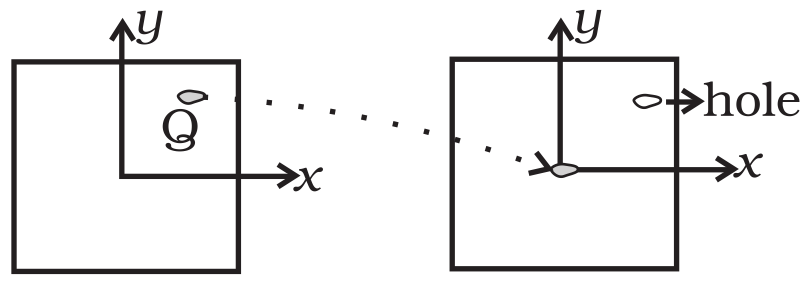
A uniform square plate has a small piece $Q$ of an irregular shape removed and glued to the centre of the plate leaving a hole behind. The moment of inertia about the $z-$axis is then:
Young's modulus of a material has the same units as
Frequency is the function of density $(\rho )$, length $(a)$ and surface tension $(T)$. Then its value is
X-ray beam can be deflected:
If the value of force is $100N$ and value of acceleration is $0.001\ ms^{-2}$, what is the value of mass in this system of units?
Hail storms are observed to strike the surface of the frozen lake at $30^o$ with the vertical and rebound at $60^o$ with the vertical. Assume contact to be smooth, the coefficient of restitution is
A force $F=\left(5+3 y^2\right)$ acts on a particle in the $y$ direction, where $F$ is newton and $y$ is in meter. The work done by the force during a displacement from $y =2\,m$ to $y =5\,m$ is $.............\,j$.
A driver takes $0.20s$ to apply the brakes after he sees a need for it. This is called the reaction time of the driver. If he is driving a car at a speed of $54km/ h$ and the brakes causes a deceleration of $6.0 m/ s^2$, find the distance traveled by the car after he sees the need to put the brakes on.
An iron ball and a wooden ball of the same radius are released from a height $‘h’$ in vacuum. The time taken by both of them to reach the ground is equal is based on 
If $50$ Vernier divisions are equal to $49$ main scale divisions of a travelling microscope and one smallest reading of main scale is $0.5 \mathrm{~mm}$, the Vernier constant of travelling microscope is: