MCQ
Young's modulus of a material has the same units as
  • Pressure
  • B
    Strain
  • C
    Compressibility
  • D
    Force

Answer

Correct option: A.
Pressure
a
(a) $Y = \frac{{{\rm{Stress}}}}{{{\rm{Strain}}}} = \frac{{{\rm{Force/Area}}}}{{{\rm{Dimensionless}}}} \Rightarrow Y \equiv {\rm{Pressure}}$.

Need a full question paper?

Generate a complete, print-ready paper with questions like this in minutes — across 16+ boards, with answer keys.
Start Generating Free

Similar questions

Weightlessness experienced while orbiting the earth in space-ship, is the result of
Radius of a soap bubble is increased from $R$ to $2R.$ Work done in this process in terms of surface tension is:
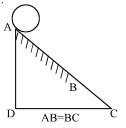
Portion $AB$ of the wedge shown in figure is rough and $BC$ is smooth. $A$ solid cylinder rolls without slipping from $A$ to $B$. The ratio of translational kinetic energy to rotational kinetic energy, when the cylinder reaches point $C$ is :
A wheel initially at rest, is rotated with a uniform angular acceleration. The wheel rotates through an angle ${\theta _1}$ in first one second and through an additional angle ${\theta _2}$ in the next one second. The ratio $\frac{{{\theta _2}}}{{{\theta _1}}}$ is
When the temperature of a gas is raised from $27^o C$ to $90^o C$, the percentage increase in the $r.m.s.$ velocity of the molecules will be ..... $\%$
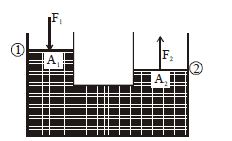
The diagram below shows a hydraulic lift.A force is applied at $side\  1$ and an output force is generated at $side\  2$. Which of the following is true?
Two stones of masses $m$ and $2\,m$ are whirled in horizontal circles, the heavier one in a radius $\frac{r}{2}$ and the lighter one in radius $r.$ The tangential speed of lighter stone is $n$ times that of the value of heavier stone when they experience same centripetal forces. The value of $n$ is
Motion of a ball bearing inside a smooth curved bowl, when released from a point slightly above the lower point is:
  1. Simple harmonic motion.
  2. Non$-$periodic motion.
  3. Periodic motion.
  4. Periodic but not $\text{S.H.M}$
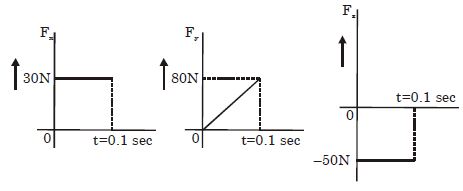
A particle is acted upon by a force whose  component's variations with time are shown in diagrams. Then the magnitude of change in momentum of the particle in $0.1\,\,sec$ will be :-
If $\vec P = \vec Q$ then which of the following is NOT correct