Question
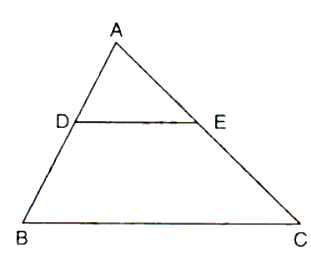
In $\triangle ABC$, point $D$ divides $AB$ in the ratio $5: 7$, Find: $\frac{ AE }{ AC }$
Answer


Considering $BE \| BC $
$ \frac{ AD }{ DB }=\frac{ AE }{ EC }$
$ \Rightarrow \frac{ AE }{ EC }=\frac{ AD }{ DB } $
$ \Rightarrow \frac{ AE }{ EC }=\frac{5}{7} $
$ \because AC = AE + EC $
$ \Rightarrow AC$
$=5+7$
$ =12 $
$ \therefore \frac{ AE }{ AC }=\frac{5}{12} .$

Need a full question paper?

Generate a complete, print-ready paper with questions like this in minutes — across 16+ boards, with answer keys.

Start Generating Free

Similar questions

Apple cost $x$ rupees per dozen and mangoes cost $y$ rupees per score. Write a formula to find the total cost $C$ in rupees of $20$ apples and $30$ mangoes.
In $\triangle ABC, D$ is a point in $AB$ such that $AC = CD = DB$. If $\angle B = 28^\circ $, find the $\angle ACD.$
Two articles $A$ and $B$ are sold for $Rs. 1,167$ making $5\%$ profit on $A$ and $7\%$ profit on $A$ and $7\%$ profit on $B$. IF the two articles are sold for $Rs. 1,165$, a profit of $7\%$ is made on $A$ and a profit of $5\%$ is made on $B$. Find the cost prices of each article.
For solving pair of equation, in this exercise use the method of elimination by equating coefficients :$\frac{5 y}{2}-\frac{x}{3}=8; \frac{y}{2}+\frac{5 x}{3}=12$
A sum of money was invested for $3$ years, interest being compounded annually. The rates for successive years were $10\%, 15\%$ and $18\%$ respectively. If the compound interest for the second year amounted to $Rs. 4,950$, find the sum invested.
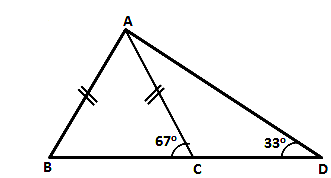
In the following figure, write $BC , AC$, and $CD$ in ascending order of their lengths.
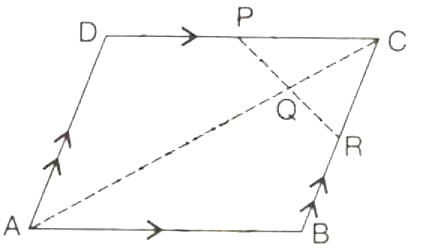
A parallelogram $\text{ABCD}$ has $P$ the mid$-$point of $D C$ and $Q$ a point of Ac such that
$CQ =\frac{1}{4} AC . PQ$ produced meets $BC$ at $R$.

Prove that
$(i) R$ is the midpoint of $B C$
$(ii) PR =\frac{1}{2} DB$
In each of the following, one trigonometric ratio is given. Find the values of the other trigonometric.$\cos B=\frac{4}{5}$
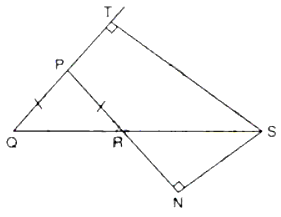
$\triangle PQR$ is an isosceles triangle with $PQ = PR. QR$ is extended to $S$ and $ST$ is drawn perpendicular to $QP$ produced, and $SN$ is perpendicular to $PR$ produced. Prove that $QS$ bisects $\angle TSN.$
​​​​​​​
Prove that the diagonals of a square are equal and perpendicular to each other.