Question 15 Marks
In $\triangle ABC , DE$ is drawn parallel to $BC$ cutting $AB$ in the ratio $2: 3$. Calculate:$ \text { (i) } \frac{\operatorname{area}(\triangle ADE )}{\operatorname{area}(\triangle ABC )};\text { (i) } \frac{\operatorname{area}(\text {trapezium EDBC})}{\operatorname{area}(\triangle ABC)}$
Answer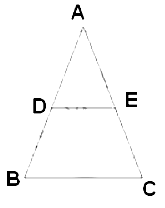
$ AD : DB =2: 3$
$= AB + DB$
$=2+3$
$=5$
$\text { (i) } \frac{\operatorname{area}(\Delta ADE )}{\operatorname{area}(\Delta ABC )}=\frac{ AD ^2}{ AB ^2}$
$\Rightarrow \frac{\operatorname{area}(\Delta ADE )}{\operatorname{area}(\Delta ABC )}=\frac{2^2}{5^2}$
$\Rightarrow \frac{\operatorname{area}(\Delta ADE )}{\operatorname{area}(\Delta ABC )}=\frac{4}{25} .$
$\text { (ii) } \frac{\operatorname{area}(\text { trapezium EDBC) }}{\operatorname{area}(\Delta ABC )}=\frac{\operatorname{area}(\Delta ABC )-\operatorname{area}(\Delta ADE )}{\operatorname{area}(\text { trapezium EDBC })}$
$\Rightarrow \frac{\operatorname{area}(\Delta ABC )}{\operatorname{area}(\Delta ABC )}=\frac{25-4}{25}$
$\Rightarrow \frac{\operatorname{arapezium EDBC})}{25} .$ View full question & answer→Question 25 Marks
$D$ and $E$ are points on the sides $A B$ and $A C$ of $\triangle A B C$ such that $D E \| B C$ and divides $\triangle A B C$ into two parts, equal in area. Find $\frac{ BD }{ AB }$.
Answer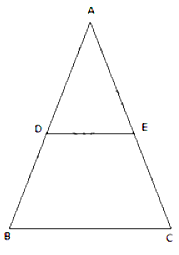
Area$(\triangle ADE )=$ area$($trapezium $\text{BCED})$
$\Rightarrow$ Area$(\triangle ADE )+$Area$(\triangle ADE )$
$=$Area$($trapezium $\text{BCED})+$Area$(\triangle ADE )$
$\Rightarrow 2$ Area$(\triangle ADE )=$Area$(\triangle ABC )$
In $\triangle ADE$ and $\triangle ABC \text {, }$
$\angle ADE =\angle B...($corresponding angles$)$
$\angle A =\angle A$
In $\triangle A D E$ and $\triangle A B C$,
$\angle ADE =\angle B...($corresponding angles$)$
$\angle A =\angle A$
Therefore, $\triangle ADE \sim \triangle ABC$
$\therefore \frac{\operatorname{area}(\triangle ADE )}{\operatorname{area}(\triangle ABC )}=\frac{ AD ^2}{ AB ^2}$
$\Rightarrow \frac{\operatorname{area}(\triangle ADE )}{2 xArea(\triangle ADE )}=\frac{ AD ^2}{ AB ^2}$
$\Rightarrow \frac{1}{2}=\left(\frac{ AD }{ AB }\right)^2$
$\Rightarrow \frac{ AD }{ AB }=\frac{1}{\sqrt{2}}$
$\Rightarrow AB =\sqrt{2} AD$
$\Rightarrow AB =\sqrt{2}( AB - BD )$
$\Rightarrow(\sqrt{2}-1) AB =\sqrt{2} BD$
$\Rightarrow \frac{ BD }{ AB }=\frac{\sqrt{2}-1}{\sqrt{2}}$
$=\frac{2-\sqrt{2}}{2} \text {. }$ View full question & answer→Question 35 Marks
The areas of two similar triangles are $169\ cm^2$ and $121\ cm^2$ respectively. If one side of the larger triangle is $26\ cm,$ find the length of the corresponding side of the smaller triangle.
Answer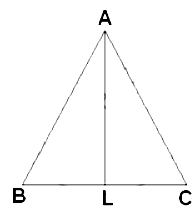
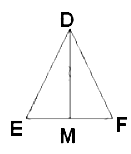
The ratio of the areas of two similar triangles is equal to the ratio of the squares of the corresponding sides.
$\therefore \frac{\operatorname{area}(\Delta ABC )}{\operatorname{area}(\Delta PQR )}=\frac{ AB ^2}{ DE ^2} $
$\Rightarrow \frac{169}{121}=\frac{26^2}{ DE ^2} $
$\Rightarrow DE ^2=\frac{121 \times 676}{169} $
$\Rightarrow DE ^2=484 $
$\Rightarrow DE =22 \ cm .$ View full question & answer→Question 45 Marks
In a $\triangle ABC, AB = 4 \ cm, BC = 4.5 \ cm$ and $CA = 5 \ cm$. Construct $\triangle ABC$. Find the image $A\ 'B\ 'C$ of the $\triangle ABC$ obtained by enlarging it by a scale factor $2$. Measure the sides of the image $A 'B\ 'C'$ and show that $AB:A\ 'B\ ' = AC:B\ 'C\ ' = CA:C\ 'A\ '$
Answer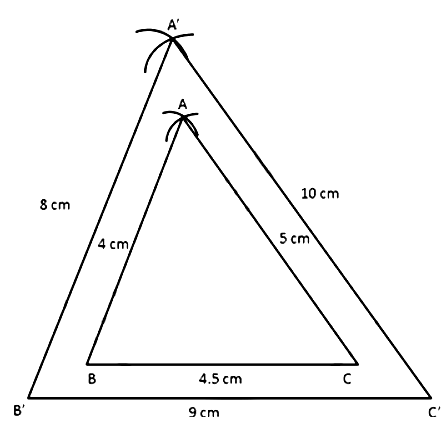
Steps of Construction of the image: :
$1$. Draw $BC$ measuring $4 \ cm$.
$2$. With $B$ as the centre and radius $4.5 \ cm$, make an arc above $B C$.
$3$. With $C$ as the centre and radius $5 \ cm$, to cut the previous arc at $C$.
$4. \triangle ABC$ us the required triangle.$"$
Scale factor $=\frac{A^{\prime} B^{\prime}}{ AB }$
$\Rightarrow 2=\frac{A^{\prime} B^{\prime}}{4}$
$\Rightarrow A^{\prime} B^{\prime}=8 \ cm$
Scale factor $=\frac{ B ^{\prime} C ^{\prime}}{ BC }$
$\Rightarrow 2=\frac{ B ^{\prime} C ^{\prime}}{4.5}$
$\Rightarrow B ^{\prime} C ^{\prime}=9 \ cm$
Scale factor $=\frac{ A ^{\prime} C ^{\prime}}{ AC }$
$\Rightarrow 2=\frac{ A ^{\prime} C ^{\prime}}{5}$
$\Rightarrow A ^{\prime} C ^{\prime}=10 \ cm$
Steps of Construction of the image:
$1$. Draw $B^{\prime} C^{\prime}$ measuring $9 \ cm$.
$2$. With $B ^{\prime}$ as the centre and radius $8 \ cm$, make an arc above $B ^{\prime} C ^{\prime}$.
$3.$ With $C^{\prime}$ as the centre and radius $9 \ cm$, to cut the pervious arc at $C^{\prime}$.
$4$. $\triangle A^{\prime} B^{\prime} C^{\prime}$ is the required image of the $\triangle A B C$.
On measuring the sides, we get
$\frac{ A ^{\prime} B ^{\prime}}{ AB }=\frac{ B ^{\prime} C ^{\prime}}{ BC }=\frac{ A ^{\prime} C ^{\prime}}{ AC }=$scale factor$=2 \text {. }$ View full question & answer→Question 55 Marks
Find the scale factor in each of the following and state the type of size transformation:Model volume $= 200\ cm^3$, Actual volume $= 8\ cm^3$
AnswerModel volume $= 200\ cm^3,$ Actual volume $= 8\ cm^3$
Actual volume
$= 8 \times 1000000\ cm^2$
$= 8000000\ cm^2$
Scale factor
$=\sqrt{\frac{\text { Model Volume }}{\text { Actual Volume }}}$
$=\sqrt{\frac{200}{8000000}}$
$=\sqrt{\frac{1}{40000}}$
$=\frac{1}{200}$
Scale factor $= 0.05$
Since the scale factor $< 1$ and $> 0$
$\Rightarrow$ Type of size transformation $=$ reduction.
View full question & answer→Question 65 Marks
Find the scale factor in each of the following and state the type of size transformation:Model area $= 75\ cm^2$, Actual area $= 3\ cm^2$
AnswerModel area $= 75\ cm^2,$ Actual area $= 3\ cm^2$
Actual area
$= 3 \times 10000\ cm^2$
$= 30000\ cm^2$
Scale factor
$=\sqrt{\frac{\text { Model Area }}{\text { Actual Area }}}$
$=\sqrt{\frac{75}{30000}}$
$=\sqrt{\frac{1}{400}}$
$=\frac{1}{20}$
Scale factor $= 0.05$
Since the scale factor $< 1$ and $> 0$
$\Rightarrow$ Type of size transformation $=$ reduction.
View full question & answer→Question 75 Marks
In $\triangle A B C, A B=8 \ cm, A C=10 \ cm$ and $\angle B=90^{\circ}$. $P$ and $Q$ are the points on the sides $A B$ and $A C$ respectively such that $P Q=3 \ cm$ ad $\angle P Q A=90$. Find: The area of $\triangle A Q P$.
Answer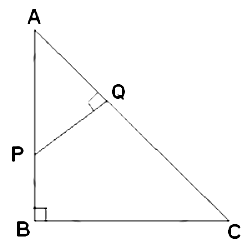
In $\triangle A Q P$ and $\triangle A B C$
$\angle A =\angle A$
$\angle P Q A=\angle A B C...($right angles$)$
Therefore, $\triangle A Q P \sim \triangle A B C$
By Pythagoras theorem,
$ B C^2=A C^2-A B^2$
$\Rightarrow B C^2=10^2-8^2$
$\Rightarrow B C^2=100-64$
$\Rightarrow B C^2=36$
$\Rightarrow B C=6 \ cm $
Area $(\triangle ABC ) \frac{1}{2} \times AB \times BC$
Area $(\triangle ABC ) \frac{1}{2} \times 8 \times 6$
Area $(\triangle A B C)=24 \ cm 2$
Since $\triangle AQP \sim \triangle ABC$
$\frac{\text { Area }(\triangle AQP )}{\text { Area }(\triangle ABC )}=\frac{ PQ ^2}{ BC ^2}$
$\frac{\text { Area }(\triangle AQP )}{\operatorname{Area}(\triangle ABC )}=\frac{3^2}{6^2}$
$\Rightarrow$ Area $(\triangle A Q P)=\frac{9 \times 24}{36}$
$\Rightarrow$ Area$(\triangle A Q P)=6 \ cm ^2$ View full question & answer→Question 85 Marks
$\triangle ABC$ is right angled at $A. AD$ is drawn perpendicular to $BC.$ If $AB = 8\ cm$ and $AC = 6\ cm,$ calculate $BD.$
Answer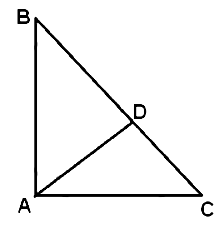
In $\triangle A B C$,
Using Pythagoras theorem
$ BC ^2=A B^2+A C^2$
$B C^2=8^2+6^2$
$B C^2=64+36$
$B C=\sqrt{100}=10 . $
In $\triangle ABD$,
Using Pythagoras theorem
$ A D^2=A B^2-B D^2$
$A D^2=8^2-B D^2 \ldots \ldots $
In $\triangle ACD$,
Using Pythagoras theorem
$ A D^2=A C^2-C D^2$
$A D^2=6^2-C D^2 \ldots . $
Equaliting $(ii)$ and $(iii)$
$ 8^2-B D^2=6^2-C D$
$\because C D=B C-B D$
$8^2-B D^2=6^2-(B C-B D)^2$
$C D=B C-B D$
$B C=10 \ cm ($from $(i))$
$8^2-B D^2=6^2-(10-B D)^2$
$8^2-B D^2=6^2-\left(100-20 B D+B D^2\right)$
$64+B D^2=6^2-\left(100+20 B D-B D^2\right)$
$64=-64+20 B D$
$20 B D=128$
$B D=6.4 \ cm . $ View full question & answer→Question 95 Marks
The sides $P Q$ and $P R$ of the $\triangle P Q R$ are produced to $S$ and $T$ respectively. $S T$ is drawn parallel to $Q R$ and $P Q$ : $P S=3: 4$. If $PT =9.6 \ cm$, find $P R$. If $' p\ '$ be the length of the perpendicular from $P$ to $Q R$, find the length of the perpendicular from $P$ to $ST$ in terms of $' p\ '.$
Answer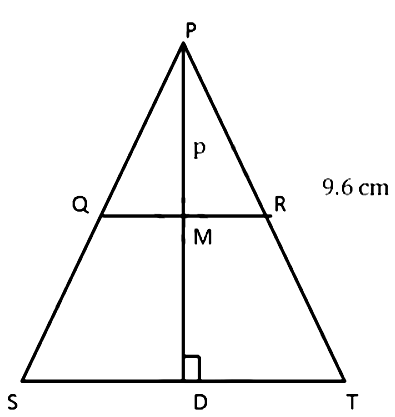
Since $Q R$ is parallel to $S T$
By Basic Theorem of Proportionality,
$ \frac{ PQ }{ PS }=\frac{ PR }{ PT }$
$\Rightarrow \frac{3}{4}=\frac{ PR }{9.6}$
$\Rightarrow PR =\frac{9.6 \times 3}{4}=7.2 \ cm $
Since $Q R$ is parallel to $S T$,
$QM \| SD$
By Basic Theorem of Proportionality,
$ \frac{ PQ }{ PS }=\frac{ PM }{ PD }$
$\Rightarrow \frac{3}{4}=\frac{ PD }{ PD }$
$\Rightarrow PD =\frac{4 P }{3} $
So, the length of the perpendicular from $P$ and $S T$ in terms of $p$ is $\frac{4 p}{2}$. View full question & answer→Question 105 Marks
In $\triangle ABC, MN$ is drawn parallel to $BC.$ If $AB = 3.5\ cm, AM : AB = 5 : 7$ and $NC = 2\ cm,$ find:$(i) AM;(ii) AC$
Answer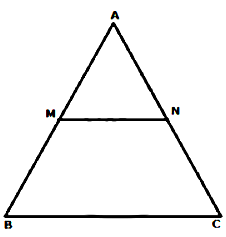
$ \text { (i) } \frac{ AM }{ AB }=\frac{5}{7}$
$\because AB =3.5 \ cm$
$\therefore AM =\frac{5 \times AB }{7}$
$\Rightarrow AM =\frac{5 \times 3.5}{7}$
$\Rightarrow AM =2.5 \ cm . $
$(ii)$ Since $M N \| B C$ and $\frac{A M}{M B}=\frac{A N}{N C}$
$\because A B=3.5 \ cm ; A M=2.5 \ cm$
$\therefore MB$
$= AB - AM$
$=3.5-2.5$
$=1 \ cm$
$\Rightarrow \frac{ AM }{ MB }=\frac{ AN }{ NC }$
$\Rightarrow \frac{2.5}{1}=\frac{ AN }{2}$
$\Rightarrow AN =\frac{2.5^2 \times 2}{1}=5 \ cm$
Now,
$ A C=A N+N C$
$\Rightarrow A C$
$=5+2$
$=7 \ cm . $ View full question & answer→Question 115 Marks
In $\triangle ABC$, point $D$ divides $AB$ in the ratio $5: 7$, Find: $\frac{ AE }{ AC }$
Answer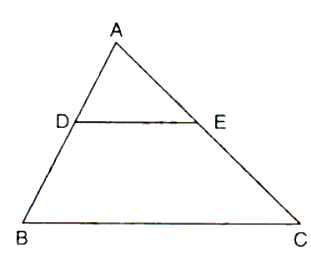
Considering $BE \| BC $
$ \frac{ AD }{ DB }=\frac{ AE }{ EC }$
$ \Rightarrow \frac{ AE }{ EC }=\frac{ AD }{ DB } $
$ \Rightarrow \frac{ AE }{ EC }=\frac{5}{7} $
$ \because AC = AE + EC $
$ \Rightarrow AC$
$=5+7$
$ =12 $
$ \therefore \frac{ AE }{ AC }=\frac{5}{12} .$ View full question & answer→Question 125 Marks
If $\triangle ABC, D$ and $E$ are points on $AB$ and $AC$. Show that $DE \| BC$ for each of the following case or not:$AB = 5.6\ cm, AD = 1.4\ cm, AC = 7.2\ cm$, and $AE = 1.8\ cm$
Answer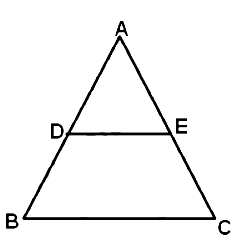
$AB =5.6 \ cm , AD =1.4 \ cm , AC =7.2 \ cm,$ and $AE =1.8 \ cm$
$\frac{ AD }{ AB }=\frac{1.4}{5.6}=\frac{7}{28}=\frac{1}{4}$
$\frac{ AE }{ AC }=\frac{1.8}{7.2}=\frac{2}{8}=\frac{1}{4}$
$\Rightarrow \frac{ AD }{ AB }=\frac{ AE }{ AC }$
$\therefore \triangle ADE \sim \triangle ABC$
$\Rightarrow \angle D =\angle B ; \angle E =\angle C$
But these are corresponding angles
Hence,$ DE \| BC.$ View full question & answer→Question 135 Marks
Prove that the external bisector of an angle of a triangle divides the opposite side externally $n$ the ratio of the sides containing the angle.
Answer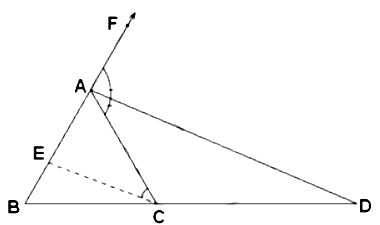
In $\triangle ABC , CE \| AD$
$\therefore \frac{ BD }{ CD }=\frac{ AB }{ AE } \ldots . \text { (i) } ($By Basic Proportionality theorem$)$
$A D$ is e bisector of $\angle C A F$
$\angle FAD =\angle CAD..... \text {(ii)}$
Since $CE \| AD$
Therefore,
$\angle ACE =\angle CAD \text (iii) ...($alternate angles$)$
$\angle AEC =\angle FAD.(iv) ...($corresponding angles$)$
From $(ii)$ and $(iii)$ and $(iv)$
$\angle AEC =\angle ACE$
In $\triangle A E C$,
$\angle AEC =\angle ACE$
$A C=A E......(v) ...($Equal angles have equal sides opposite to them$)$
From $(i)$ and $(v)$
$\frac{B D}{C D}=\frac{A B}{A C}$. View full question & answer→Question 145 Marks
In $\triangle ABC, D$ and $E$ are the mid-point on $AB$ and $AC$ such that $DE \| BC.$If $AD = 8\ cm, AB = 12\ cm$ and $AE = 12\ cm,$ find $CE.$
Answer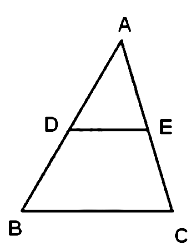
In $\triangle ADE$ and $\triangle ABC$
$\angle D =\angle B$ and $\angle C =\angle E \ldots( DE \| BC )$
$\Rightarrow \triangle ADE \sim \triangle ABC$
$\therefore \frac{ AD }{ DB }=\frac{ AE }{ EC }$
$DB$
$= AB - AD$
$=12-8$
$=4$
$\Rightarrow \frac{8}{4}=\frac{12}{ EC }$
$\Rightarrow 8 \times EC =12 \times 4$
$\Rightarrow EC =\frac{12 \times 4}{8}$
$\Rightarrow EC =6 \ cm .$ View full question & answer→Question 155 Marks
In $\triangle ABC, D$ and $E$ are the mid$-$point on $AB$ and $AC$ such that $DE \| BC.$If $AD = 4x - 3, AE = 8x - 7, BD = 3x - 1$ and $CE = 5x - 3,$ Find $x.$
Answer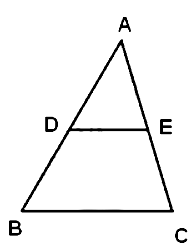
In $\triangle ADE$ and $\triangle ABC$
$\angle D =\angle B$ and $\angle C =\angle E \ldots( DE \| BC )$
$\Rightarrow \triangle ADE \sim \triangle ABC$
$\therefore \frac{ AD }{ DB }=\frac{ AE }{ EC }$
$\Rightarrow \frac{4 x-3}{3 x-1}=\frac{8 x-7}{5 x-3}$
$\Rightarrow(4 x -3) \times (5 x -3)=(8 x -7) \times(3 x -1)$
$\Rightarrow 20 x ^2-15 x -12 x +9=24 x ^2-21 x -8 x +7$
$\Rightarrow 20 x ^2-27 x +9=24 x ^2- 29 x +7$
$\Rightarrow 4 x ^2-2 x -2=0$
$\Rightarrow x(x-1)+\frac{1}{2}(x-1)=0$
$\Rightarrow\left(x+\frac{1}{2}\right)=0 ; x -1=0$
$\Rightarrow x =-\frac{1}{2} ; x=1$
$\therefore x =1 $ View full question & answer→