Question
In $\triangle\text{ABC, AB = AC}$ and $\angle\text{B}=50^{\circ}.$ Then, $\angle\text{A = } ?$
Answer

  1. 80°
    Solution:
    In $\triangle\text{ABC,}$
    $\text{AB = AC}$
    $\Rightarrow\angle\text{C}=\angle\text{B}$ (angles opposite to equal sides are equal)
    $\Rightarrow\angle\text{C}=50^{\circ}$
    Now, $\angle\text{A}+\angle\text{B}+\angle\text{C}=180^{\circ}$
    $\Rightarrow\angle\text{A}+50^{\circ}+50^{\circ}=180^{\circ}$
    $\Rightarrow\angle\text{A}=80^{\circ}$

Need a full question paper?

Generate a complete, print-ready paper with questions like this in minutes — across 16+ boards, with answer keys.

Start Generating Free

Similar questions

Write the correct answer in the following:
Points (1, -1), (2, -2), (4, -5) and (-3, -4):
  1. lie in II quadrant.
  2. lie in III quadrant.
  3. lie in IV quadrant.
  4. Do not lie in the same quadrant.
If $\text{x}=3+\sqrt{8}$ then $\Big(\text{x}^2+\frac{1}{\text{x}^2}\Big)=?$
The base of an isosceles triangle is 6cm and each of its equal sides is 5cm. The height of the triangle is:
In $\triangle\text{ABC}$ and $\triangle\text{PQR},$ AB = PR and $\angle\text{A} = \angle\text{P}.$ Then, the two triangles will be congruent by SAS axiom if:
PQRS is a quadrilateral. PR and QS intersect each other at O. in which of the following cases, PQRS is a parallelogram?
  1. $\angle\text{P}=100^\circ,\angle\text{Q}=80^\circ,\angle\text{R}=100^\circ$
  2. $\angle\text{P}=85^\circ,\angle\text{Q}=85^\circ,\angle\text{R}=95^\circ$
  3. $\text{PQ}=7\text{cm},\text{QR}=7\text{cm},\text{RS}=8\text{cm},\text{SP}=8\text{cm}$
  4. $\text{OP}=6.5\text{cm},\text{OQ}=6.5\text{cm},\text{OR}=5.2\text{cm},\text{OS}=5.2\text{cm}$
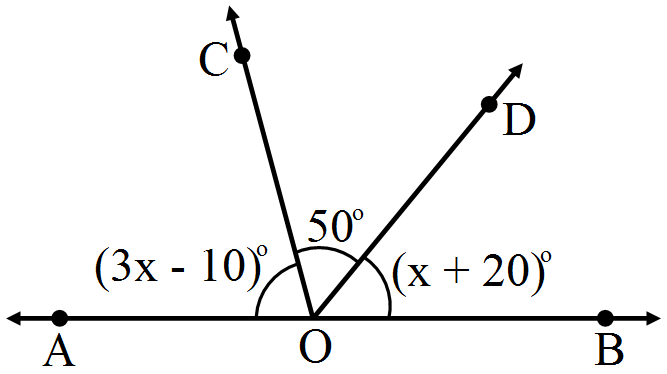
In the given figure, AOB is a straight line. If $\angle\text{AOC}=(3\text{x}-10)^\circ,\angle\text{COD}=50^\circ$ and $\angle\text{BOD}=(\text{x}+20)^\circ$ then $\angle\text{AOC}=?$
  1. 40º
  2. 60º
  3. 80º
  4. 50º
The point at which the two coordinate axes meet is called the:
If $\sqrt{2}=1.414$ then $\sqrt{\frac{\big(\sqrt{2}-1\big)}{\big(\sqrt{2}+1\big)}}=?$
  1. 0.207
  2. 2.414
  3. 0.414
  4. 0.621
If all the altitudes from the vertices to the opposite sides of a triangle are equal, then the triangle is:
If the degree measures of the angles of quadrilateral are 4x, 7x, 9x and 10, what is the sum of the measures of the smallest angle and largest angle?
  1. 140°
  2. 150°
  3. 168°
  4. 180°