MCQ
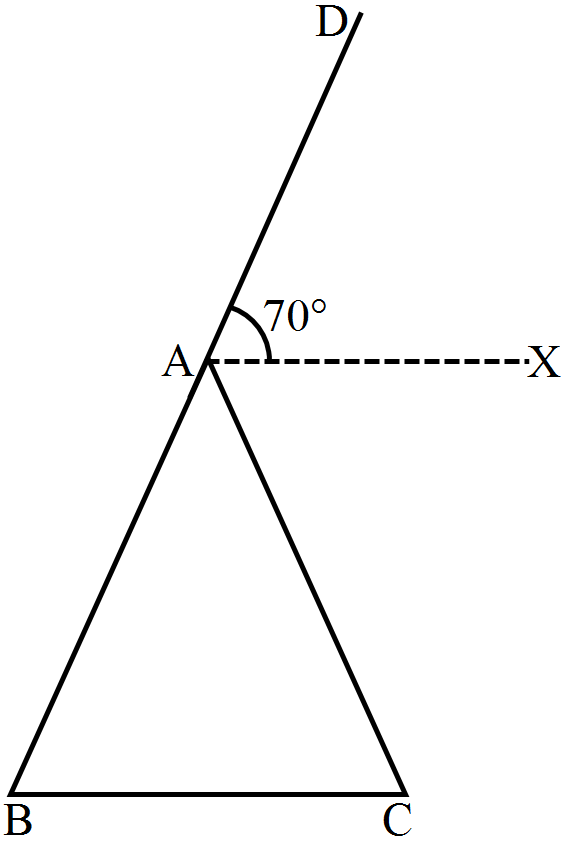
In $\triangle\text{ABC}, \ \angle\text{B} = \angle\text{C}$ and ray AX bisects the exterior angle $\triangle\text{DAC}.$ If $\triangle\text{DAX} = 70^\circ,$ then $\angle\text{ACB} =$
  • A
    55º
  • B
    35º
  • C
    70º
  • D
    90º

Need a full question paper?

Generate a complete, print-ready paper with questions like this in minutes — across 16+ boards, with answer keys.
Start Generating Free

Similar questions

The range of the data
12, 25, 15, 18, 17, 20, 22, 6, 16, 11, 8, 19, 10, 30, 20, 32 is:
Write the correct answer in the following:
A grouped frequency table with class intervals of equal sizes using 250-270 (270 not included in this interval) as one of the class interval is constructed for the following data:
268, 220, 368, 258, 242, 310, 272, 342, 310, 290, 300, 320, 319, 304, 402, 318, 406, 292, 354, 278, 210, 240, 330, 316, 406, 215, 258, 236.
The frequency of the class 310-330 is:
  1. 4
  2. 5
  3. 6
  4. 7
The name of the vertical line drawn to determine the position of any point in the Cartesian plane is:
Write the correct answer in the following:
The three steps from solids to points are:
An exterior angle of a triangle is 108º and its interior opposite angles are in the ratio 4 : 5 The angles of the triangle are:
  1. 48º, 60º, 72º
  2. 50º, 60º, 70º
  3. 52º, 56º, 72º
  4. 42º, 60º, 76º
In the given figure, AOB is a diameter and ABCD is a cyclic quadrilateral. If $\angle\text{ADC}=120^\circ$ then $\angle\text{BAC}=?$
Three Statements are given below:
  1. In a, Parallelogram the angle bisectors of 2 adjacent angles enclose a right angle.
  2. The angle bisector of a Parallelogram form a Rectangle.
  3. The Triangle formed by joining the mid-points of the sides of an isosceles triangle is not necessarily an isosceles triangle.
    Which of the statement/ statements is/ are True?
Let f(x) be a polynomial such that $\text{f}(-\frac{1}{2})=0,$ then a factor of f(x) is: