Question
In vector combination, commutative and associative rules are followed. Explain.
Answer

(i) Permutation rule of vector combination : If vectors $\vec{a}$ and $\vec{b}$ are two vectors then,
$\vec{a}+\vec{b}=\vec{b}+\vec{a}$
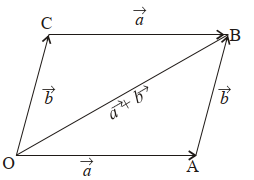
Proof : Let $\vec{a}$ and $\vec{b}$ are denoted by $\overrightarrow{ OA }$ and $\overrightarrow{ OB }$ respectively. Hence,
$\overrightarrow{ OA }=\vec{a}$ and $\overrightarrow{ AB }=\vec{b}$
By vector addition rule of triangle,
$\begin{array}{l}
\overrightarrow{OB}=\overrightarrow{OA}+\overrightarrow{AB} \\
\overrightarrow{OB}=\vec{a}+\vec{b} \ldots(1)
\end{array}$
Image

The parallelogram completes OABC whose two adjacent sides are $O A$ and $A B$ :$
\begin{array}{l}
\overrightarrow{CD}=\overrightarrow{OA}=\vec{a} \\
\overrightarrow{OC}=\overrightarrow{AB}=\vec{b}
\end{array}$
Again, by triangle law of vector addition
$\begin{array}{l}
\overrightarrow{OB}=\overrightarrow{OC}+\overrightarrow{CB}=\vec{b}+\vec{a} \\
\overrightarrow{OB}=\vec{b}+\vec{a} \ \ldots(2)
\end{array}$
From equations (1) and (2)
$\vec{a}+\vec{b}=\vec{b}+\vec{a}$So, this proves the rule.
(ii) Associative rule in vector addition : If $\vec{a}, \vec{b}$ and $\vec{c}$ are three vectors.
Then, $(\vec{a}+\vec{b})+\vec{c}=\vec{a}+(\vec{b}+\vec{c})$
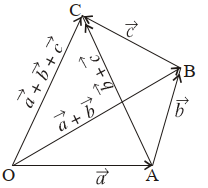
Proof : Three vectors $\vec{a}, \vec{b}$ and $\vec{c}$ are represented by $\overrightarrow{ OA }, \overrightarrow{ AB }$ and $\overrightarrow{ BC }$ respectively.
Hence, $\overrightarrow{ OA }=\vec{a}, \overrightarrow{ AB }=\vec{b}, \overrightarrow{ BC }=\vec{c}$
By applying triangle law of vector addition in $\triangle OAB$ and $\triangle OBC , \overrightarrow{ OB }=\overrightarrow{ OA }+\overrightarrow{ AB }$
$\begin{array}{l}
\overrightarrow{OB}=\vec{a}+\vec{b} \\
\overrightarrow{OC}=\overrightarrow{OB}+\overrightarrow{BC}
\end{array}$$=(\vec{a}+\vec{b})+\vec{c} \ \ldots(1)$
Image
In $\triangle ABC$ and $\triangle OAC$, we get
$\begin{aligned}
\overrightarrow{AC} & =\overrightarrow{AB}+\overrightarrow{BC}=\vec{b}+\vec{c} \\
\overrightarrow{OC} & =\overrightarrow{OA}+\overrightarrow{AC} \\
& =\vec{a}+(\vec{b}+\vec{c}) \ \ldots(2)
\end{aligned}$
From equations (1) and (2)
$(\vec{a}+\vec{b})+\vec{c}=\vec{a}+(\vec{b}+\vec{c})$

Need a full question paper?

Generate a complete, print-ready paper with questions like this in minutes — across 16+ boards, with answer keys.
Start Generating Free

Similar questions

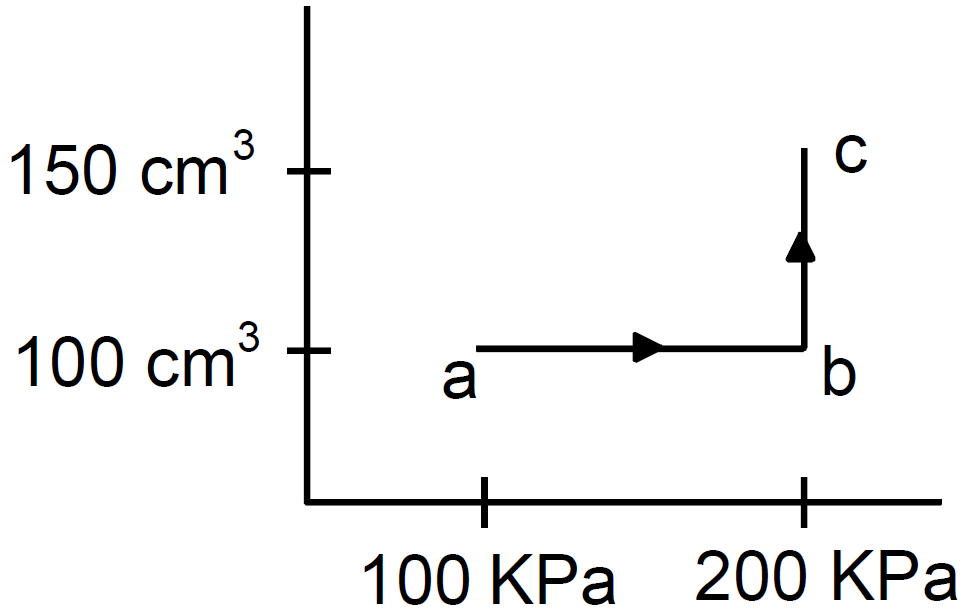
An ideal gas $(\gamma=1.67)$ is taken through the process abc shown in the figure. The temperature at point a is $300K$. Calculate,
  1. The temperatures at b and c.
  2. The work done in the process.
  3. The amount of heat supplied in the path ab and in the path bc.
  4. The change in the internal energy of the gas in the process.
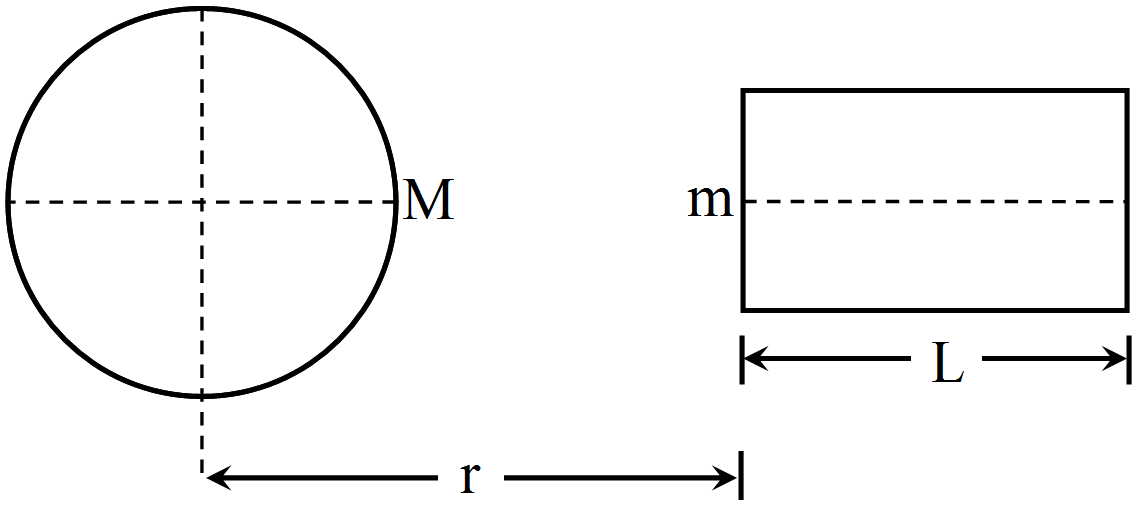
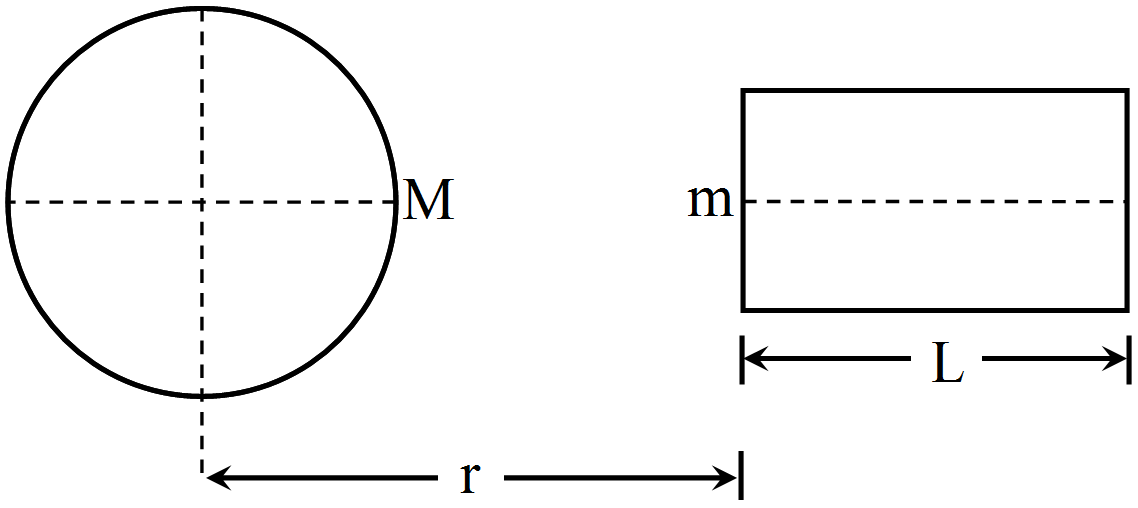
Find the gravitational pull between a sphere of mass M, and a uniform rod of length L and mass m as shown in the given figure.
A train starts from rest and moves with a constant acceleration of $2.0m/s^2$ for half a minute. The brakes are then applied and the train comes to rest in one minute. Find:
  1. The total distance moved by the train.
  2. The maximum speed attained by the train.
  3. The position(s) of the train at half the maximum speed.
A tightly-wound, long solenoid is kept with its axis parallel to a large metal sheet carrying a surface current. The surface current through a width dl of the sheet is Kdl and the number of turns per unit length of the solenoid is n. The magnetic field near the centre of the solenoid is found to be zero.
  1. Find the current in the solenoid.
  2. If the solenoid is rotated to make its axis perpendicular to the metal sheet, what would be the magnitude of the magnetic field near its centre ?
Given below are observations on molar specific heats at room temperature of some common gases.
Gas Molar specific heat (Cv)
(cal $mo1^{–1} K^{–1}$)
Hydrogen 4.87
Nitrogen 4.97
Oxygen 5.02
Nitric oxide 4.99
Carbon monoxide 5.01
Chlorine 6.17
The measured molar specific heats of these gases are markedly different from those for monatomic gases. Typically, molar specific heat of a monatomic gas is 2.92 cal/ mol K. Explain this difference. What can you infer from the somewhat larger (than the rest) value for chlorine?
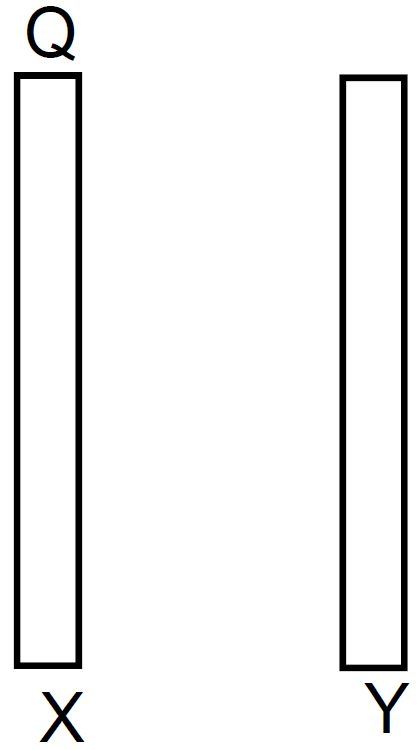
Two conducting plates X and Y, each having large surface area A (on one side), are placed parallel to each other as shown in figure. The plate X is given a charge Q whereas the other is neutral. Find:
  1. The surface charge density at the inner surface of the plate X.
  2. The electric field at a point to the left of the plates.
  3. The electric field at a point in between the plates.
  4. The electric field at a point to the right of the plates.
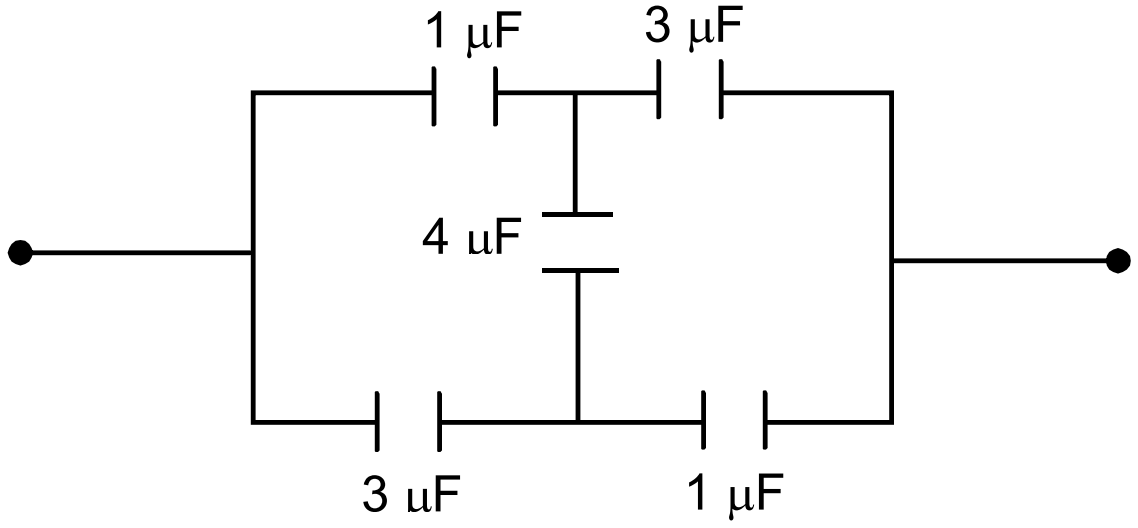
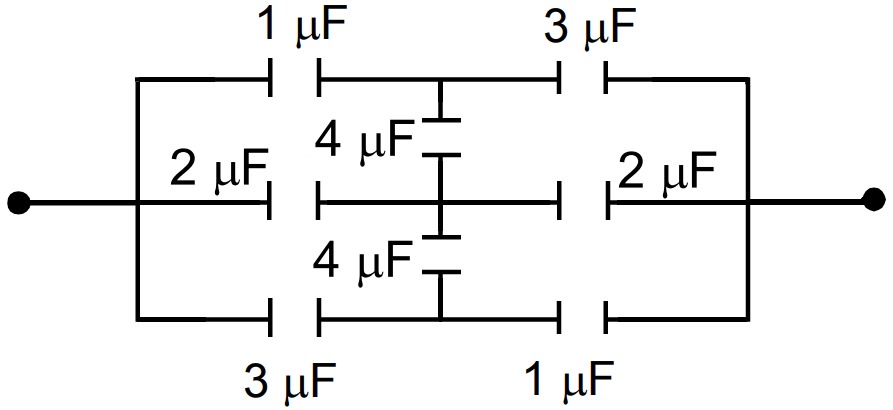
Find the equivalent capacitances of the combinations shown in figure between the indicated points.


A body is in translational equilibrium under the action of coplanar forces. If the torque of these forces is zero about a point, is it necessary that it will also be zero about any other point?
Two coils A and B have inductances 1.0H and 2.0H respectively. The resistance of each coil is $10\Omega.$ Each coil is connected to an ideal battery of emf $2.0V$ at $t = 0$ Let $i_A$ and $i_B$ be the currents in the two circuit at time t. Find the ratio $\frac{\text{i}_\text{A}}{\text{i}_\text{B}}$
  1. t = 100ms
  2. t = 200ms
  3. t = 1s.
The position of a particle is given by $\text{r}=3.0\text{t}\hat{\text{i}}-2.0\text{t}^2\hat{\text{j}}+4.0\hat{\text{k }}\text{m}$ Where t is in seconds and the coefficients have the proper units for r to be in metres. (a) Find the v and a of the particle? (b) What is the magnitude and direction of velocity of the particle at t = 2.0s?