MCQ
In which of the following decays the element does not change?
  • A
    $\alpha-\text{decay}$
  • B
    $\beta^+-\text{decay}$
  • C
    $\beta^--\text{decay}$
  • $\gamma-\text{decay}$

Answer

Correct option: D.
$\gamma-\text{decay}$
In alpha particle decay, the unstable nucleus emits an alpha particle reducing its proton number Z by 4 and neutron number N by 2 such that the element gets changed.
$\text{ }^{\text{A}}_{\text{Z}}\text{X}\rightarrow\text{ }^{\text{A}-4}_{\text{Z}-2}\text{Y}+\text{ }^4_2\text{He}$
During $\beta^--\text{decay},$ a neutron is converted to a proton​, an electron and an antineutrino, i.e. an active nucleus gets converted to one of its isobars and hence the element gets changed.
$\text{ }^{\text{A}}_{\text{Z}}\text{X}\rightarrow\text{ }^{\text{A}}_{\text{Z}+1}\text{Y}+\text{e}+\bar{\text{v}}$
During $\beta^+-\text{decay},$ a proton in the nucleus is converted to a neutron​, a positron and a neutrino in order to maintain the stability of the nucleus, i.e. an active nucleus gets converted to one of its isobars and hence the element gets changed.
$\text{ }^{\text{A}}_{\text{Z}}\text{X}\rightarrow\text{ }^{\text{A}}_{\text{Z}-1}\text{Y}+\beta^++\text{v}$
When a nucleus is in higher excited state or has excess of energy, it comes to the ground state in order to become stable and release energy in the form of electromagnetic radiation called gamma ray. Hence, the element in gamma decay doesn't change.

Need a full question paper?

Generate a complete, print-ready paper with questions like this in minutes — across 16+ boards, with answer keys.
Start Generating Free

Similar questions

A metal rod of Young's modulus $Y$ and coefficient of thermal expansion $\alpha$ is held at its two ends such that its length remains invariant. If its temperature is raised by $t^{\circ} C$, the linear stress developed in it is
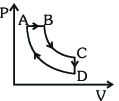
A cyclic process $ABCDA$ is shown in the $P-V$ diagram. Which of the following curves represent the same process
A gas expands with temperature according to the relation $V = k{T^{2/3}}.$ What is the work done when the temperature changes by ${30^o}C$
A particle is projected from the ground with an initial speed $\upsilon $ at an angle $\theta $ with horizontal. The average velocity of the particle between its point of projection and highest point of trajectory is
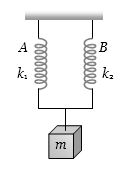
A mass $m$ is suspended by means of two coiled spring which have the same length in unstretched condition as in figure. Their force constant are $k_1$ and $k_2$ respectively. When set into vertical vibrations, the period will be
$Assertion :$ A tube light emits white light.
$Reason :$ Emission of light in a tube takes place at a very high temperature.
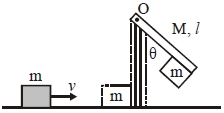
A block of mass $m =1\, kg$ slides with velocity $v=6\, m / s$ on a frictionless horizontal surface and collides with a uniform vertical rod and sticks to it as shown. The rod is pivoted about $O$ and swings as a result of the collision making angle $\theta$ before momentarily coming to rest. If the rod has mass $M =2 \,kg $ and length $l=1\, m$ the value of $\theta$ is approximately

(Take $\left.g=10 \,m / s ^{2}\right)$
Two persons are holding a rope of negligible weight tightly at its ends so that it is horizontal. A $15\, kg$ weight is attached to the rope at the mid-point, which now no longer remains horizontal. The minimum tension required to completely straighten the rope is
A car of weight $W$ is on an inclined road that rises by $100\,m$ over a distance of $1\,Km$ and applies a constant frictional force $\frac {W}{20}$ on the car. While moving uphill on the road at a speed of  $10\,ms^{-1},$ the car needs power $P.$  If it needs power $\frac {P}{2}$ while moving down hill at speed $v$ then value of $v$ is ........ $ms^{-1}$
A wooden cylinder floats vertically in water with half of its length immersed. The density of wood is