MCQ
In which of the following the final image is erect?
- ACompound microscope
- BAstronomical telescope
- CSimple microscope
- DAll of the above
Explanation:
The image formed by the Compound microscope and Astronomical telescope is inverted,but in case of Simple microscope it form erect image.
Generate a complete, print-ready paper with questions like this in minutes — across 16+ boards, with answer keys.
A concave lens of glass, refractive index 1.5, has both surfaces of same radius of curvature R. On immersion in a medium of refractive index 1.75, it will behave as a
|
(a) Convergent lens of focal length 3.5 R |
|
(b) Convergent lens of focal length 3.0 R |
|
(c) Divergent lens of focal length 3.5 R |
|
(d) Divergent lens of focal length 3.0 R |
The energy in MeV is released due to transformation of 1 kg mass completely into energy (c = 3
| (a) 7.625 ×10 MeV |
(b) 10.5 
|
(c) 2.8 
|
(d) 5.625
|
An electric dipole is situated in an electric field of uniform intensity E whose dipole moment is p and moment of inertia is I. If the dipole is displaced slightly from the equilibrium position, then the angular frequency of its oscillations is
|
(a) |
(b) |
(c) |
(d) |
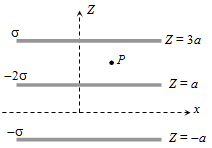
Three infinitely long charge sheets are placed as shown in figure. The electric field at point P is
|
(a) |
(b) |
(c) |
(d) |
Five resistances are connected as shown in the figure. The effective resistance between the points A and B is

|
(a) |
(b) |
(c) 15 Ω |
(d) 6 Ω |
The thermo e.m.f. of a thermo-couple is 25μV/℃ at room temperature. A galvanometer of 40 ohm resistance, capable of detecting current as low as  , is connected with the thermocouple. The smallest temperature difference that can be detected by this system is
|
(a) 20 ℃ |
(b) 16 ℃ |
(c) 12 ℃ |
(d) 8℃ |
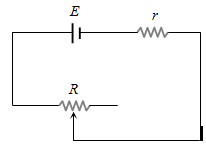
A battery of e.m.f. E and internal resistance r is connected to a variable resistor R as shown here. Which one of the following is true
|
(a) Potential difference across the terminals of the battery is maximum when R = r |
|
(b) Power delivered to the resistor is maximum when R = r |
|
(c) Current in the circuit is maximum when R = r |
|
(d) Current in the circuit is maximum when R >> r |


