MCQ
In which transition minimum energy is emitted
- A$\infty \to 1$
- B$2 \to 1$
- C$3 \to 2$
- ✓$n \to (n - 1){\mkern 1mu} [n \geq 4]$
$n_2=5 , n_1=4$
$n_2=6 , n_1=5$
$n \rightarrow(n-1)(n \geq 4)$
Generate a complete, print-ready paper with questions like this in minutes — across 16+ boards, with answer keys.
$(i)\, 6C(s) + 3H_2(g) \to C_6H_6(l) ; \Delta H = +45.9\,kJ$
$(ii)\, H_2(g) +\frac {1}{2}O_2(g) \to H_2O(l) ; \Delta H = -285.9\,kJ$
$(iii) \,C(s) + O_2(g) \to CO_2(g) ; \Delta H = -393.5\,kJ$
.....$kJ$
(Given: Atomic mass of $\mathrm{C}=12, \mathrm{H}=1, \mathrm{O}=16 \mathrm{u}$ )
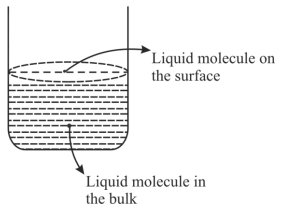
$A.$ Surface tension is the outcome of equal attractive and repulsion forces acting on the liquid molecule in bulk.
$B.$ Surface tension is due to uneven forces acting on the molecules present on the surface.
$C.$ The molecule in the bulk can never come to the liquid surface.
$D.$ The molecules on the surface are responsible for vapour pressure if the system is a closed system.