MCQ
In $X-$ray experiment $K_a, K_b$ denotes
  •  Characteristic
  • B
     Continuous wavelength
  • C
     $a, b-$emissions respectively
  • D
     None of these

Answer

Correct option: A.
 Characteristic
Characteristic

Need a full question paper?

Generate a complete, print-ready paper with questions like this in minutes — across 16+ boards, with answer keys.

Start Generating Free

Similar questions

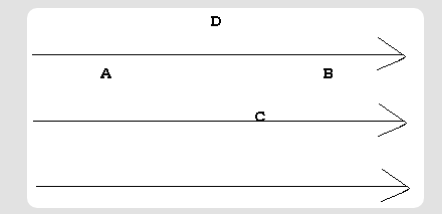
A negative charge is located in the uniform electric field between two plates (not shown).
Where in the diagram will the electron have the greatest change in potential energy before hitting the one of the plates?
In the Fraunhofer diffraction experiment of single aperture, the condition of path difference ( $\Delta$ ) for the secondary maximum of $n^{\text {th }}$ order is :
In a series $\text {LCR}$ circuit, the voltage across the resistance, capacitance and inductance is $10 V$ each. If the capacitance is short circuited the voltage across the inductance will be
The logic behind ‘NOR’ gate is that it gives(a) High output when both the inputs are low(b) Low output when both the inputs are low(c) High output when both the inputs are high(d) None of these


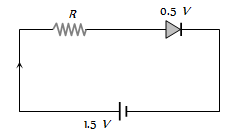
The diode used in the circuit shown in the figure has a constant voltage drop of $0.5 V$ at all currents and a maximum power rating of $100$ milliwatts. What should be the value of the resistor $R,$ connected in series with the diode for obtaining maximum current
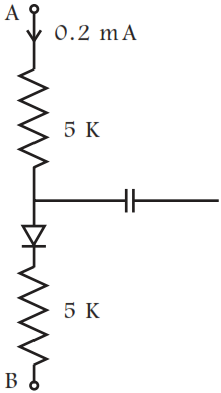
In the circuit shown in Fig., if the diode forward voltage drop is $0.3V,$ the voltage difference between $A$ and $B$ is:
A galvanometer is converted into ammeter by adding :
When a body is charged by induction, then the body.
Comparing real and virtual images, we may say that:
A charge of 5C  experiences a force of 5000 N when it is kept in a uniform electric field. What is the potential difference between two points separated by a distance of 1 cm (a) 10 V(b) 250 V (c) 1000 V (d) 2500 V