Question
The logic behind ‘NOR’ gate is that it gives(a) High output when both the inputs are low(b) Low output when both the inputs are low(c) High output when both the inputs are high(d) None of these


Answer

(a) High output when both the inputs are low

Need a full question paper?

Generate a complete, print-ready paper with questions like this in minutes — across 16+ boards, with answer keys.
Start Generating Free

Similar questions

Complete the reaction $\mathrm{n}+{ }_{92}^{235} \mathrm{U} \rightarrow{ }_{56}^{144} \mathrm{Ba}+\cdots+3 \mathrm{n}$
In Huygens' theory, light waves
A photoelectric cell is illuminated by a point source of light 1 m away. When the source is shifted to 2 m then(a) Number of electrons emitted is half the initial number(b) Each emitted electron carries half the initial energy(c) Number of electrons emitted is a quarter of the initial number(d) Each emitted electron carries one quarter of the initial energy


The critical angle of a material is the angle of incidence for which the angle of refraction is:
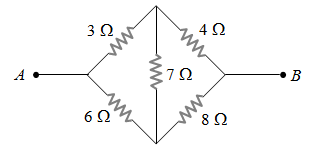
In the given figure, equivalent resistance between $A$ and $B$ will be
Mark the correct options:
  1. A diode valve can be used as a rectifier.
  2. A triode valve can be used as a rectifier.
  3. A diode valve can be used as an amplifier.
  4. A triode valve can be used as an amplifier.
The peak voltage in a 220V AC source is:
  1. 220V.
  2. About 160V.
  3. About 310V.
  4. 440V.
Assertion  :  The cloud in sky generally appear to be whitish.
Reason      : Diffraction due to cloud is efficient in equal measure at all wavelengths.(a) If both assertion and reason are true and the reason is the correct explanation of the assertion.(b) If both assertion and reason are true but reason is not the correct explanation of the assertion.(c) If assertion is true but reason is false.(d) If the assertion and reason both are false.


A charge $q$  is placed at the centre of the open end of cylindrical vessel. The flux of the electric field through the surface of the vessel is
An electron $($mass $=9 \times 10^{-31} \mathrm{~kg}$. Charge $=1.6 \times 10^{-19} \mathrm{C} )$ whose kinetic energy is $7.2 \times 10^{-18}$ joule is moving in a circular orbit in a magnetic field of $9 \times 10^{-5}$ weber $/ \mathrm{m}^2$. The radius of the orbit is