MCQ
In Young’s double slit experiment, a minimum is obtained when the phase difference of super imposing waves is
  • A
     Zero
  •  (2n – 1)π
  • C
  • D
    (n + 1) π

Answer

Correct option: B.
 (2n – 1)π
(2n – 1)π

Need a full question paper?

Generate a complete, print-ready paper with questions like this in minutes — across 16+ boards, with answer keys.

Start Generating Free

Similar questions

Two radioactive isotopes $P$ and $Q$ have half Jives $10$ minutes and $15$ minutes respectively. Freshly prepared samples of each isotope initially gontain the same number of atoms. After $30$ minutes, the ratio $\frac{\text { number of atoms of } P}{\text { number of atoms of } Q}$ will be
Which of the following is correct?
The electric field part of an electromagnetic wave in a medium is represented by $E_x = 0\,;$

${E_y} = 2.5\,\frac{N}{C}\,\,\cos \,\left[ {\left( {2\pi \, \times \,{{10}^6}\,\frac{{rad}}{m}} \right)t - \left( {\pi  \times {{10}^{ - 2}}\frac{{rad}}{s}} \right)x} \right];$

$E_z = 0$. The wave is
Moseley's Law for characteristic $X-$ray is $\sqrt{\text{v}}=\text{a}(\text{z}-\text{b})$. Here,
Light of wavelength $589.3\,nm$ is incident normally on the slit of width $0.1\,mm.$ What will be the angular width of the central diffraction maximum at a distance of $1\,m$ from the slit........$^o$
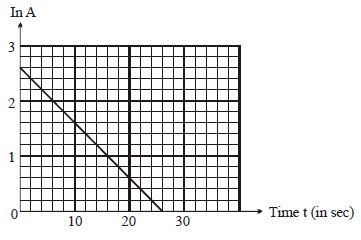
The graph in figure shows how the count-rate $A$ of a radioactive source as measured by a Geiger counter varies with time $t.$ The relationship between $A$ and $t$ is : $($ Assume $ln\,\, 12 = 2.6)$
At what distance in front of a concave mirror of focal length $30\; cm$, an object be placed (in $cm$) so that its real image of size three times that of the object is obtained?
The electromagnetic waves of frequency $2 MHz$ to $30 MHz$ are
Light is incident normally on a diffraction grating through which the first order diffraction is seen at $32^\circ$. The second order diffraction will be seen at
Beyond which frequency, the ionosphere bands any incident electromagnetic radiation but do not reflect it back towards the earth?