MCQ
In Young’s double-slit experiment, an interference pattern is obtained on a screen by a light of wavelength $6000 \mathring A$ , coming from the coherent sources $S_1$ and $S_2$. At certain point $P$ on the screen third dark fringe is formed. Then the path difference $S_1 P-S_2 P$ in microns is
  • A
    $0.75$
  • $1.5$
  • C
    $3.0$
  • D
    $4.5$

Answer

Correct option: B.
$1.5$
$1.5$

Need a full question paper?

Generate a complete, print-ready paper with questions like this in minutes — across 16+ boards, with answer keys.

Start Generating Free

Similar questions

Find the direction of vibration of Electric field if vibration of magnetic field is in positive $x-$ axis and propagation of em wave is along positive $y-$ axis.
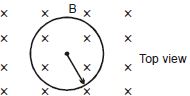
A non conducting ring (of mass $m,$ radius $r,$ having charge $Q$) is placed on a rough horizontal surface (in a region with transverse magnetic field). The field is increasing with time at the rate $R$ and coefficient of friction between the surface and the ring is $\mu .$ For ring to remain in equilibrium $\mu$ should be greater than
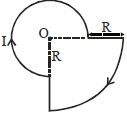
A current $I$ flowing through the loop as shown in the adjoining figure. The magnetic field at centre $O$ is
Half life of a radioactive substance is $T$. The time taken for all the nuclei to disintegrate will be
Electric potential of earth is taken to be zero because earth is a good
A parallel plate capacitor has plates of area $A$ separated by distance $d$ between them. It is filled with a dielectric which has a dielectric constant that varies as $\mathrm{k}(\mathrm{x})=\mathrm{K}(1+\alpha \mathrm{x})$ where $\mathrm{x}$ is the distance measured from one of the plates. If $(\alpha \text {d)}<<1,$ the total capacitance of the system is best given by the expression 
In Young’s doubled slit experiment, the separation between the slit and the screen increases. The fringe width
Statement$(A):$ Negative charges always move from a higher potential to lower potential point
Statement $(B):$ Electric potential is vector.
This question contains statement$-1$ and statement$-2$. Of the four choices given after the statements, choose the one that best describes the two statements.

statement$-1$ : The temperature dependence of resistance is usually given as $R=R_{0}(1+\alpha \Delta t)$. The resistance of a wire changes from $100\; \Omega$ to $150\; \Omega$ when its temperature is increased from $27^{\circ} C$ to $227^{\circ} C$. This implies that $\alpha=2.5$ $\times 10^{-3} /{ }^{\circ} C$

statement$-2\;: R=R_{0}(1+\alpha \Delta t)$ is valid only when the change in the temperature $\Delta T$ is small and $\Delta R=\left(R-R_{0}\right) < < R_{0}$

100 mA current gives a full scale deflection in a galvanometer of 2Ω resistance. The resistance connected with the galvanometer to convert it into a voltmeter to measure 5V is