MCQ
In Young's double slit experiment how many maximas can be obtained on a screen $($including the central maximum$)$ on both sides of the central fringe if $\lambda=2000 \mathring A$ and $d=700 \mathring A$
  • A
    $12$
  • $7$
  • C
    $18$       
  • D
    $4$

Answer

Correct option: B.
$7$
 $7$

Need a full question paper?

Generate a complete, print-ready paper with questions like this in minutes — across 16+ boards, with answer keys.
Start Generating Free

Similar questions

Consider sunlight incident on a pinhole of width $10^3\mathring{\text{A}}$. The image of the pinhole seen on a screen shall be:
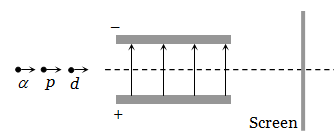
A proton, a deutron and an $a-$particle having the same momentum, enters a region of uniform electric field between the parallel plates of a capacitor. The electric field is perpendicular to the initial path of the particles. Then the ratio of deflections suffered by them is
       
If $4\times 10^{20} eV$ energy is required to move a charge of $0.25$ coulomb between two points. Then what will be the potential difference between them
A compass needle is placed in the gap of a parallel plate capacitor. The capacitor is connected to a battery through a resistance. The compass needle:
  1. Does not deflect.
  2. Deflects for a very short time and then comes back to the original position.
  3. Deflects and remains deflected as long as the battery is connected.
  4. Deflects and gradually comes to the original position in a time that is large compared to the time constant.
The condition for stable orbit in Bohr's model of hydrogen atom is :
There is a solid sphere of radius $' R\ '$ having uniformly distributed charge. What is the relation between electric field $'E\ ' ($inside the sphere$)$ and radius of sphere $' R\ '$ is
 
A convex lens forms a real image of a point object placed on its principal axis. If the upper half of the lens is painted black, the image will(a) Be shifted downwards(b) Be shifted upwards(c) Not be shifted(d) Shift on the principal axis
   
   
Which of the following happens when a body is charged positively?
The average acceleration in one time period in a simple harmonic motion is:
  1. $\text{A}\omega^2$
  2. $\frac{\text{A}\omega^2}{2}$
  3. $\frac{\text{A}\omega^2}{\sqrt{2}}$
  4. $\text{Zero}.$
The plate current $i_p$ in a triode valve is given $i_p=K\left(V_p+\mu V_g\right)^{3 / 2}$ where $i_p$ is in milliampere and $V_p$ and $V_g$ are in volt. If $r_p=10^4$ ohm, and $g_m=5 \times 10^{-3} \ mho$, then for ${ }^{i_p}=8 mA$ and $V_p=300$ volt, what is the value of K and grid cut off voltage