MCQ
In Young's interference experiment, if the slits are of unequal width, then:
  • A
    No fringes will be formed
  • B
    The positions of minimum intensity will not be completely dark.
  • C
    Bright fringe as displaced from the original central position.
  • D
    Distance between two consecutive dark fringes will not be equal to the distance between two consecutive right fringes.

Answer

  1. The positions of minimum intensity will not be completely dark.

Explanation:

Unequal width of slits will cause unequal intensity of lights entering from both slits.

As a result, during interference complete cancelling of light intensity will not take place at regions of otherwise dark fringe.

As the value of $\beta$ does not depend on intensity of light, there will be no shifting of fringes as well as no change in fringe width.

Need a full question paper?

Generate a complete, print-ready paper with questions like this in minutes — across 16+ boards, with answer keys.

Start Generating Free

Similar questions

The kinetic energy of the electron in an orbit of radius r in hydrogen atom is (e = electronic charge)

(a)

(b)

(c)

(d)

According to corpuscular theory of light, the different colours of light are due to

(a) Different electromagnetic waves

(b) Different force of attraction among the corpuscles

(c) Different size of the corpuscles

(d) None of the above

The total work done on a particle is equal to the change in its kinetic energy:
  1. Always.
  2. Only if the forces acting on it are conservative.
  3. Only if gravitational force alone acts on it.
  4. Only if elastic force alone acts on it.

A convex lens of focal length f  is placed somewhere in between an object and a screen. The distance between the object and the screen is x. If the numerical value of the magnification produced by the lens is m, then the focal length of the lens is

(a)  

(b)

(c)

(d)

A rocket is going away from the earth at a speed 0.2c, where c = speed of light. It emits a signal of frequency 4 . What will be the frequency observed by an observer on the earth

(a) 4  

(b) 3.2  

(c) 3  

(d) 5  

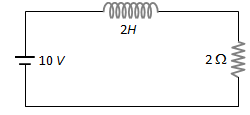
In the figure magnetic energy stored in the coil is

(a) Zero  

(b) Infinite

(c) 25 joules

(d) None of the above

Which of the following is used to produce radio waves of constant amplitude

(a) Oscillator

(b) FET

(c) Rectifier

(d) Amplifier

In the adjoining circuit diagram each resistance is of 10 W. The current in the arm AD will be

(a)     

(b) 

(c) 

(d)  

A beam consisting of protons and electrons moving at the same speed goes through a thin region in which there is a magnetic field perpendicular to the beam. The protons and the electrons:

A triode whose mutual conductance is 2.5 m A/volt and anode resistance is 20 kilo ohm, is used as an amplifier whose amplification is 10. The resistance connected in plate circuit will be

(a) 1 kW  

(b) 5 kW

(c) 10 kW

(d) 20 kW