Question
$\int\frac{1}{1+\tan\text{x}}\text{ dx}=$
  1. $\log_\text{e}(\text{x}+\sin\text{x})+\text{C}$
  2. $\log_\text{e}(\sin\text{x}+\cos\text{x})+\text{C}$
  3. $2\sec^2\frac{\text{x}}{2}+\text{C}$
  4. $\frac{1}{2}\big[\text{x}+\log(\sin\text{x}+\cos\text{x})\big]+\text{C}$
Answer

  1. $\frac{1}{2}\big[\text{x}+\log(\sin\text{x}+\cos\text{x})\big]+\text{C}$

Solution:

$\text{I}=\int\frac{1}{1+\tan\text{x}}\text{ dx}$

$=\int\frac{\cos\text{x}}{\sin\text{x}+\cos\text{x}}\text{ dx}$

Numerator can be written as,

$\cos\text{x}=\text{A}(\sin\text{x}+\cos\text{x})+\text{B}\frac{\text{d}(\sin\text{x}+\cos\text{x})}{\text{dx}}$

$\cos\text{x}=(\text{A}-\text{B})\sin\text{x}+(\text{A}+\text{B})\cos\text{x}$

$\text{A}-\text{B}=0$ and $\text{A}+\text{B}=1$

$\text{A}=\frac{1}{2}=\text{B}$

$\text{I}=\int\frac{\big[\frac{1}{2}(\sin\text{x}+\cos\text{x})+\frac{1}{2}(\cos\text{x}-\sin\text{x})\big]\text{dx}}{\sin\text{x}+\cos\text{x}}$

$\text{I}=\frac{1}{2}\int\Big(1+\frac{\cos\text{x}-\sin\text{x}}{\sin\text{x}+\cos\text{x}}\Big)\text{dx}$

$\text{I}=\frac{1}{2}\big[1+\int(\sin\text{x}+\cos\text{x})\big]+\text{C}$

Need a full question paper?

Generate a complete, print-ready paper with questions like this in minutes — across 16+ boards, with answer keys.

Start Generating Free

Similar questions

Choose the correct answer from the given four options.

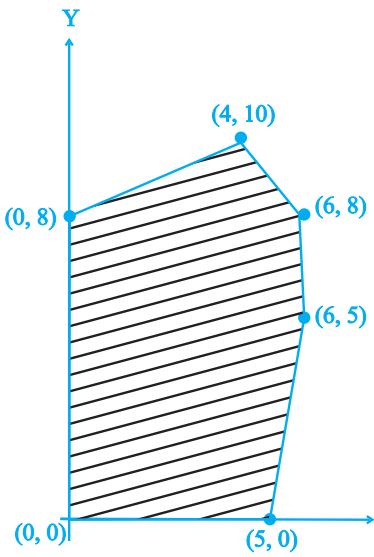
The feasible solution for a LPP is shown in. Let Z = 3x - 4y be the objective function.

Maximum of Z occurs at:

Let $f: R \rightarrow R$ be defined by $f(x)=1 / x$, for all $x \in R$, Then, $f$ is
The value of $\lambda $ for which points $A(2,2,1)$ , $B(1,1,1)$ , $C(-\lambda ,2,1)$ and $D(3,0,-1)$ are coplanar, is $\lambda  =$  ............ 
If f : R → R is given by f(x) = 3x - 5, then f-1(x)
  1. is given by $\frac{1}{3\text{x}-5}$
  2. is given by $\frac{\text{x}+5}{3}$
  3. does not exist because f is not one-one.
  4. does not exist because f is not onto.
Let $f : R \rightarrow R$ be a continuous function such that $f(3 x)-f(x)=x$. If $f(8)=7$, then $f(14)$ is equal to.
If $|\vec{a}-\vec{b}|=|\vec{a}|=|\vec{b}|=1$, then the angle between $\vec{a}$ and $\vec{b}$ is
If $\text{x}=2\text{ at},\text{y}=\text{at}^2,$ where a is a constant, then $\frac{\text{d}^2\text{y}}{\text{dx}^2}\text{ at}\ \text{x}=\frac{1}{2}$ is:
  1. $\frac{1}{2}\text{a}$
  2. 1
  3. 2a
  4. None of these
If $A \subset B$, then the value of $P(A \cap B)$ will be-
Mean and variance of a binomial probability distribution are $4$ and $\frac{4}{3}$ respectively then the probability of atleast two success is equal to
Let $S$ be the set of all  $a \in R$ for which the angle between the vectors $\overrightarrow{ u }= a \left(\log _{ e } b \right) \hat{ i }-6 \hat{ j }+3 \hat{ k }$ and $\vec{v}=\left(\log _{e} b\right) \hat{i}+2 \hat{j}+2 a\left(\log _{e} b\right) \hat{k},(b>1)$ is acute Then $S$ is equal to.