MCQ
$\int_{}^{} {\frac{{3{x^2}}}{{{x^6} + 1}}dx = } $
  • A
    $\log ({x^6} + 1) + c$
  • ${\tan ^{ - 1}}({x^3}) + c$
  • C
    $3{\tan ^{ - 1}}({x^3}) + c$
  • D
    $3{\tan ^{ - 1}}\left( {\frac{{{x^3}}}{3}} \right) + c$

Answer

Correct option: B.
${\tan ^{ - 1}}({x^3}) + c$
b
(b) Put ${x^3} = t \Rightarrow 3{x^2}dx = dt,$ therefore
$\int_{}^{} {\frac{{3{x^2}}}{{{x^6} + 1}}\,dx = \int_{}^{} {\frac{1}{{{t^2} + 1}}dt = {{\tan }^{ - 1}}(t) + c} }  = {\tan ^{ - 1}}({x^3}) + c$.

Need a full question paper?

Generate a complete, print-ready paper with questions like this in minutes — across 16+ boards, with answer keys.

Start Generating Free

Similar questions

$Z = 20x_1 + 20x_2$, subject to $\text{x}_1\geq0,\text{x}_{2}\geq0,\text{x}_{1}+2\text{x}_{2}\geq8,3\text{x}_{1}+2\text{x}_{2}\geq15,5\text{x}_{1}+2\text{x}_{2}\geq20.$ The minimum value of $Z$ occurs at
Let $f(x)$ be a non-constant twice differentiable function defined on $(-\infty, \infty)$ such that $f(x)=f(1-x)$ and $f^{\prime}\left(\frac{1}{4}\right)=0$. Then

$(A)$ $f^{\prime \prime}(x)$ vanishes at least twice on $[0,1]$

$(B)$ $f^{\prime}\left(\frac{1}{2}\right)=0$

$(C)$ $\int_{-1 / 2}^{1 / 2} f\left(x+\frac{1}{2}\right) \sin x d x=0$

$(D)$ $\int_0^{1 / 2} f(t) e^{\sin \pi t} d t=\int_{1 / 2}^1 f(1-t) e^{\sin \pi t} d t$

The given table shows the number of cars manufactured in four different colours on a particular day. Study it carefully and answer the question.
 
Number of cars manufactured
Colour
Vento
Creta
WagonR
Red
65
88
93
White
54
42
80
Black
66
52
88
Sliver
37
49
74
What was the total number of black cars manufactured?
$\int_{}^{} {\frac{{\sqrt {\tan x} }}{{\sin x\cos x}}} \;dx = $
Solution of differential equation

$\left( {x + 2{y^3}} \right)\frac{{dy}}{{dx}} - y = 0$ is

Let the mean and the standard deviation of the probability distribution

$X$ $\alpha$ $1$ $0$ $-3$
$P(X)$ $\frac{1}{3}$ $K$ $\frac{1}{6}$ $\frac{1}{4}$

be $\mu$ and $\sigma$, respectively. If $\sigma-\mu=2$, then $\sigma+\mu$ is equal to....................
The distance moved by a particle travelling in straight line in $t$ seconds is given by $s = 45t + 11t^2- t^3$. The time taken by the particle to come to rest is:
$\int_{}^{} {\frac{1}{{\sqrt {1 - {e^{2x}}} }}\;dx = } $
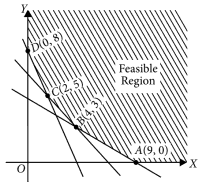
Feasible region for an L.P.P. is shown shaded in the following figure. Minimum of $Z=4 x+3 y$ occurs at the point
Image
If $\left| {\begin{array}{*{20}{c}}   {a - b}&{b - c}&{c - a} \\    {b - c}&{c - a}&{a - b} \\    {c - a + 1}&{a - b}&{b - c}  \end{array}} \right| = 0$ ,$\left( {a,b,c \in R - \left\{ 0 \right\}} \right),$ then