Question
$\int \frac{e^x}{x+1}[1+(x+1) \log (x+1)] d x$ equals

Answer

$\text { (d) : Let } I=\int \frac{e^x}{x+1}[1+(x+1) \log (x+1)] d x$
$=\int e^x\left[\frac{1}{x+1}+\log (x+1)\right] d x$
It is of the form $\int e^x\left[f(x)+f^{\prime}(x) d x\right]$,
where $f(x)=\log (x+1)$ and $f^{\prime}(x)=\frac{1}{x+1}$
So, $I=e^x \log (x+1)+C$

Need a full question paper?

Generate a complete, print-ready paper with questions like this in minutes — across 16+ boards, with answer keys.
Start Generating Free

Similar questions

A linear programming of linear functions deals with:
  1. Minimizing
  2. Optimizing
  3. Maximizing
  4. None
If $x=t^2+1, y=2 a t$, then $\frac{d^2 y}{d x^2}$ at $t=a$ is
If $\alpha, \beta, \gamma$ are the direction angles of a vector and $\cos \alpha=\frac{14}{15}, \cos \beta=\frac{1}{3}$, then $\cos \gamma=$
Which of the following functions from $\text{A}=\{\text{x}\in\text{R}:-1\leq\text{x}\leq1\}$ to itself are bijections?
  1. $\text{f(x)}=|\text{x}|$
  2. $\text{f(x)}=\sin\frac{\pi\text{x}}{2}$
  3. $\text{f(x)}=\sin\frac{\pi\text{x}}{4}$
  4. $\text{None of these}$
Choose the correct answer from the given four options.
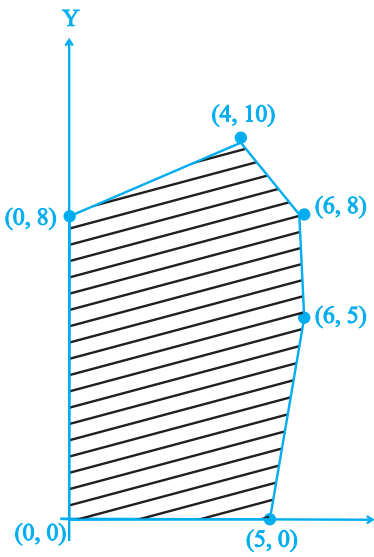
The feasible solution for a LPP is shown in. Let Z = 3x - 4y be the objective function.

Minimum of Z occurs at:
Five persone entered the lift cabin on the ground floor of an $8$ floor house. Suppose that each of them independently and with equal probability can leave the cabin at any flor beginning with the first, then the probability of all $5$ persons leaving at different floors is,
Side of an equilateral triangle expands at the rate of $2\text{cm}/ \text{sec}.$ The rate of increase of its area when each side is 10cm is:
  1. $10\sqrt{2}\text{cm}^2/\sec.$
  2. $10\sqrt{3}\text{cm}^2/\sec.$
  3. $10\text{cm}^2/\sec.$
  4. $5\text{cm}^2/\sec.$
The value of p and q for which the function $f ( x )=\left\{\begin{array}{cl}\frac{\sin (p+1) x+\sin x}{x} & , x<0 \\ \frac{q}{x^2} & , x=0 \\ \frac{\sqrt{x+b x^2}-\sqrt{x}}{x^{\frac{3}{2}}} & , x>0\end{array}\right.$ is continuous for all $x \in R$, are
Let $\vec{a}$ and $\vec{b}$ are non-collinear. If $\vec{c}=(x-2) \vec{a}+\vec{b}$ and $\vec{d}=(2 x+1) \vec{a}-\vec{b}$ are collinear, then find the value of $x$.
If cofactor $C _{i j}$ represent for element $p_{i j},$ of matrix $P =\left[\begin{array}{ccc}1 & -1 & 2 \\ 0 & 2 & -3 \\ 3 & 2 & 4\end{array}\right]$ then value of $C_{31} . C_{23}$ is $:$