MCQ
$\int_0^{\pi / 2} \frac{\sin x-\cos x}{1+\sin x \cos x} d x$ is equal to :
  • A
    $\pi$
  • B
    Zero (0)
  • C
    $\int_0^{\pi / 2} \frac{2 \sin x}{1+\sin x \cos x} d x$
  • D
    $\frac{\pi^2}{4}$

Answer

Let $I=\int_0^{\pi / 2} \frac{\sin x-\cos x}{1+\sin x \cos x} d x$
$
\begin{array}{l}
\Rightarrow I=\int_0^{\pi / 2} \frac{\sin (\pi / 2-x)-\cos (\pi / 2-x)}{1+\sin (\pi / 2-x) \cos (\pi / 2-x)} d x \\
\Rightarrow I=\int_0^{\pi / 2} \frac{\cos x-\sin x}{1+\cos x \cdot \sin x} d x
\end{array}
$
Adding (i) and (ii), we get
$
2 I=\int_0^{\pi / 2} 0 d x=0 \Rightarrow I=0
$

Need a full question paper?

Generate a complete, print-ready paper with questions like this in minutes — across 16+ boards, with answer keys.
Start Generating Free

Similar questions

if x lies in the interval [0, 1], then the least value of x2 + x + 1 is :
  1. $3$ 
  2. $\frac{3}{4}$
  3. $1$
  4. none of these.
The order of the differential whose general solution is given by ${\text{y}}=\text{C}_1\cos(2\text{x}+\text{C}_{2})+(\text{C}_{3}+\text{C}_{4})\text{a}^{\text{x}+\text{C}_{5}}+\text{C}_{6}\sin(\text{x}-\text{C}_{7}).$ 
  1. 3
  2. 4
  3. 5
  4. 2
The solution set of the inequation 2x + y > 5 is:
  1. half plane that contains the origin
  2. open half plane not containing the origin
  3. whole xy-plane except the points lying on the line 2x + y = 5
  4. none of these
Choose the correct answer from the given four options.

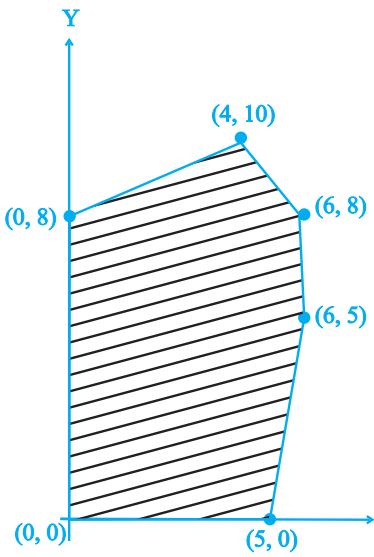
The feasible solution for a LPP is shown in. Let Z = 3x - 4y be the objective function.

Maximum of Z occurs at:

  1. (5, 0)
  2. (6, 5)
  3. (6, 8)
  4. (4, 10)
Let $g(x) = |   |x + 2| -3|$ . If $'a'$ denotes the number of relative minima, $'b'$ denotes the number of relative maxima and $'c'$ denotes  the product of the zeroes of $g(x)$ , then the value of $(a + 2b -c)$ is 
If $g(x) = \int_0^x {{{\cos }^4}t\,dt,} $ then $g(x + \pi )$ equals
If $\text{x}=\text{at}^2,\text{y}=2\text{at}$ then $\frac{\text{d}^2\text{y}}{\text{dx}^2}$=
  1. $-\frac{1}{\text{t}^2}$
  2. $\frac{1}{2\text{at}^3}$
  3. $-\frac{1}{\text{t}^3}$
  4. $-\frac{1}{2\text{at}^3}$
Assume $X,\, Y,\, Z, W$ and $P$ are the matrices of order $2 \times n, \,3 \times k,\, 2 \times p, \,n \times 3$ and $p \times k$ respectively. The restriction on $n,\, k$ and $p$ so that $P Y+W Y$ will be defined are :
If $\text{A}=\begin{bmatrix}3&\text{x}-1\\2\text{x}+3&\text{x}+2\end{bmatrix}$ is a symmetric matrix, then x =
  1. 4
  2. 3
  3. -4
  4. -3
$\int_{}^{} {\sqrt {\frac{x}{{{a^3} - {x^3}}}} \;dx = } $