MCQ
Intensity of an electric field E due to a dipole, depends on distance r as
  • A
    $E ∝\frac{1}{r^4}$
  • $E ∝ \frac{1}{r^3}$
  • C
    $ E ∝ \frac{1}{r^2}$
  • D
    $ E ∝\frac{1}{r}$

Answer

Correct option: B.
$E ∝ \frac{1}{r^3}$
(b) $E ∝ \frac{1}{r^3}$

Need a full question paper?

Generate a complete, print-ready paper with questions like this in minutes — across 16+ boards, with answer keys.
Start Generating Free

Similar questions

Electron in hydrogen atom first jumps from third excited state to second excited state and then from second excited to the first excited state. The ratio of the  wavelengths $\lambda_1 :\lambda_2$ emitted in the two cases is
Two galvanometers A and B require 3mA and 5mA respectively to produce the same deflection of 10 divisions. Then
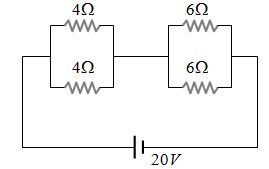
Four resistances are connected in a circuit in the given figure. The electric current flowing through 4 ohm and 6 ohm resistance is respectively
A nucleus of lead $Pb _{82}^{214}$ emits two electrons followed by an $\alpha$-particle. The resulting nucleus will have
While walking on ice, one should take small steps to avoid slipping. This is because smaller steps ensure:
Assertion $(A):$ A spherical equipotential surface is not possible for a point charge.

Reason $(R):$ A spherical equipotential surface is possible inside a spherical capacitor.

If in a nuclear fission, piece of uranium of mass $0.5\, g$ is lost, the energy obtained in $kWh$ is
A charge $ + q$ is fixed at each of the points $x = {x_0},\,x = 3{x_0},\,x = 5{x_0}$..... $\infty$, on the $x - $axis and a charge $ - q$ is fixed at each of the points $x = 2{x_0},\,x = 4{x_0},x = 6{x_0}$,..... $\infty$. Here ${x_0}$ is a positive constant. Take the electric potential at a point due to a charge $Q$ at a distance $r$ from it to be $Q/(4\pi {\varepsilon _0}r)$. Then, the potential at the origin due to the above system of charges is
Avalanche breakdown is due to
The magnet of a vibration magnetometer is heated so as to reduce its magnetic moment by $19\%$. By doing this the periodic time of the magnetometer will