MCQ
$\int\limits_{ - 1}^1 {[x + [x + [x]]]\,\,dx = } $ (where $[·] =$ greatest integer function)
  • A
    $-1$
  • B
    $-2$
  • $-3$
  • D
    $3$

Answer

Correct option: C.
$-3$
c
$3 \int_{-1}^{1}[x] d x=3\left[\int_{-1}^{0}-1 d x+\int_{0}^{1} 0 d x\right]$

$=3[-x]_{-1}^{0}$

$=-3[0-(-1)]=-3$

Need a full question paper?

Generate a complete, print-ready paper with questions like this in minutes — across 16+ boards, with answer keys.
Start Generating Free

Similar questions

The value of $\frac{d}{{d(\ln x)}}({e^x}{\ln ^2}x)$ at $x=e$, is
$\int_{}^{} {\sqrt {1 + \sin x} \;dx = } $
Choose the correct answer from the given four options.

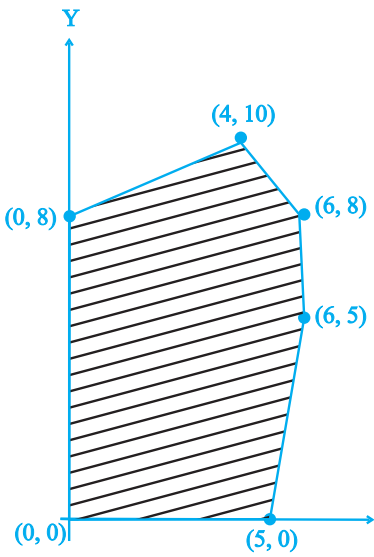
The feasible solution for a LPP shown in Fig. 12.12. Let z = 3x - 4y be objective functio. (Maximum value of Z + Minimum value of Z) is equal to:
$\overrightarrow{\text{r}} = \overrightarrow{\text{x}}{\hat{\text{i}}}+ \overrightarrow{\text{y}}{\hat{\text{j}}}$ is the equation of:
  1. Yoz plane
  2. A straight line joining the points ${\hat{\text{i}}}$ and ${\hat{\text{j}}}$
  3. Zox plane
  4. Xoy plane
Which of the following is incorrect
$\int_{}^{} {\frac{{\cos \sqrt x }}{{\sqrt x }}} dx = $
A ladder  $5\ m$ in length is resting against vertical wall. The bottom of the ladder is pulled along the ground away from the wall at the rate of $1.5\,m/\sec $. The length of the highest point of the ladder when the foot of the ladder $4.0\,m$ away from the wall decreases at the rate of .......... $m/sec$
The function $\text{f(x)}=4\sin^3\text{x}-6\sin^2\text{x}+12\sin\text{x}+100$ is strictly:
The graph of the function $f(x)=x+\frac{1}{8} \sin (2 \pi x), 0 \leq x \leq 1$ is shown below. Define $f_1(x)=f(x), f_{n+1}(x)=f\left(f_n(x)\right)$, for $n \geq 1$.

Which of the following statements are true?

$I.$ There are infinitely many $x \in[0,1]$ for which $\lim _{n \rightarrow \infty} f_n(x)=0$

$II.$ There are infinitely many $x \in[0,1]$ for which $\lim _{n \rightarrow \infty} f_n(x)=\frac{1}{2}$

$III.$ There are infinitely many $x \in[0,1]$ for which $\lim _{n \rightarrow \infty} f_n(x)=1$

$IV.$ There are infinitely many $x \in[0,1]$ for which $\lim _{n \rightarrow \infty} f_n(x)$ does not exist.

If $\sum_{r=1}^{50} \tan ^{-1} \frac{1}{2 r^{2}}=p$, then the value of $\tan p$ is :