MCQ
$\int|\text{x}|\text{dx}$ is equal to :
- A$\frac{1}{2}\text{x}^2+\text{c}$
- B$-\frac{\text{x}^2}{2}+\text{c}$
- C$\text{x}|\text{x}|+\text{c}$
- ✓$\frac{1}{2}\text{x}|\text{x}|+\text{c}$
Generate a complete, print-ready paper with questions like this in minutes — across 16+ boards, with answer keys.
|
Column $A$
|
Column $B$
|
|
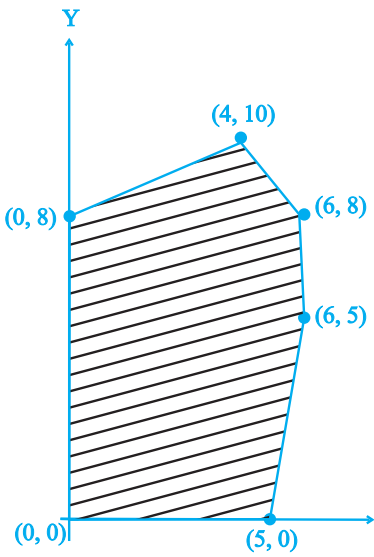
Maximum of $Z$
|
$325$
|
$f(x) =$ $\left\{ {\begin{array}{*{20}{c}} {(x\, + \,1)\,\,{e^{ - \,\left[ {\tfrac{1}{{|x|}}\,\, + \,\,\tfrac{1}{x}} \right]}}}&{(x\,\, \ne \,\,0)} \\ {0\,\,\,\,\,\,\,\,\,\,\,\,\,\,\,\,\,\,\,\,\,\,\,\,\,\,\,\,\,}&{(x\,\, = \,\,0)} \end{array}} \right.$
then which one of the following does not hold good ?
$2 x+y-z=5$
$2 x-5 y+\lambda z=\mu$
$x+2 y-5 z=7$
has infinitely many solutions, then $(\lambda+\mu)^2+(\lambda-\mu)^2$ is equal to
Statement $-I$ : ${A^{ - 1}} = \frac{1}{7}\left( {5I - A} \right).$
Statement $II$ : the polynomial $A^3 - 2A^2 - 3A + I$ can be reduced to $5\, (A - 4I)$.