MCQ
$\int_{\,\pi }^{\,10\pi } {\,|\sin x|dx} $ is
  • A
    $20$
  • B
    $8$
  • C
    $10$
  • $18$

Answer

Correct option: D.
$18$
d
(d) $\int_\pi ^{10\pi } {|\sin x|dx = \int_0^\pi {|\sin x|dx + \int_\pi ^{10\pi } {\,\,|\sin x|dx} } } - \int_0^\pi {\,|\sin x|dx} $

$ = \int_0^{10\pi } {|\sin x|dx - \int_0^\pi {\,|\sin x|dx} } $

$ = 10\int_{\,0}^{\,\pi } {|\sin x|dx - \int_{\,0}^{\,\pi } {\,|\sin x|dx} } $

$ = 9\int_{\,0}^{\,\pi } {\sin x\,dx} $

$[\because \,|\sin x|$ is periodic with period $\pi $ and in $[0,\pi ],\sin x \ge 0]$

$ = 9\,[ - \cos x]_0^\pi = 9\,( - \cos \pi + \cos 0)$

$ = 9\,(1 + 1) = 18$.

Need a full question paper?

Generate a complete, print-ready paper with questions like this in minutes — across 16+ boards, with answer keys.
Start Generating Free

Similar questions

If  $\begin{gathered} f(x)\, = \,\left\{ \begin{gathered}
  x\left( {\frac{{{e^{1/x}} - {e^{ - 1/x}}}}{{{e^{1/x}} + {e^{ - 1/x}}}}} \right)\,,\,\,x \ne 0 \hfill \\
  \,\,\,\,\,\,\,\,\,\,\,\,\,\,\,\,0\,\,\,\,\,\,\,\,\,\,\,\,\,\,\,\,\,\,\,\,\,\,\,\,\,\,\,\,\,\,\,\,\,\,\,,\,\,\,\,x\, = \,0\,\,\,\,\,\,\,\,\,\,\,\,\, \hfill \\ 
\end{gathered}  \right. \hfill \\
  \,\,\,\,\,\,\,\,\,\,\,\,\,\,\,\,\,\,\,\,\,\,\,\,\,\,\,\,\,\,\,\,\,\,\ \hfill \\ 
\end{gathered}$ then correct statement is
A relation on the set $A\, = \,\{ x\,:\,\left| x \right|\, < \,3,\,x\, \in Z\} ,$ where $Z$ is the set of integers is defined by $R= \{(x, y) : y = \left| x \right|, x \ne  - 1\}$. Then the number of elements in the power set of $R$ is
The area of the region bounded by the parabola (y - 2)2 = x - 1, the tangent to it at the point with the ordinate 3 and the x-axis is:
  1. 3
  2. 6
  3. 7
  4. none of these
$\int_{}^{} {\frac{{\sqrt {{x^2} + 1} [\log ({x^2} + 1) - 2\log x]}}{{{x^4}}}} dx$ is equal to
Choose the correct answer from the given four options.

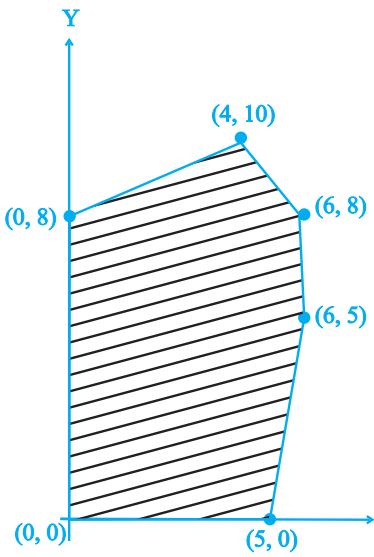
The feasible solution for a LPP is shown in. Let Z = 3x - 4y be the objective function.

Maximum of Z occurs at:

The domain of the function defind by $\text{f(x)}=\sin^{-1}\sqrt{\text{x}-1}$ is:
  1. [1, 2]
  2. [-1, 1]
  3. [0, 1]
  4. None of these.
Evaluate: $\int\sqrt{1+\text{y}}^2.\text{2ydy:}$
  1. $\text{I}=\frac{2}{3}(1+\text{y}^2)^\frac{3}{2}+\text{c}$
  2. $\text{I}=\frac{2}{5}(1-\text{y}^2)\frac{3}{2}+\text{c}$
  3. $\text{I}=\frac{2}{3}(1-\text{y}^2)^\frac{3}{2}+\text{c}$
  4. None of these
The area bounded by the curve y = f(x), x-axis, and the ordinates x = 1 and $(\text{b}-1)\sin(3\text{b}+4)$ Then, f(x) is:
  1. $(\text{x}-1)\cos(3\text{x}+4)$
  2. $\sin(3\text{x}+4)$
  3. $\sin(3\text{x}+4)+3(\text{x}-1)\cos(3\text{x}+4)$
  4. none of these
If $A$ and $B$ are two invertible matrices of the same order, then $adj \,(AB)$ is equal to :-
If the system of equations $x + 2y + 3z = 4 , x + py + 2z = 3 , x + 4y + \mu z = 3$ has an infinite number of solutions , then :