Question
Is it necessary to have two waves of equal intensity to study interference pattern? Will there be an effect on clarity if the waves have unequal intensity?

Answer

Interference pattern can be studied with waves of unequal intensity.$\text{I}=\text{I}_1+\text{I}_2+2\sqrt{[\text{I}_1\times\text{I}_2]}\cos(\phi),$
Where $\phi$, = phase difference. In case of waves of unequal intensities, the contrast will not be clear, as the minima will not be completely dark.

Need a full question paper?

Generate a complete, print-ready paper with questions like this in minutes — across 16+ boards, with answer keys.
Start Generating Free

Similar questions

Explain the dependence of the electric potential generated at a great distance due to a small electric dipole, when the point of observation is (i) in the axial position, and (ii) in the equatorial position.
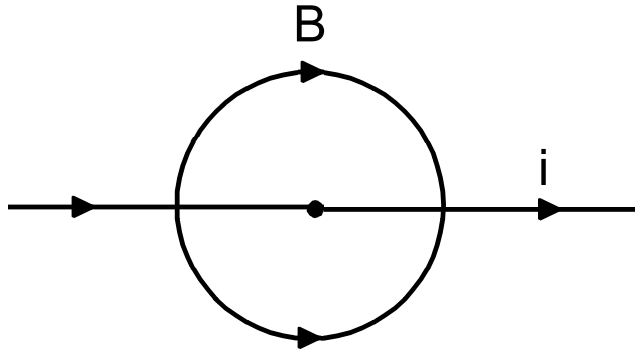
A conducting circular loop of radius a is connected to two Iong, straight wires. The straight wires carry current I as shown in figure. Find the magnetic field B at the centre of the loop.
The surface of water in a water tank on the top of a house is $4m$ above the tap level Find the pressure of water at the tap when the tap is closed Is it necessary to specify that the tap is closed? Take $g = 10m/s^2.$
A charge Q is placed at the centre of a cube. Find the flux of the electric field through the six surfaces of the cube.
A point charge Q is placed at the origin. Find the electrostatic energy stored outside the sphere of radius R centred at the origin.
Can work be done by a system without changing its volume?
The force between two point charges kept at a distance r apart in air is F. If the same charges are kept in water at the same distance, how does the force between them change?
At a hydroelectric power plant, the water pressure head is at a height of $300m$ and the water flow available is $100\ m^3s^{–1}.$ If the turbine generator efficiency is $60\%$, estimate the electric power available from the plant $(g = 9.8\ ms^{–2}).$
Consider an ice cube of edge 1.0cm kept in a gravity free hall. Find the surface area of the water when the ice melts. Neglect the difference in densities of ice and water.
Define the magnifying power of a compound microscope when the final image is formed at infinity. Why must both the objective and the eyepiece of a compound microscope has short focal lengths? Explain.