Question
Is it necessary to have two waves of equal intensity to study interference pattern? Will there be an effect on clarity if the waves have unequal intensity?

Answer

Interference pattern can be studied with waves of unequal intensity.
$\text{I}=\text{I}_1+\text{I}_2+2\sqrt{[\text{I}_1\times\text{I}_2]}\cos(\phi),$
Where $\phi$, = phase difference.
In case of waves of unequal intensities, the contrast will not be clear, as the minima will not be completely dark.

Need a full question paper?

Generate a complete, print-ready paper with questions like this in minutes — across 16+ boards, with answer keys.
Start Generating Free

Similar questions

In an electrolyte, the positive ions move from left to right and the negative ions from right to left. Is there a net current? If yes, in what direction?
Two thin lenses, whose power is +5 D and $-3 D$. are kept in mutual contact. Find the focal length of the combination.
Two point charges of $+10 \mu C$ and $-10 \mu C$ are kept at a distance of 40 cm from each other in air.(a) Calculate the electrical potential energy of the system. Assume that the electric potential energy at infinity is zero.(b) Draw the equipotential surface for the system.(c) How much work will have to be done to separateboth the charges of the system to infinity?
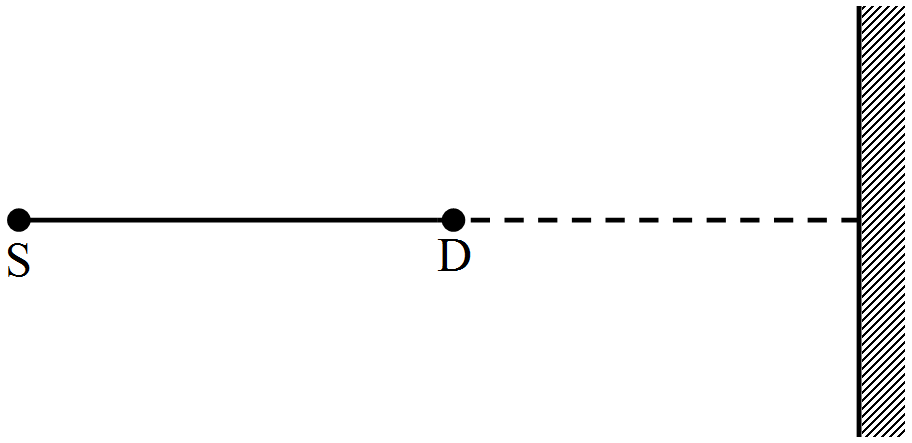
A source of sound S and a detector D are placed at some distance from one another. A big cardboard is placed near the detector and perpendicular to the line SD as shown in figure, It is gradually moved away and it is found that the intensity changes from a maximum to a minimum as the board is moved through a distance of 20cm. Find the frequency of the sound emitted. Velocity of sound in air is 336m/s.

A nucleus  $\frac{23}{10}$ Ne undergoes β− decay and becomes $\frac{23}{11}$Na. Calculate the maximum kinetic energy of electrons emitted assuming that the daughter nucleus and anti-neutrino carry negligible kinetic energy.

$\left\{\text{mass of} \frac{23}{10} Ne = 22.994466 u\right\}$

$\left\{\text{mass of}\frac{23}{11}Na=22.989770u\right\}$

$\left\{ 1u = 931.5\text{MeV}/ c^{2}\right\}$

The photoelectric cut-off voltage in a certain experiment is 1.5 V. What is the maximum kinetic energy of photoelectrons emitted?
The maximum value of electric field vector $\overrightarrow{ E }$ in a electromagnetic wave is 0.3 mV metre$^{-1}$. Calculate the maximum value of magnetic field vector $\overrightarrow{ B }$.
A convex lens made of a material of refractive index n1 is kept in a medium of refractive index n2. Parallel rays of light are incident on the lens. Complete the path of rays of light emerging from the convex lens if: (i) n1 > n2 (ii) n1 = n2 (iii) n1 < n2.
$\frac{1}{\text{f}}=\Big(\frac{\text{n}_1}{\text{n}_2}-1\Big)\Big(\frac{1}{\text{R}_2}+\frac{1}{\text{R}_2}\Big)$
A metal sphere of radius 1mm and mass 50mg falls vertically in glycerine. Find:
  1. The viscous force exerted by the glycerine on the sphere when the speed of the sphere is 1cm/s.
  2. The hydrostatic force exerted by the glycerine on the sphere and.
  3. The terminal velocity with which the sphere will move down without acceleration. Density of glycerine = 1260kg/m3 and its coefficient of viscosity at room temperature = 8.0 poise.
What is the longest wavelength of photon that can ionize a hydrogen atom in its ground state? Specify the type of radiation.