Question
Is there any lower limit to the electric force between two particles placed at a separation of 1cm ?

Answer

Yes, there's a lower limit to the electric force between two particles placed at a separation of 1cm, which is equal to the magnitude of force of repulsion between two electrons placed at a separation of 1cm.

Need a full question paper?

Generate a complete, print-ready paper with questions like this in minutes — across 16+ boards, with answer keys.
Start Generating Free

Similar questions

Define ionisation energy. How would the ionsation energy change when electron in hydrogen atom is replaced by a particle of mass 200 times that of the electron but having the same charge?
A small town with a demand of 800kW of electric power at 220V is situated 15km away from an electric plant generating power at 440V. The resistance of the two wire line carrying power is 0.5Ω per km. The town gets power from the line through a 4000-220V step-down transformer at a sub-station in the town.
  1. Estimate the line power loss in the form of heat.
  2. How much power must the plant supply, assuming there is negligible power loss due to leakage?
  3. Characterise the step up transformer at the plant.
A circular loop of one turn carries a current of 5.00A. If the magnetic field B at the centre is 0.200mT find the radius of the loop.
A heavy nucleus X of mass number 240 and binding energy per nucleon 7.6 MeV is split into two fragments Y and Z of mass numbers 110 and 130. The binding energy of nucleons in Y and Z is 8.5 MeV per nucleon. Calculate the energy Q released per fission in MeV
Ultraviolet radiations of different frequencies ν1 and ν2, are incident on two photosensitive materials having work functions W1 and W2 (W1 > W2) respectively. The kinetic energy of the emitted photoelectrons is same in both the cases. Which one of the two relations will be of the higher frequency?
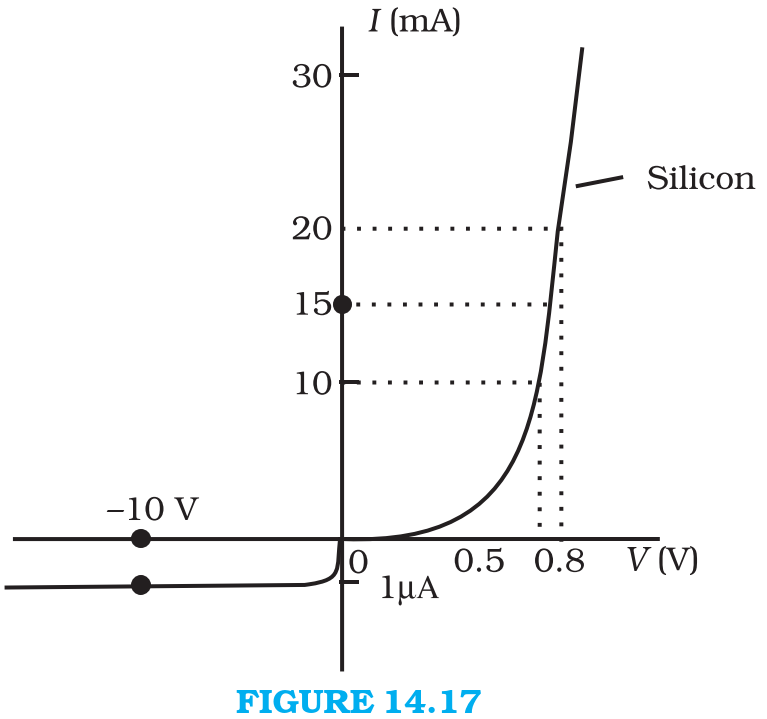
The $V-I$ characteristic of a silicon diode is shown in the Fig. 14.17. Calculate the resistance of the diode at (a) $I_D=15 mA$ and (b) $V_D=-10 V$.
Image
A metal sphere of radius 1mm and mass 50mg falls vertically in glycerine. Find:
  1. The viscous force exerted by the glycerine on the sphere when the speed of the sphere is 1cm/s.
  2. The hydrostatic force exerted by the glycerine on the sphere and.
  3. The terminal velocity with which the sphere will move down without acceleration. Density of glycerine = 1260kg/m3 and its coefficient of viscosity at room temperature = 8.0 poise.
Find the wavelength of the electron orbiting in the first excited state in hydrogen atom.
The ratio of mass numbers of two nuclei is $1: 8$. What is the ratio of their nuclear radii?
A steel wire and a copper wire of equal length and equal cross-sectional area are joined end to end and the combination is subjected to a tension. Find the ratio of.
  1. The stresses developed in the two wires.
  2. The strains developed. Y of steel = 2 × 10¹¹N/m2. Y of copper =  1.3 × 10¹¹N/m2.