Question
It is a well known fact that during a total solar eclipse the disk of the moon almost completely covers the disk of the Sun. From this fact and from the information you can gather from examples $2.3$ and $2.4$, determine the approximate diameter of the moon.
Answer

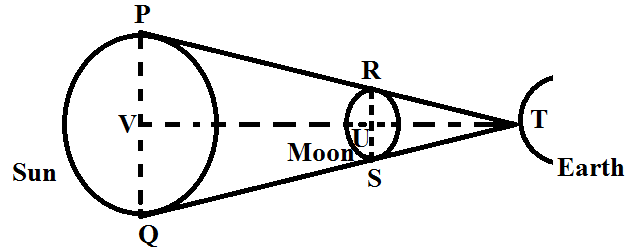
The position of the Sun, Moon, and Earth during a lunar eclipse is shown in the given figure.

Distance of the Moon from the Earth $=3.84 \times 10^8 \mathrm{~m}$ Distance of the Sun from the Earth $=1.496 \times 10^{11} \mathrm{~m}$ Diameter of the Sun $=1.39 \times 10^9 \mathrm{~m}$ It can be observed that $\Delta \mathrm{TRS}$ and $\Delta \mathrm{TPQ}$ are similar. Hence, it can be written as: $\mathrm{PQ} / \mathrm{RS}=$ VT/UT $1.39 \times 10^9 /$ RS $=1.496 \times 10^{11} / 3.84 \times 10^8 \mathrm{RS}=(1.39 \times 3.84 / 1.496) \times 10^6=3.57 \times 10^6 \mathrm{~m}$ Hence, the diameter of the Moon is $3.57 \times 10^6 \mathrm{~m}$

Need a full question paper?

Generate a complete, print-ready paper with questions like this in minutes — across 16+ boards, with answer keys.

Start Generating Free

Similar questions

A progressive wave is given by $\text{y}(\text{x, t})=8\cos(300\text{t}-0.15\text{x})$ where x in m, y in cm and t in second. What is the-
  1. Direction of propagation?
  2. Wavelength?
  3. Frequency?
  4. Wave speed?
  5. Phase difference between two points 0.2m apart?
Two Carnot engines A and B are operated in series. The first one A receives heat at $900K$ and rejects it to a reservoir at temperature T. The second engine B operates on this reservoir and rejects heat to a reservoir at $400K$. Calculate temperature T when,
  1. Efficiencies of both A and B are equal.
  2. The work outputs of both A and B are equal.
What do you mean by interference of waves? Distinguish between constructive and destructive interference.
Standing waves are produced by the superposition of two waves
$\text{y}_1=0.05\sin(3\pi\text{t}-2\text{x})$ and $\text{y}_2=0.05\sin(3\pi\text{t}+2\text{x})$
where y and x are measured in metres and t in seconds. Find the amplitude of a particle at x = 0.5m.
A car weighs $1800kg$. The distance between its front and back axles is $1.8m$. Its centre of gravity is $1.05m$ behind the front axle. Determine the force exerted by the level ground on each front wheel and each back wheel.
The period of oscillation of a simple pendulum is $\text{T}=2\pi\sqrt{\frac{\text{l}}{\text{g}}}$ measured value of 1 is 20.0cm known to 1mm accuracy and time for 100 oscillations of the pendulum is found to be 90s using a wrist watch of 1s resolution. What is the accuracy in determination of g?
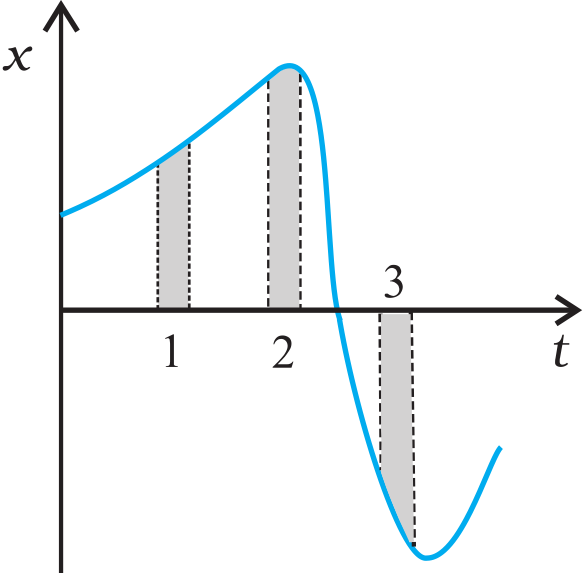
Gives the x-t plot of a particle in one-dimensional motion. Three different equal intervals of time are shown. In which interval is the average speed greatest, and in which is it the least? Give the sign of average velocity for each interval.
Prove that velocity of efflux of an ideal liquid through an orifice is equal to the velocity attained by a freely falling body from the surface of the liquid to the orifice. Also find the horizontal range in terms of height. When is this range maximum?
India has had a long and unbroken tradition of great scholarship-in mathematics, astronomy, linguistics, logic and ethics. Yet, in parallel with this, several superstitious and obscurantistic attitudes and practices flourished in our society and unfortunately continue even today-among many educated people too. How will you use your knowledge of science to develop strategies to counter these attitudes?
Consider the case of two bodies of mass $m_1$ and $m_2$ connected by a string and placed on a smooth horizontal surface as shown. Calculate the acceleration of the system, and tension in the string when the force F is applied on $m_2$.
​​​​​​​
An object falling through a fluid is observed to have acceleration given by a = g - bv where g = gravitational acceleration and b is constant. After a long time of release, it is observed to fall with constant speed. What must be the value of constant speed?
