Question
It is a well known fact that during a total solar eclipse the disk of the moon almost completely covers the disk of the Sun. From this fact and from the information you can gather from examples 2.3 and 2.4, determine the approximate diameter of the moon.
Answer

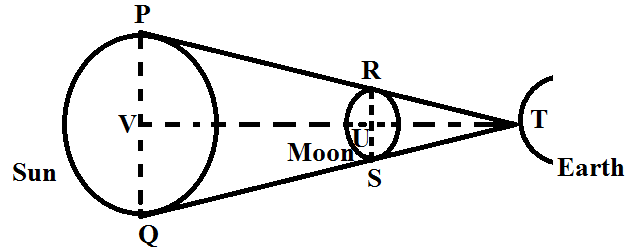
The position of the Sun, Moon, and Earth during a lunar eclipse is shown in the given figure.

Distance of the Moon from the Earth = 3.84 × 10⁸m
Distance of the Sun from the Earth = 1.496 × 10¹¹m
Diameter of the Sun = 1.39 × 10⁹m
It can be observed that $\Delta\text{TRS}$ and $\Delta\text{TPQ}$ are similar. Hence, it can be written as:
PQ/RS = VT/UT
1.39 × 10⁹/RS = 1.496 × 1011/3.84 × 108
RS = (1.39 × 3.84/1.496) × 106 = 3.57 × 106m
Hence, the diameter of the Moon is 3.57 × 106m

Need a full question paper?

Generate a complete, print-ready paper with questions like this in minutes — across 16+ boards, with answer keys.

Start Generating Free

Similar questions

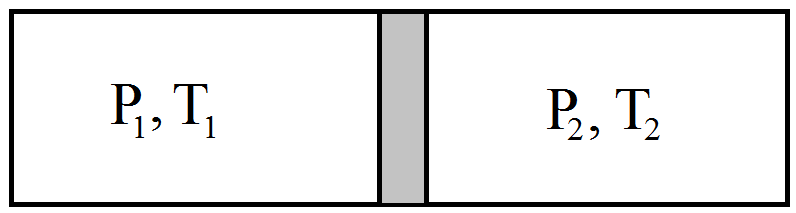
The figure shows an adiabatic cylindrical tube of volume V0 divided in two parts by a frictionless adiabatic separator. Initially, the separator is kept in the middle, an ideal gas at pressure p1 and temperature T1 is injected into the left part and another ideal gas at pressure p2 and temperature T2 is injected into the right part. $\frac{\text{C}_\text{P}}{\text{C}_\text{V}}=\gamma$ is the same for both the gases. The separator is slid slowly and is released at a position where it can stay in equilibrium. Find,

  1. The volumes of the two parts.
  2. The heat given to the gas in the left part.
  3. The final common pressure of the gases.

A 50kg girl wearing high heel shoes balances on a single heel. The heel is circular with a diameter 1.0cm. What is the pressure exerted by the heel on the horizontal floor?
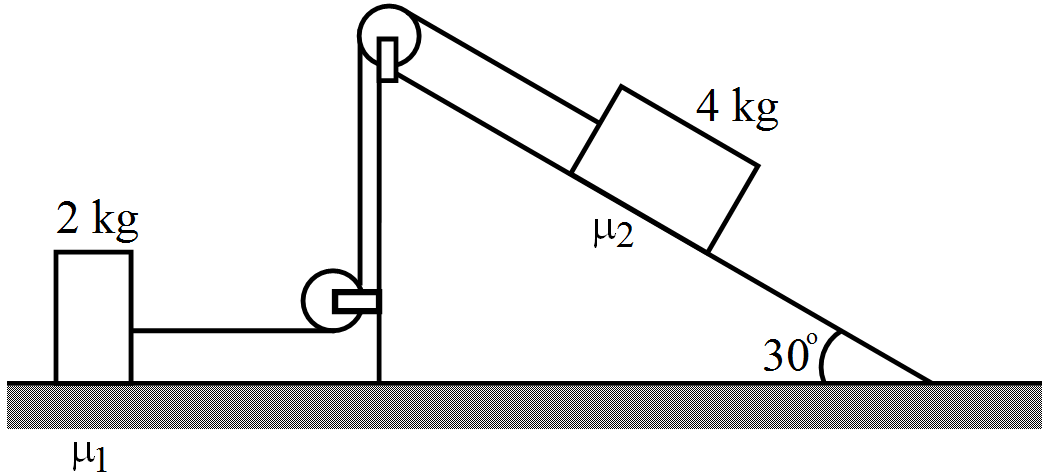
If the tension in the string in figure is 16N and the acceleration of each block is 0.5m/s2, find the friction coefficients at the two contacts with the blocks.

10kg mass is attached to one end of a copper wire 3m long and 1mm in diameter. Calculate the lateral compression produced in it (Poisson's ratio is 0.25 and Young's modulus of the material of the wire is 12.5 × 10¹⁰N/ m2).
Define the following international units and supplementary units : (i) Meter (ii) Kilogram (iii) Second (iv) Ampere (v) Kelvin (vi) Candela (vii) Mole (viii) Radian (ix) Steradian.
A gun is mounted on a railroad car. The mass of the car, the gun, the shells and the operator is 50m where m is the mass of one shell. If the velocity of the shell with respect to the gun (in its state before firing) is 200m/s, what is the recoil speed of the car after the second shot? Neglect friction.
A progressive harmonic wave on a string is expressed as follow
$
y(x, t)=7.5 \sin (0.0050 x+12 t+\pi / 4)
$
(a) Find the speed at a point $x=1 cm$ on time $t=1$ sec. Is this speed is equal to the speed of wave propagation?
(b) Find the location of those points of the string whose tranverse displacement and speed are the same as that of the point located at $x=1 cm$ at times $t =2 s, 5 s$ and $11s.$
Read statement below carefully and state with reasons and examples, if it is true or false;
A particle in one-dimensional motion.
With positive value of acceleration must be speeding up.
A solid disc and a ring, both of radius 10cm are placed on a horizontal table simultaneously, with initial angular speed equal to 10 π rad s-1. Which of the two will start to roll earlier? The co-efficient of kinetic friction is $\mu_\text{k}=0.2$
  1. Define mean free path.
  2. Derive an expression for mean free path of a gas molecule.