Question
It is dangerous to connect the switch in the neutral wire. Explain your answer.

Answer

In case of excessive current, it is dangerous to connect the switch in the neutral wire.

Even if the fuse blows off due to excessive current and the current in the circuit would no longer be conducted, the appliance will still remain connected to the live wire of a very high potential.

In such a case, if a person touches the body of that appliance, he/she may suffer a fatal electric shock.

That is why it is highly dangerous to connect the switch with the neutral wire.

Need a full question paper?

Generate a complete, print-ready paper with questions like this in minutes — across 16+ boards, with answer keys.
Start Generating Free

Similar questions

State two dis-similarities and one similarity between a d.c. motor and an a.c. generator.
Two sets A and B of four bulbs each are glowing in two separate rooms. When one of the bulbs in set A is fused, the other three bulbs also cease to glow. But in set B, when one bulb fuses the other bulbs continue to glow. Explain the difference.
Prove that
Refractive index $=\frac{\text { Real depth }}{\text { Apparent depth }}$
(i) (a) What is meant by specific heat capacity of a substance?
(b) Why does the heat supplied to a substance during its change of state not cause any rise in its temperature?
(ii) A student performs the following experiment in order to calculate specific latent heat of fusion of ice. He takes a calorimeter of mass 5.0 g containing 50 g of water at $30^{\circ} C$. Into this calorimeter he adds 5 g of dry ice at $0^{\circ} C$. When all the ice melts the final temperature recorded by him is $20^{\circ} C$ ?
(a) What is the total quantity of water in the calorimeter at $20^{\circ} C$ ?
(b) What quantities of heat are released by water and calorimeter in attaining the temperature of $20{ }^{\circ} C$.
(c) What is the total amount of heat gained by the ice?
(d) Calculate the value of latent heat of fusion of ice from the above calculations.
[Take SHC of water $=4.2 Jg ^{-10} C ^{-1}$ and SHC of copper $=0.4 Jg ^{-10} C ^{-1}$ ]
(iii) (a) Define heat capacity of a substance.
(b) Write the SI unit of heat capacity.
(c) What is the relationship between heat capacity and specific heat capacity of a substance?
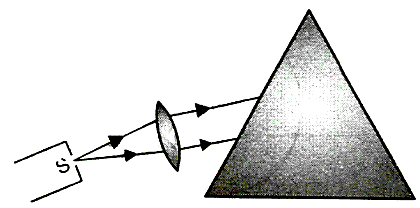
Fig shows part of the arrangement for obtaining pure spectrum.
(a) Complete thediagram and show how to obtain a pure spectrum.
(b) What are the conditions necessary for obtaining a pure spectrum?
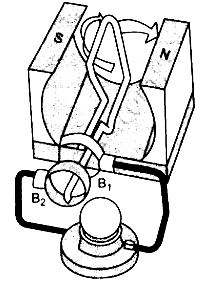
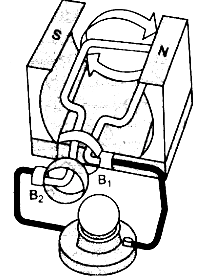
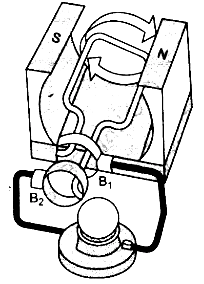
The given figures $1$ to $3$ show the working of a simple $A.C$. generator. Study the diagrams and answers of the following questions.


(i) State and explain the principle underlying the working of a simple generator.
(ii) Where is the loop of wire placed?
(iii) What happens when the loop is rotated?
(iv) Indicate the direction of the current flow through the wire for the first half of the turn (in first figure). Name and state the rule used in finding the direction of the current.
(v) Indicate the direction of the current for the case shown in second figure.
(vi) Indicate the direction of current in the outer circuit (i.e., electric bulb) in first and third figure.
(vii) What type of current is shown in the above diagrams? Explain.
(i) An electric bulb is rated $240 V-60 W$ and is working at $100 \%$ efficiency.
(a) Calculate the resistance of the bulb.
(b) If an identical bulb is connected in series with this bulb, then :
(i) Draw the circuit diagram.
(ii) What is the rate of conversion of energy in each bulb?
(iii) Total power used by the bulbs.
(ii) A family uses 2 light bulbs of 60 W , a fan of 120 W and a heater of 750 W an average of 8 hours a day. If the cost of electricity is ₹ 3.50 per unit, what is the daily expenditure of the family in a day?
(iii) A bulb is marked $150 W-220 V$ and an electric heater is marked $1500 W-220 V$.
(a) What is the ratio of resistance of these two devices?
(b) How does power rating of a device help you to select the type of connecting wire to be used?
(c) Which of the above devices needs thicker connecting wire?
Describe in brief how would you determine the approximate focal length of a convex lens.
A radioactive nucleus ${ }_{\mathrm{Z}}^{\mathrm{A}} \mathrm{X}$ first emits a beta particle and then an alpha particle to give the resulting nucleus ${ }_Q^P Y$ What will be the values of $P$ and $Q$ in terms of $A$ and $Z$ ?
Explain, why no tracks are left on the ice during ice skating?