Question
Explain, why no tracks are left on the ice during ice skating?

Answer

The weight of the body acts on a very small area of skate, in comparison to that of ice. Under this high pressure, ice melts to form water below 0°C. The water so formed makes the surface water skating more slippery. But as soon as the skater moves further, the water does not experience any pressure and re-freezes into ice leaving no track on ice surface.

Need a full question paper?

Generate a complete, print-ready paper with questions like this in minutes — across 16+ boards, with answer keys.
Start Generating Free

Similar questions

Three resistors each of 2Ω are connected together so that their total resistance is 3Ω. Draw a diagram to show this arrangement and check it by calculation.
Two unlike forces (parallel) of 10 N and 25 N act at a distance of 12 cm. from each other. Find the point about which the body balance.
Name three factors on which heat energy absorbed by a body depends and state how does it
depend on them.
A cell of e.m.f. ε and internal resistance 𝔯 sends current 1.0 A when it is connected to an external resistance 1.9Ω. But it sends current 0.5 A when it is connected to an external resistance 3.9 Ω.
Calculate the values of ε and 𝔯.
What do you understand by forced vibrations?
Write three conditions necessary to obtain a pure spectrum on a screen. Name the instrument in which the conditions stated by you are fulfilled.
A man stands in between two parallel cliffs and blows a whistle. He hears first echo after $0.6s$ and second echo after $2.4s$. Calculate the distance between cliffs.
[Speed of sound $= 336 m/s]$
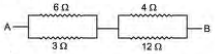
(i) (a) Find the equivalent resistance between A and B .
(b) State whether the resistivity of a wire changes with the change in the thickness of the wire.
(ii) (a) Write down differences between resistance and specific resistance.
(b) What does the slope of a V-I graph for a conductor represent.
(c) A corrent of 0.2 A flows through a conductor of resistance $4.5 \Omega$ Calculate the p.d. at the ends of the conductor.
Image
(iii) (a) Derive an expression for the current (I), when $n$ cells each of emf (E) and the internal resistance ( $r$ ) are connected in series to an external resistance $R$.
(b) State two conditions necessary to have maximum current in the external circuit when the cells are connected in series.
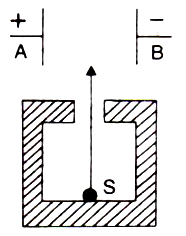
In following Figure shows a radioactive source S in a thick lead walled container having a narrow opening. The radiations pass through an electric field between the plates A and B.


(a) Complete the diagram to show the paths of α , β and γ radiations.
(b) Why is the source S kept in a thick lead walled container with a narrow opening?
(c) Name the radiation which is unaffected by the electrostatic field.
(d) Which radiation is defleced the most. Given reason.
(e) Which among the three radiations causes the least biological damage?
The following table gives the electrical appliances used, their power and the average time for which they are used each day in a home. Estimate the monthly electricity bill if the rate is 60 paise per unit.
Sr.no. Name Nos. Power rating Time/day
1 Bulb 4 100 W 7.5 hr
2 Fans 2 50 W 10 hr
3 T.V. 1 100 W 2 hr
4 Iron 1 500 W 1 hr
5 Electric stove 1 750 W 2 hr