Question
It is known that, if the interest is compounded continuously, the principal changes at the rate equal to the product of the rate of bank interest per annum and the principal. Let $P$ denotes the principal at any time $t$ and rate of interest be $r\%$ per annum.

Based on the above information, answer the following question.
  1. Find the value of $\frac{\text{dP}}{\text{dt}}.$
  1. $\frac{\text{Pr}}{1000}$
  2. $\frac{\text{Pr}}{100}$
  3. $\frac{\text{Pr}}{10}$
  4. $\text{Pr}$
  1. If $P_0$ be the initial principal, then find the solution of differential equation formed in given situation.
  1. $\log\Big(\frac{\text{P}}{\text{P}_0}\Big)=\frac{\text{rt}}{100}$
  2. $\log\Big(\frac{\text{P}}{\text{P}_0}\Big)=\frac{\text{rt}}{10}$
  3. $\log\Big(\frac{\text{P}}{\text{P}_0}\Big)=\text{rt}$
  4. $\log\Big(\frac{\text{P}}{\text{P}_0}\Big)=100\text{rt}$
  1. If the interest is compounded continuously at $5\%$ per annum, in how many years will $₹ 100$ double it self $?$
  1. $12.728$ years
  2. $14.789$ years
  3. $13.862$ years
  4. $15.872$ years
  1. At what interest rate will $₹ 100$ double itself in $10$ years$?\ (\log_\text{e}2 = 0.6931 ).$
  1. $9.66\%$
  2. $8.239\%$
  3. $7.341\%$
  4. $6.931\%$
  1. How much will $₹ 1000$ be worth at $5\%$ interest after $10$ years$?\ (e^{0.5} = 1.648).$
  1. $₹ 1648$
  2. $₹ 1500$
  3. $₹ 1664$
  4. $₹ 1572$

Answer

  1. $(b)\ \frac{\text{Pr}}{100}$
Solution:
Here, $P$ denotes the principal at any time $t$ and the rate of interest be $r\%$ per annum compounded continuously, then according to the law given in the problem, we get
$\frac{\text{dP}}{\text{dt}}=\frac{\text{Pr}}{100}$
  1. $(a)\ \log\Big(\frac{\text{P}}{\text{P}_0}\Big)=\frac{\text{rt}}{100}$
Solution:
We have, $\frac{\text{dP}}{\text{dt}}=\frac{\text{Pr}}{100}$
$\Rightarrow\frac{\text{dP}}{\text{P}}=\frac{\text{r}}{100}\text{dt}$
$\Rightarrow\int\frac{\text{1}}{\text{P}}\text{dP}=\frac{\text{r}}{100}\int\text{dt}$
$\Rightarrow\log\text{P}=\frac{\text{rt}}{100}+\text{C}...\text{(i)}$
$\text{At t}=0,\ \ \text{P}=\text{P}_0.$
$\therefore\ \ \text{C}=\log\text{P}_0$
So, $\log\text{P}=\frac{\text{rt}}{100}+\log\text{p}_0$
$\Rightarrow\log\Big(\frac{\text{P}}{\text{P}_0}\Big)=\frac{\text{rt}}{100}...\text{(ii)}$
  1. $(c)\ 13.862$ years
Solution:
We have, $r = 5, P_{0 }= ₹ 100$ and $P = ₹ 200 = 2P_0 $
Substituting these values in $(2),$ we get
$\log2=\frac{5}{100}\text{t}$
$\Rightarrow\text{t}=20\log_\text{e}$
$2 = 20 \times 0.6931\ \text{years} = 13.862\ \text{years}$
  1. $(d)\ 6.931\%$
Solution:
We have,
$P_0 = ₹ 100, P = ₹ 200 = 2P_0$​​​​​​​ and $t = 10$ years Substituting these values in $(2),$ we get
$\log2\frac{10\text{r}}{100}\Rightarrow\text{r}=10\log2=10\times0.6931=6.931$
  1. $(a)\ ₹ 1648$
Solution:
We have $P_0 = ₹ 1000, r = 5$ and $t = 10$ Substituting these values in $(2),$ we get
$\log\Big(\frac{\text{P}}{1000}\Big)=\frac{5\times10}{100}=\frac{1}{2}=0.5$
$\Rightarrow\frac{\text{P}}{1000}=\text{e}^{0.5}$
$\Rightarrow\text{ P} = 1000 × 1.648 = ₹ \ 1648$

Need a full question paper?

Generate a complete, print-ready paper with questions like this in minutes — across 16+ boards, with answer keys.

Start Generating Free

Similar questions

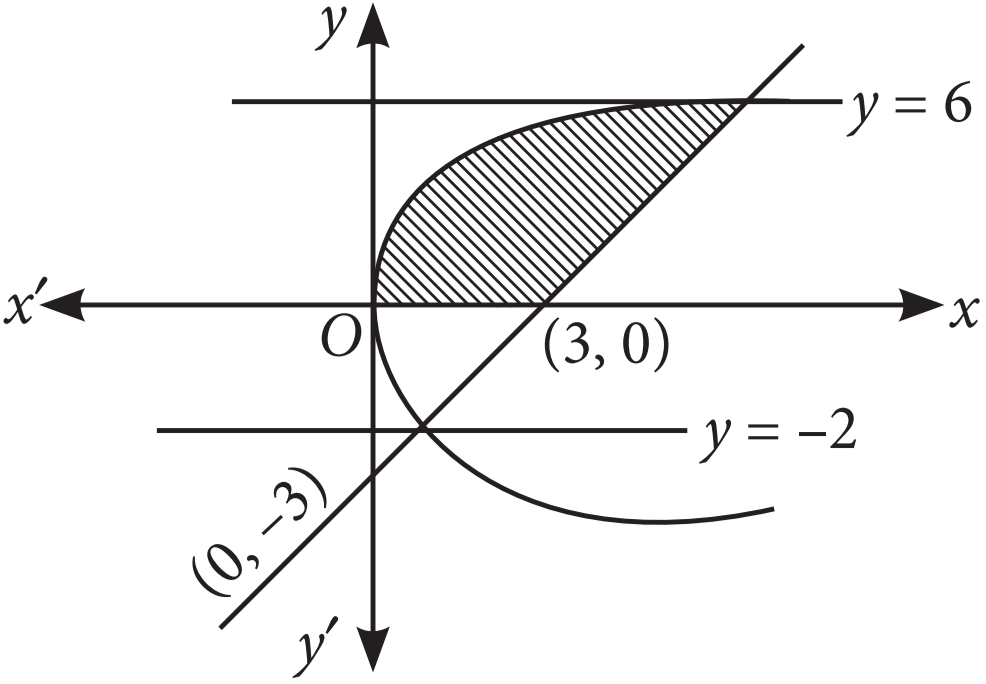
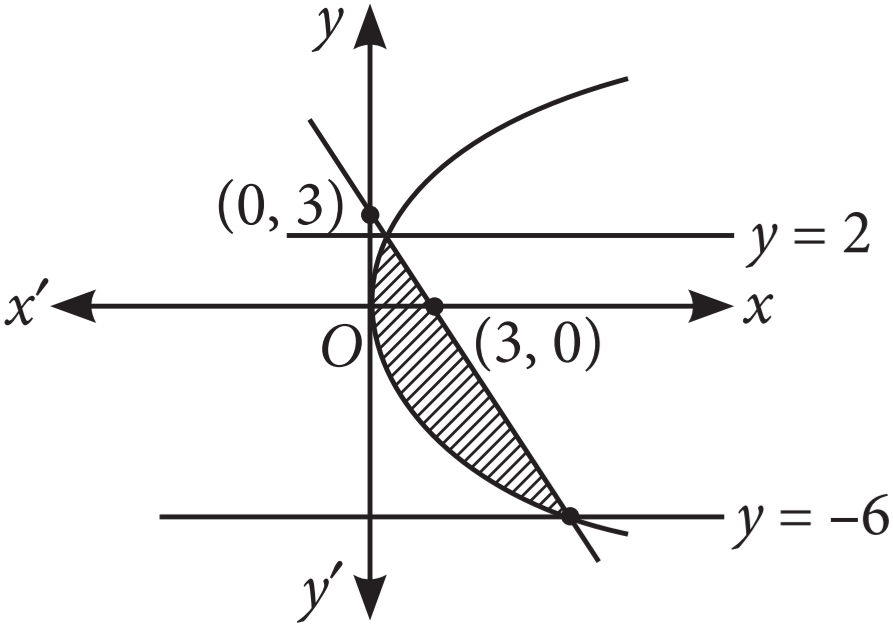
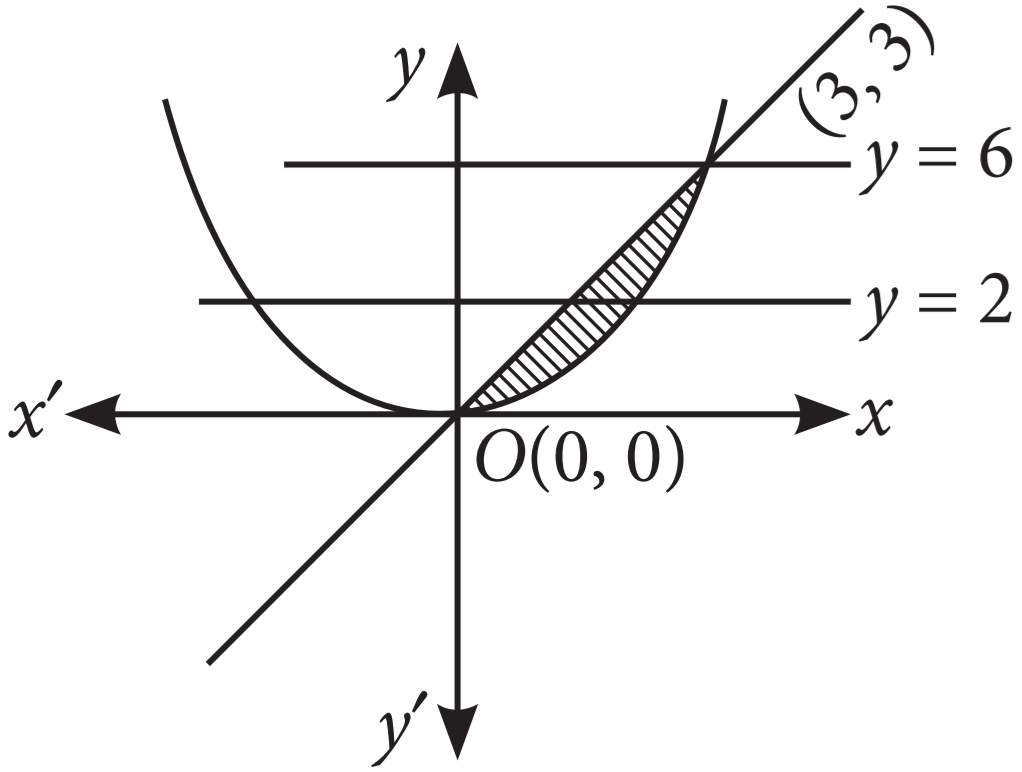
Consider the following equation of curve $y^2 = 4x$ and straight line $x + y = 3.$
Based on the above information, answer the following questions.
  1. The line $x + y = 3$ cuts the $x-$axis and $y-$axis respectively at.
  1. $(0, 2), (2, 0)$
  2. $(3, 3), (0, 0)$
  3. $(0, 3), (3, 0)$
  4. $(3, 0), (0, 3)$
  1. Point$(s)$ of intersection of two given curves is $($are$).$
  1. $(1, -2), (-9, 6)$
  2. $(2, 1), (-6, 9)$
  3. $(1, 2), (9, -6)$
  4. None of these.
  1. Which of the following shaded portion re present the area bounded by given curves?
    1. None of these
  1. Value of the integral $\int\limits_{-6}^{2}(3-\text{y})\text{ dy}$ is
  1. $10$
  2. $20$
  3. $30$
  4. $40$
  1. Value of area bounded by given curves is.
  1. $56\text{ sq.units}$
  2. $\frac{63}{5}\text{ sq. units}$
  3. $\frac{64}{3}\text{ sq. units}$
  4. $31\text{ sq.units}$
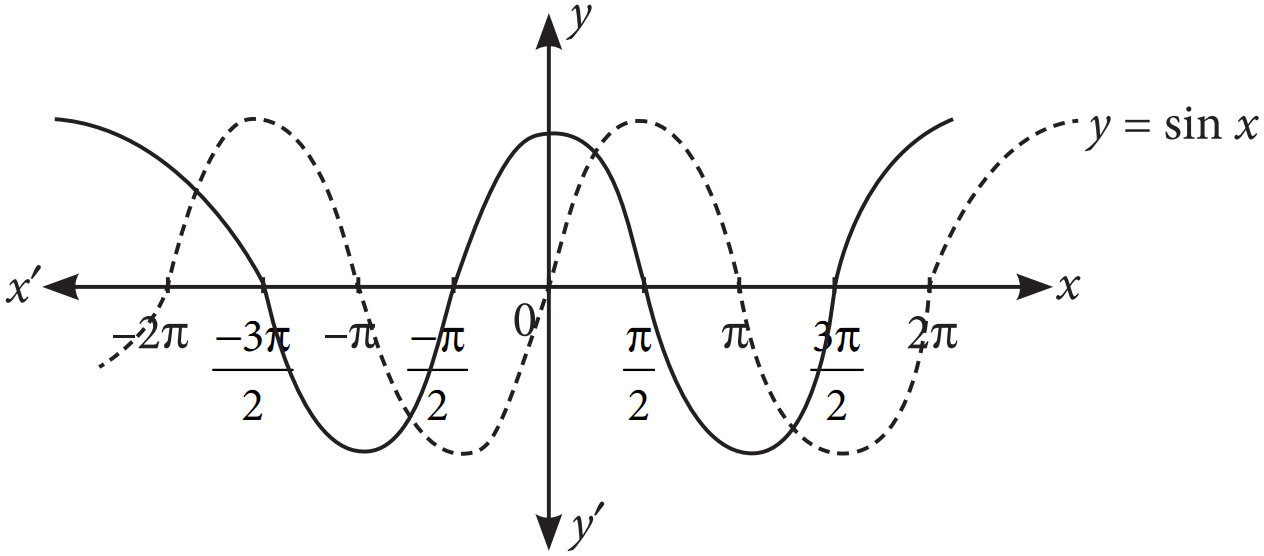
In a classroom, teacher explains the properties of a particular curve by saying that this particular curve has beautiful up and downs. It starts at 1 and heads down until $\pi$ radian, and then heads up again and closely related to sine function and both follow each other, exactly $\frac{\pi}{2}$ radians apart as shown in figure.

Based on the above information, answer the following questions.
  1. Name the curve, about which teacher explained in the classroom.
  1. Cosine
  2. Sine
  3. Tangent
  4. Cotangent
  1. Area of curve explained in the passage from 0 to $\frac{\pi}{2}$ is.
  1. $\frac{1}{3}\text{ sq.unit}$
  2. $\frac{1}{2}\text{ sq.unit}$
  3. ${1}\text{ sq.unit}$
  4. ${2}\text{ sq.units}$
  1. Area of curve discussed in classroom from $\frac{\pi}{2}$ to $\frac{3\pi}{2}$ is.
  1. -2 sq. units
  2. 2 sq. units
  3. 3 sq. units
  4. -3 sq. units
  1. Area of curve discussed in classroom from $\frac{3\pi}{2}$ to $2\pi$ is.
  1. 1 sq. unit
  2. 2 sq. units
  3. 3 sq. units
  4. 4 sq. units
  1. Area of explained curve from 0 to $2\pi$ is.
  1. 1 sq. unit
  2. 2 sq. units
  3. 3 sq. units
  4. 4 sq. units
Corner points of the feasible region for an LPP are (0, 3), (5, 0), (6, 8), (0, 8). Let Z = 4x - 6y be the objective function. Based on the above information, answer the following questions.
  1. The minimum value of Z occurs at:
  1. (6, 8)
  2. (5, 0)
  3. (0, 3)
  4. (0, 8)
  1. Maximum value of Z occurs at:
  1. (5, 0)
  2. (0, 8)
  3. (0, 3)
  4. (6, 8)
  1. Maximum of Z - Minimum of Z =
  1. 58
  2. 68
  3. 78
  4. 88
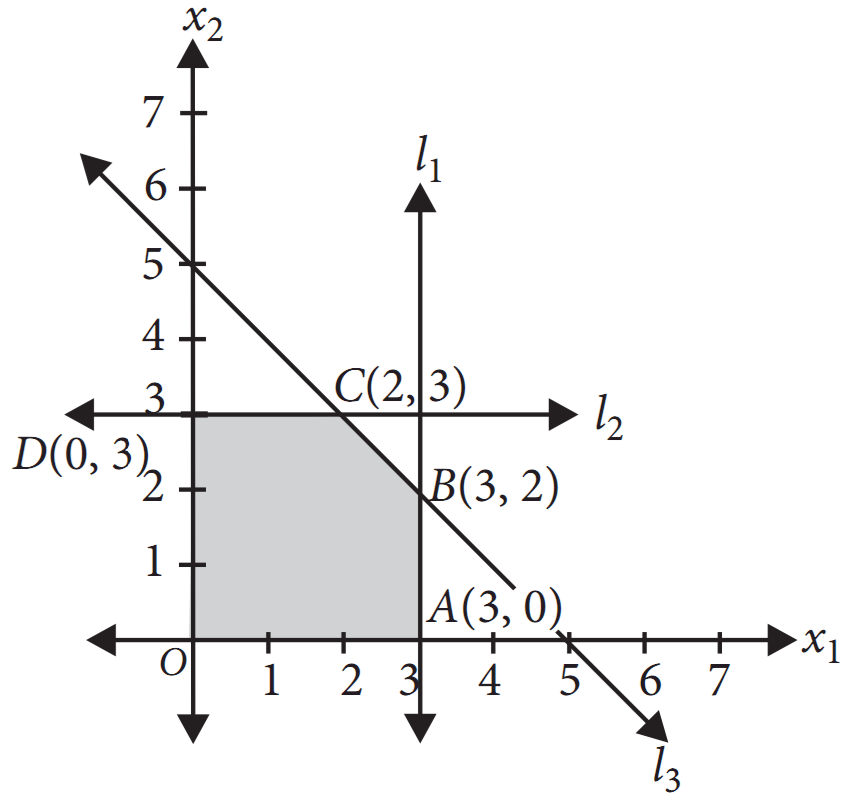
  1. The corner points of the feasible region determined by the system of linear inequalities are:
  1. (0, 0), (-3, 0), (3, 2). (2, 3)
  2. (3, 0), (3, 2), (2, 3), (0, -3)
  3. (0, 0), (3, 0), (3, 2), (2, 3), (0, 3)
  4. None of these
  1. The feasible solution of LPP belongs to:
  1. First and second quadrant.
  2. First and third quadrant.
  3. Only second quadrant.
  4. Only first quadrant.
Read the following text carefully and answer the questions that follow :
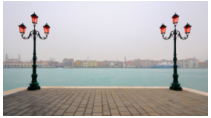
In a street two lamp posts are $600$ feet apart. The light intensity at a distance d from the first $($stronger$)$ lamp post. $\frac{1000}{d^2}$ the light intensity at distance d from the second $($weaker$)$ lamp post is $\frac{125}{d^2} \ ($in both cases the light intensity is inversely proportional to the square of the distance to the light source$)$. The combined light intensity is the sum of the two light intensities coming from both lamp posts.
Image
i. If $l\ (x)$ denotes the combined light intensity, then find the value of $x$ so that $I\ (x)$ is minimum.
ii. Find the darkest spot between the two lights.
iii. If you are in between the lamp posts, at distance $x$ feet from the stronger light, then write the combined light intensity coming from both lamp posts as function of $x$ .
OR
Find the minimum combined light intensity ?
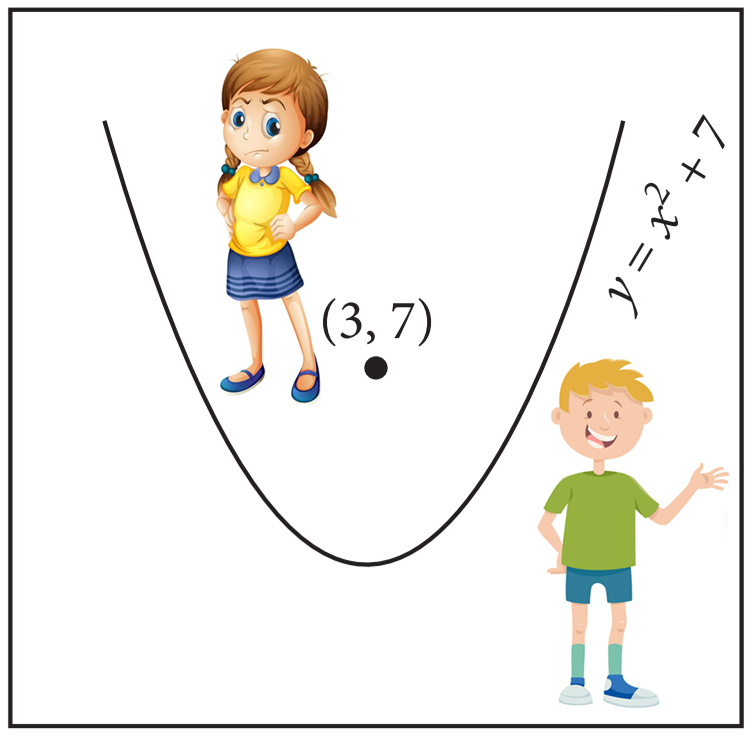
A student Arun is running on a playground along the curve given by $y = x^2 + 7.$ Another student Manila standing at point $(3, 7)$ on playground wants to hit Arun by paper ball when Arun is nearest to Manila.

Based on above information, answer the following questions.
  1. Arun's position at any value of $x$ will be.
  1. $(x^2, y - 7)$
  2. $(x^2, y + 7)$
  3. $(x, x^2 + 7)$
  4. $(x^2, x - 7)$
  1. Distance $($say $D)$ between Arun and Manila will be.
  1. $(\text{x}-1)(2\text{x}^2+2\text{x}+3)$
  2. $(\text{x}-3)^2+\text{x}^4$
  3. $\sqrt{(\text{x}-3)+\text{x}^4}$
  4. $\sqrt{(\text{x}-1)(2\text{x}^2+2\text{x}+3)}$
  1. For which real value$(s)$ of $x,$ first derivative of $D^2 w.r.t, x$ will Vanish?
  1. $1$
  2. $2$
  3. $3$
  4. $4$
  1. Find the position of Arun when Manila will hit the paper hall.
  1. $(5, 32)$
  2. $(1, 8)$
  3. $(3, 7)$
  4. $(3, 16)$
  1. The minimum value of $D$ is.
  1. $3$
  2. $\sqrt{3}$
  3. $5$
  4. $\sqrt{5}$
Linear programming is a method for finding the optimal values (maximum or minimum) of quantities subject to the constraints when relationship is expressed as linear equations or inequations. Based on the above information, answer the following questions.
  1. The optimal value of the objective function is attained at the points:
  1. On X-axis.
  2. On Y-axis.
  3. Which are comer points of the feasible region.
  4. None of these.
  1. The graph of the inequality 3x + 4y < 12 is:
  1. Half plane that contains the origin.
  2. Half plane that neither contains the origin nor the points of the line 3x + 4y = 12.
  3. Whole XOY-plane excluding the points on line 3x + 4y = 12.
  4. None of these.
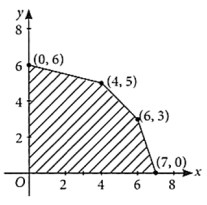
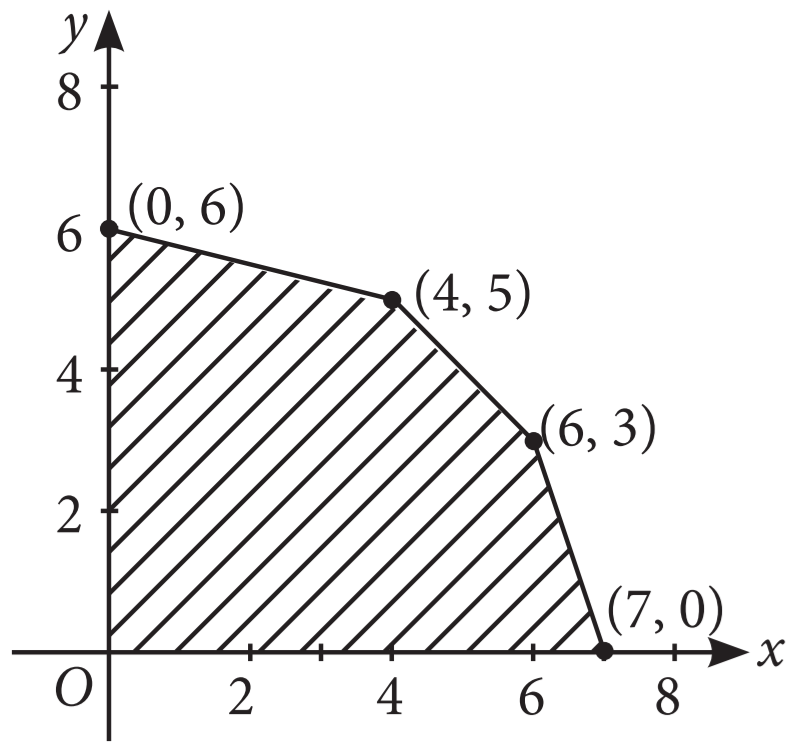
  1. The feasible region for an LPP is shown in the figure. Let Z = 2x + 5y be the objective function. Maximum of Z occurs at:
  1. (7, 0)
  2. (6, 3)
  3. (0, 6)
  4. (4, 5)
  1. The corner points of the feasible region determined by the system of linear constraints are (0, 10), (5, 5), (15, 15), (0, 20). Let Z = px + qy, where p, q > 0. Condition on p and q so that the maximum of Z occurs at both the points ( 15, 15) and (0, 20) is:
  1. p = q
  2. p = 2q
  3. q = 2p
  4. q = 3p
  1. The comer points of the feasible region determined by the system of linear constraints are (0, 0), (0, 40), (20, 40), (60, 20), (60, 0). The objective function is Z = 4x + 3y.
Compare the quantity in Column A and Column B
Column A
Column B
Maximum of Z
325
  1. The quantity in column A is greater.
  2. The quantity in column Bis greater.
  3. The two quantities are equal.
  4. The relationship cannot be determined on the basis of the information supplied.
A football match is organised between students of class XII of two schools, say school A and school B. For which a team from each school is chosen. Remaining students of class XII of school A and Bare respectively sitting 
on the plane represented by the equation$ \vec{\text{r}}.(\hat{\text{i}}+\hat{\text{j}}+\hat{2\text{k}})=5$ and $ \vec{\text{r}}.(\hat{2\text{i}}-\hat{\text{j}}+\hat{\text{k}})=6$ to cheer up the team of their respective schools. 
Based on the above information, answer the following questions. 
  1. The cartesian equation of the plane on which students of school A are seated is:
  1. 2x - y + z = 8
  2. 2x + y + z = 8
  3. x + y + 2z = 5
  4. x + y + z = 5
  1. The magnitude of the normal to the plane on which students of school Bare seated, is:
  1. $\sqrt{5}$
  2. $\sqrt{6}$
  3. $\sqrt{3}$
  4. $\sqrt{2}$
  1. The intercept form of the equation of the plane on which students of school Bare seated is:
  1. $\frac{\text{x}}{6}+\frac{\text{y}}{6}+\frac{\text{z}}{6}=1$
  2. $\frac{\text{x}}{3}+\frac{\text{y}}{(-6)}+\frac{\text{z}}{6}=1$
  3. $\frac{\text{x}}{3}+\frac{\text{y}}{6}+\frac{\text{z}}{6}=1$
  4. $\frac{\text{x}}{3}+\frac{\text{y}}{6}+\frac{\text{z}}{3}=1$
  1. Which of the following is a student of school B?
  1. Mohit sitting at (1, 2, 1)
  2. Ravi sitting at (0, 1, 2)
  3. Khushi sitting at (3, 1, 1)
  4. Shewta sitting at (2, -1, 2)
  1. The distance of the plane, on which students of school Bare seated, from the origin is:
  1. 6 units
  2. $\frac{1}{\sqrt{6}}\text{ units}$
  3. $\frac{5}{\sqrt{6}}\text{ units}$
  4. $\sqrt{6}\text{ units}$
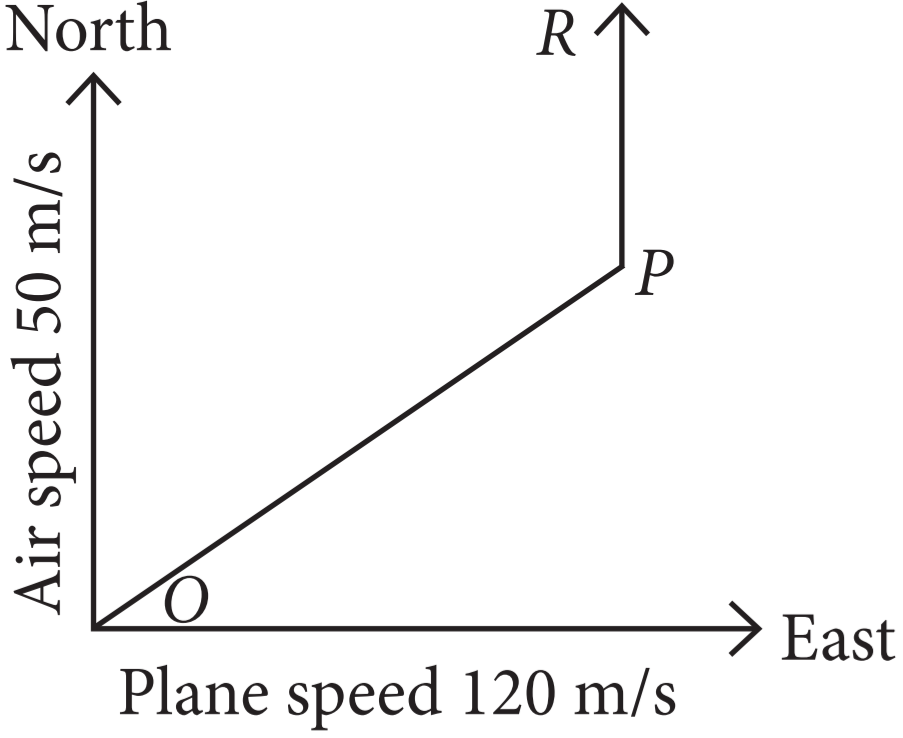
A plane started from airport situated at O with a velocity of 120m/s towards east. Air is blowing at a velocity of 50m/ s towards the north as shown in the figure.
The plane travelled 1hr in OP direction with the resultant velocity. From P to R the plane travelled 1hr keeping velocity of 120m/s and finally landed at R.

Based on the above information, answer the following questions.
  1. What is the resultant velocity from O to P?
  1. 100m/ s
  2. 130m/ s
  3. 126m/ s
  4. 180m/ s
  1. What is the direction of travel of plane from O to P with East?
  1. $\tan^{-1}\Big(\frac{5}{12}\Big)$
  2. $\tan^{-1}\Big(\frac{12}{3}\Big)$
  3. 50
  4. 80
  1. What is the displacement from O to P?
  1. 600km
  2. 468km
  3. 532km
  4. 500km
  1. What is the resultant velocity from P to R?
  1. 120m/ s
  2. 70m/ s
  3. 170m/ s
  4. 200m/ s
  1. What is the displacement from P to R?
  1. 450km
  2. 532km
  3. 610km
  4. 612km
Three slogans on chart papers are to be placed on a school bulletin board at the points A, Band C displaying A (Hub of Learning), B (Creating a better world for tomorrow) and C (Education comes first). The coordinates of these points are (1, 4, 2), (3, -3, -2) and (-2, 2, 6) respectively.

Based on the above information, answer the following questions.
  1. Let $\vec{\text{a}},\vec{\text{b}}$ and $\vec{\text{c}}$ be the position vectors of points A, B and C respectively, then $\vec{\text{a}}+\vec{\text{b}}+\vec{\text{c}}$ is equal to:
  1. $2\hat{\text{i}}+3\hat{\text{j}}+6\hat{\text{k}}$
  2. $2\hat{\text{i}}-3\hat{\text{j}}-6\hat{\text{k}}$
  3. $2\hat{\text{i}}+8\hat{\text{j}}+3\hat{\text{k}}$
  4. $2(7\hat{\text{i}}+8\hat{\text{j}}+3\hat{\text{k}})$
  1. Which of the following is not true?
  1. $\overline{\text{AB}}+\overline{\text{BC}}+\overline{\text{CA}}=\vec{0}$
  2. $\overline{\text{AB}}+\overline{\text{BC}}-\overline{\text{AC}}=\vec{0}$
  3. $\overline{\text{AB}}+\overline{\text{BC}}-\overline{\text{CA}}=\vec{0}$
  4. $\overline{\text{AB}}-\overline{\text{CB}}+\overline{\text{CA}}=\vec{0}$
  1. Area of $\triangle\text{ABC}$ is:
  1. 19 sq. units
  2. $\sqrt{1937}\text{sq}.\text{units}$
  3. $\frac{1}{2}\sqrt{1937}\text{sq}.\text{units}$
  4. $\sqrt{1837}\text{sq}.\text{units}$
  1. Suppose, if the given slogans are to be placed on a straight line, then the value of $|\vec{\text{a}}\times\vec{\text{b}}+\vec{\text{b}}\times\vec{\text{c}}+\vec{\text{c}}\times\vec{\text{a}}|$ will be equal to:
  1. -1
  2. -2
  3. 2
  4. 0
  1. If $\vec{\text{a}}=2\hat{\text{i}}+3\hat{\text{j}}+6\hat{\text{k}},$ then unit vector in the direction of vector $\vec{\text{a}}$ is:
  1. $\frac{2}{7}\hat{\text{i}}-\frac{3}{7}\hat{\text{j}}-\frac{6}{7}\hat{\text{k}}$
  2. $\frac{2}{7}\hat{\text{i}}+\frac{3}{7}\hat{\text{j}}+\frac{6}{7}\hat{\text{k}}$
  3. $\frac{3}{7}\hat{\text{i}}+\frac{2}{7}\hat{\text{j}}+\frac{6}{7}\hat{\text{k}}$
  4. None of these