MCQ
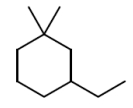
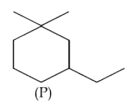
$IUPAC$ name of following compound $(\mathrm{P})$ is 
  • A
    $1-$Ethyl$-5,$ $5-$dimethylcyclohexane
  • $3-$Ethyl$-1$,$1-$dimethylcyclohexane
  • C
    $1-$Ethyl$-3$, $3-$dimethylcyclohexane
  • D
    $1$,$1-$Dimethyl$-3-$ethylcyclohexane

Answer

Correct option: B.
$3-$Ethyl$-1$,$1-$dimethylcyclohexane
b
$image$

$3-$ $1,$ dimenthylcyclohexane

Need a full question paper?

Generate a complete, print-ready paper with questions like this in minutes — across 16+ boards, with answer keys.
Start Generating Free

Similar questions

According to molecular orbital theory, the number of unpaired electron(s) in $\mathrm{O}_{2}^{2-}$ is :
A certain electronic transition from an excited state to the ground state of the $H_2$ atom  in one or more steps gives rise to four lines in the ultra violet region of the  spectrum, how many lines does this transition produce in the infrared region of the spectrum :-
At $300\, K$ and $1\, atm,\, 15\, mL$ of a gaseous hydrocarbon requires $375\, mL$ air containing $20\%\,\, O_2$ by volume for complete combustion. After combustion the gases occupy $330\, mL.$ Assuming that the water formed is in liquid form and the volumes were measured at the same temperature and pressure, the formula of the hydrocarbon is :
What is the correct $IUPAC$ name for  $C{{H}_{3}}-\underset{C{{H}_{3}}}{\mathop{\underset{|\,\,\,\,}{\mathop{\overset{H\,\,\,}{\mathop{\overset{|\,\,\,\,\,}{\mathop{C-}}\,}}\,}}\,}}\,CH=CH-C{{H}_{2}}-\overset{O\,\,\,\,}{\mathop{\overset{||\,\,\,\,}{\mathop{C-}}\,}}\,OH$
Molecular shapes of $SF_4 , CF_4$ and $XeF_4$ are
The ionization enthalpy of hydrogen atom is $1.312 \times 10^6\, J\, mol^{-1}.$ The energy required to excite the electron in the atom from $n= 1$ to $n=2$ is
The molar heat capacity of water at constant pressure is $75$ $J{K^{ - 1}}\,\,mo{l^{ - 1}}$. When $1.0 \,kJ $ of heat is supplied to $100\, g$ of water which is free to expand, the increases in temperature of water is
The $pH$ of $0.1\,\, M$ solution of the following salts increases in the order
The electronic configuration $1 s^2 2 s^2 2 p ^6 3 s^2 3 p ^6$ $3 d^5 4 s^1$ of any element represents :
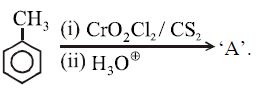
Product $A$ in the reaction will be