MCQ
IUPAC name of Na3[Co(ONO)6] is:
- ASodium cobaltinitrite
- BSodium hexanitritocobaltate (III)
- CSodium hexanitrocobalt (III)
- DSodium hexanitritocobaltate (II)
Explanation:
The above complex Na3[Co(ONO)6] has two ions: Na+ and a complex ion which is negatively charged [Co(ONO)6]3−
According to the rules, name of the positive ion comes first (i.e., sodium), do not mention the number of sodium as it is not present in a square bracket.
After naming the positive ion, next will be the negative ion, Now in this example, the negative ion is a complex compound, which contain's 'metal' and 'ligand'.
While naming a complex, name of ligand comes first, also mention the number of ligand by using prefix (di, tri, tetra. etc..) and if a bidentate ligand is present then mention the atom which is attached to central metal (i.e., hexanitrito −O−) followed by name of metal with the ending 'ate' (i.e., cobaltate, always use the word 'ate' if the complex is negatively charge) and than oxidation number of metal.
To show the oxidation state, we use Roman numerals inside parenthesis.
Generate a complete, print-ready paper with questions like this in minutes — across 16+ boards, with answer keys.
$RCOOAg \xrightarrow{{B{r_2}/\Delta }} R-Br$
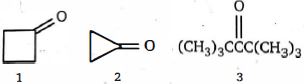
which one of the following acid will give maximum yield of $R-Br$ in the above reaction?
Reason : Cerium salts are used as catalyst in petroleum cracking.
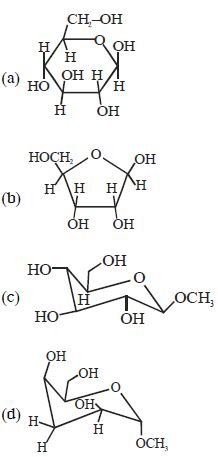
Glucose, Mannose, Galactose, $\alpha -$ Glucose, $\beta -$ Glucose
$(K)\,\, (L)\,\, (M)\,\, (N)\,\, (O)$
Correct set of epimer and anomer is respectivley
Epimer - Anomer