MCQ
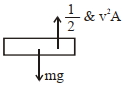
Karman line is a theoretical construct that separates the earth's atmosphere from outer space. It is defined to be the height at which the lift on an aircraft flying at the speed of a polar satellite $(8 \,km / s )$ is equal to its weight. Taking a fighter aircraft of wing area $30 \,m ^2$, and mass $7500 \,kg$, the height of the Karman line above the ground will be in the range .............. $km$ (assume the density of air at height $h$ above ground to be $\rho( h )=1.2 e ^{\frac{ h }{10}} \,kg / m ^3$ where $h$ is in $km$ and the lift force to be $\frac{1}{2} \rho v^2 A$, where $v$ is the speed of the aircraft and $A$ its wing area).
  • A
    $25-50$
  • $75-100$
  • C
    $125-150$
  • D
    $175-200$

Answer

Correct option: B.
$75-100$
b
(B)

For equilibrium :

$mg ^{\prime}=\frac{1}{2} \rho v ^2 A$

$mg \left(1-\frac{2 h }{ R }\right)=\frac{1}{2} \times 1.2 e ^{-\frac{ h }{10}} v ^2 A$

$\Rightarrow 7500 \times 9.8\left(1-\frac{2 h }{ R }\right)=0.6 e ^{-\frac{ h }{10}}\left(8 \times 10^3\right)^2 \times 30$

$\downarrow$ Neglect this term for a while and we get $h \simeq 95 \,km$

So, with $\left(1-\frac{2 h}{R}\right)$, we will get little lesser value or $h$.

$\therefore(B)$ is the answer.

Need a full question paper?

Generate a complete, print-ready paper with questions like this in minutes — across 16+ boards, with answer keys.

Start Generating Free

Similar questions

A small block slides down on a smooth inclined plane, starting from rest at time $t=0 .$ Let $S_{n}$ be the distance travelled by the block in the interval $\mathrm{t}=\mathrm{n}-1$ to $\mathrm{t}=\mathrm{n} .$ Then, the ratio $\frac{\mathrm{S}_{\mathrm{n}}}{\mathrm{S}_{\mathrm{n}+1}}$ is
Radius of an air bubble at the bottom of the lake is $r$  and it becomes $ 2r $ when the air bubbles rises to the top surface of the lake. If $P $ $cm$  of water be the atmospheric pressure, then the depth of the lake is
A couple is acting on a two particle systems. The resultant motion will be:
A disc of radius $R$ and thickness $\frac {R}{6}$ has moment of inertia $I$ about an axis passing through its centre and perpendicular to its plane. Disc is melted and recast into a solid sphere. The moment of inertia of a sphere about its diameter is
Work done per mol in an isothermal change is
A thin circular ring of mass $M$ and radius $R$ is rotating about its axis with a constant angular velocity $\omega$.  Four objects each of mass $m$, are kept gently to the opposite ends of two perpendicular diameters of the ring. The angular velocity of the ring will be 
Given below are two statements: One is labelled as Assertion $(A)$ and the other is labelled as Reason $(R)$.

Assertion $(A)$: Clothes containing oil or grease stains cannot be cleaned by water wash.

Reason $(R)$: Because the angle of contact between the oil/ grease and water is obtuse. In the light of the above statements, choose the correct answer from the option given below.

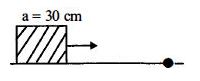
A cubical block of side $30\,cm$  is moving with  velocity $2\,\,ms^{-1}$ on a smooth horizontal surface. The surface has a bump at a point $O$ as shown in figure. The angular velocity (in rad/s) of the block immediately after it hits the bump, is
Three vectors $\vec{\text{A}},\ \vec{\text{B}}$ and $\vec{\text{C}}$ add up to zero. Find which is false.
The unit of thermal conductivity is