MCQ
Km​ of enzyme is:
  • A
    The substrate concentration at 1/2 of maximum velocity of enzyme action.
  • B
    The substrate concentration at maximum velocity of enzyme action.
  • C
    Half of maximum velocity of enzyme at unit substrate concentration at infinite velocity of enzyme action.
  • D
    Substrate concentration at infinite velocity of enzyme action.
Answer

  1. The substrate concentration at 1/2 of maximum velocity of enzyme action.

Explanation:

The Michaelis Menten constant is the substrate concentration at which the reaction rate is one half the maximum. 

The Km​ describes the affinity of enzyme for a substrate molecule.

Greater the affinity lower is the Km​ value and sooner the Vmax​ can be attained and vice versa.

Need a full question paper?

Generate a complete, print-ready paper with questions like this in minutes — across 16+ boards, with answer keys.

Start Generating Free

Similar questions

Barium ions, CN− and Co2+ form an ionic complex. If that complex is supposed to be 75% ionised in water with vant Hoff factor 'i' equal to four, then the coordination number of Co2+ in the complex can be.
 IUPAC name of the given compound is:
$\text{H}_3\text{C}\text{−C​H}−\text{CH}_2\text{−C​H}\text{−C​H}​−\text{CH}_2−\text{CH}_3\\ \ \ \ \ \ \ \ \ \ \ \ \ \ | \ \ \ \ \ \ \ \ \ \ \ \ \ \ \ \ \ \ \ \ | \ \ \ \ \ \ \ \ | \\ \ \ \ \ \ \ \ \ \ \ \ \ \text{OH} \ \ \ \ \ \ \ \ \ \ \ \ \ \text{OH} \ \ \ \ \text{C}_2\text{O}_5$
Oil and fats are which class of compound?
Which of the following is halogen exchange reaction?
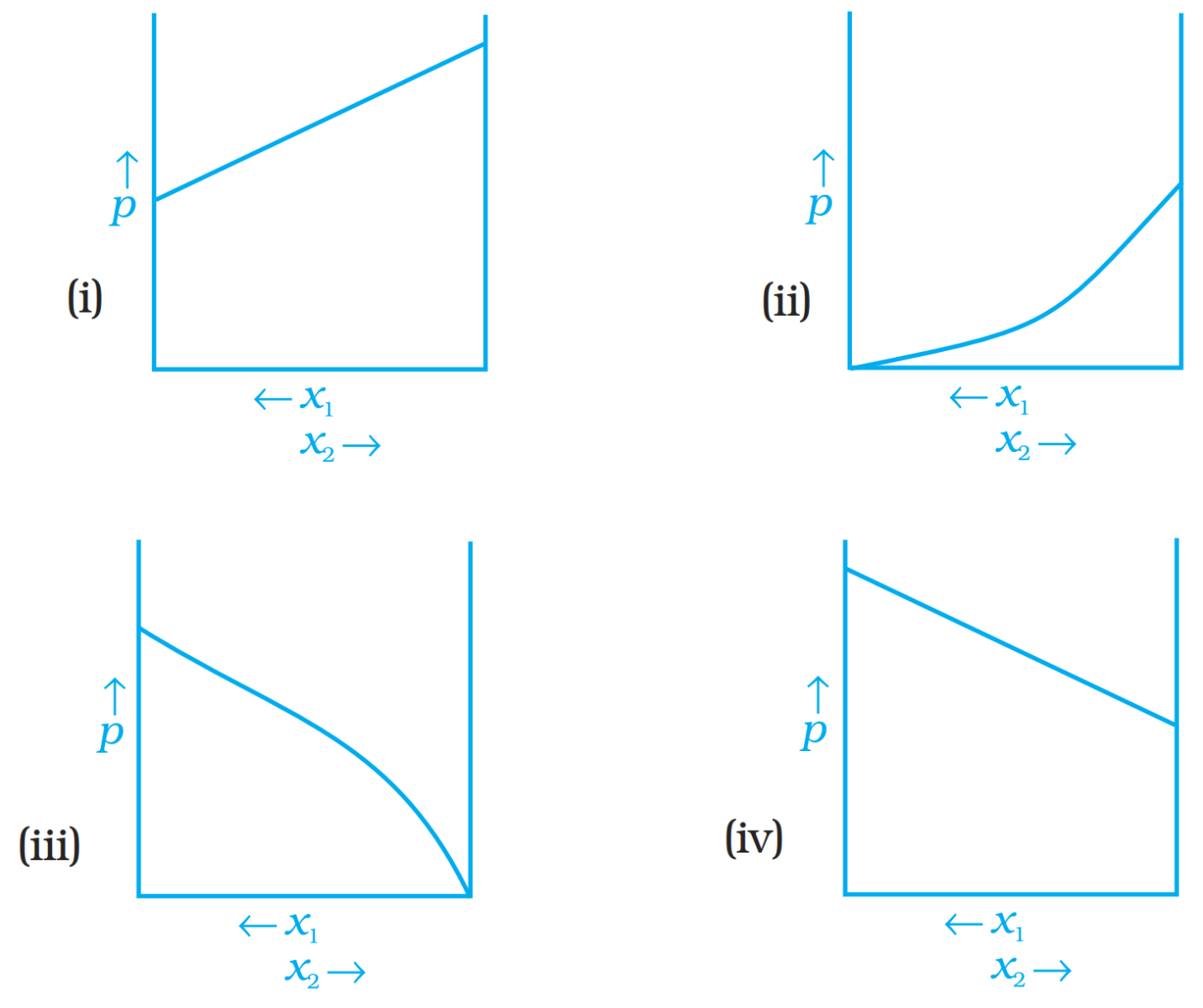
For a binary ideal liquid solution, the variation in total vapour pressure versus composition of solution is given by which of the curves?

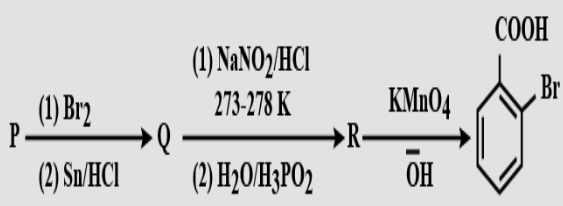
In the sequence of the given reactions, the starting compound P is:

The order of reactivity of following alcohols with halogen acids is ___________.

  1. $\text{CH}_3\text{CH}_2-\text{CH}_2-\text{OH}$

  2. $\text{CH}_3\text{CH}_2-\text{CH}-\text{OH}\\ \ \ \ \ \ \ \ \ \ \ \ \ \ \ \ \ \ \ \ \ \ | \\ \ \ \ \ \ \ \ \ \ \ \ \ \ \ \ \ \ \ \ \ \text{CH}_3$

  3. $\ \ \ \ \ \ \ \ \ \ \ \ \ \ \ \ \ \ \ \ \text{CH}_3 \\ \ \ \ \ \ \ \ \ \ \ \ \ \ \ \ \ \ \ \ \ \ |\ \ \ \ \ \ \ \ \ \ \ \ \ \ \ \ \ \ \ \ \ \\\text{CH}_3\text{CH}_2-\text{C}-\text{OH}\\ \ \ \ \ \ \ \ \ \ \ \ \ \ \ \ \ \ \ \ \ \ | \\ \ \ \ \ \ \ \ \ \ \ \ \ \ \ \ \ \ \ \ \ \text{CH}_3$

    Amongst the following, the most stable complex is :
    The reaction of alkyl halide with sodium alkoxide is :
