MCQ
$\text{LCD}$ stands for:
  • A
    Light Carrying Diode
  • Liquid Crystal Display
  • C
    Long Crystal Display
  • D
    Light Crystal Display

Answer

Correct option: B.
Liquid Crystal Display
$\text{LCD}$ stands for "Liquid Crystal Display".$\text{LCD}$ is a special thin flat panel that can let light go through it, or can block the light. $($Unlike an $\text{LED}$ it does not produce its own light$)$.
The panel is made up of several blocks, and each block can be in any shape. Each block is filled with liquid crystals that can be made clear or solid, by changing the electric current to that block.

Need a full question paper?

Generate a complete, print-ready paper with questions like this in minutes — across 16+ boards, with answer keys.
Start Generating Free

Similar questions

In an $AC$ circuit containing only capacitance, the current:
Five cells each of emf $E$ and internal resistance $r$ are connected in series. Due to oversight one cell is connected wrongly. The equivalent internal resistance of the combination is ........... $r$
A nucleus of masss $M$ emits $\gamma$-ray photon of frequency $'v'.$ The loss of internal energy by the nucleus is:
Assertion : When a tiny circular obstacle is placed in the path of light from some distance, a bright spot is seen at the centre of shadow of the obstacle.
Reason : Destructive interference occurs at the centre of the shadow.
The time period of oscillation of a magnet in a vibration magnetometer is $1.5$ seconds. The time period of oscillation of another magnet similar in size, shape and mass but having one-fourth magnetic moment than that of first magnet, oscillating at same place will be.....$sec$
Natural light from the sun is :
In Young’s double-slit experiment, an interference pattern is obtained on a screen by a light of wavelength $6000 Å$, coming from the coherent sources $S_1$ and $S_2$. At certain point $ P $ on the screen third dark fringe is formed. Then the path difference $S_1P$ -$S_2P$ in microns is
If an electron jumps from $1^{st}$ orbital to $3^{rd}$ orbital, then it will.
Three equal charges $+q$ are placed at the three vertices of an equilateral triangle centred at the origin. They are held in equilibrium by a restoring force of magnitude $F(r)=k r$ directed towards the origin, where $k$ is a constant. What is the distance of the three charges from the origin?
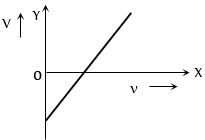
The stopping potential $V$ for photoelectric emission from a metal surface is plotted along $Y-$ axis and frequency $v$ of incident light along $X-$ axis. A straight line is obtained as shown. Planck's constant is given by