MCQ
Three equal charges $+q$ are placed at the three vertices of an equilateral triangle centred at the origin. They are held in equilibrium by a restoring force of magnitude $F(r)=k r$ directed towards the origin, where $k$ is a constant. What is the distance of the three charges from the origin?
  • A
    $\left[\frac{1}{6 \pi \varepsilon_0} \frac{q^2}{k}\right]^{1 / 2}$
  • $\left[\frac{\sqrt{3}}{12 \pi \varepsilon_0} \frac{q^2}{k}\right]^{1 / 3}$
  • C
    $\left[\frac{1}{6 \pi \varepsilon_{0}} \frac{q^2}{k}\right]^{2 / 3}$
  • D
    $\left[\frac{\sqrt{3}}{4 \pi \varepsilon_0} \frac{q^2}{k}\right]^{2 / 3}$
Answer

Correct option: B.
$\left[\frac{\sqrt{3}}{12 \pi \varepsilon_0} \frac{q^2}{k}\right]^{1 / 3}$
b
(b)

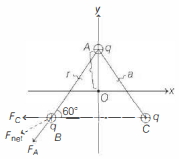
In given charge configuration,

Net force on any of charge is

$F_{\text {net }}=\sqrt{F_A^2+F_B^2+2 F_A F_B \cos 60^{0}}$

$=\frac{\sqrt{3} \cdot q^2}{4 \pi \varepsilon_{0} a^2}$

where, $a=$ side length of equilateral triangle.

So, radius $r$ is $r=\frac{2}{3}\left(\frac{\sqrt{3}}{2} a\right)$

$\Rightarrow \quad a=\sqrt{3} r$

$\text { Hence, } F_{\text {net }}=\frac{\sqrt{3} \cdot q^2}{\left(4 \pi \varepsilon_0\right) 3 r^2}$

or $F_{\text {net }}=\frac{q^2}{\left(4 \pi \varepsilon_0\right) \sqrt{3} r^2}$

Now, given that this force is balanced by a force $F(r)=k r$

$\therefore k r =\frac{q^2}{\left(4 \pi \varepsilon_0\right) \sqrt{3} r^2}$

$\Rightarrow r^3=\frac{\sqrt{3} q^2}{12 \pi \varepsilon_0 k}$

So, $\quad r=\left(\frac{\sqrt{3} q^2}{12 \pi \varepsilon_0 k}\right)^{\frac{1}{3}}$

Need a full question paper?

Generate a complete, print-ready paper with questions like this in minutes — across 16+ boards, with answer keys.

Start Generating Free

Similar questions

The temperature dependence of resistances of $Cu$ and undoped $Si$ in the temperature range $300-400\;K$, is best described by
The angle of minimum deviation measured with a prism is $30^o $ and the angle of prism is $60^o $. The refractive index of prism material is
When subjected to a transverse electric field, cathode rays move
A particle of mass $100\, gm$ and charge $2\, \mu C$ is released from a distance of $50\, cm$  from a fixed charge of $5\, \mu C$. Find the speed of the particle when its distance  from the  fixed charge becomes $3\, m$. Neglect any other force........$m/s$
The large scale destruction, that would be caused due to the use of nuclear weapons is called
Work function of lithium and copper are respectively $2.3 \ eV$ and $4.0 \ eV.$ Which one of the metal will be useful for the photoelectric cell working with visible light ? $\left(\mathrm{h}=6.6 \times 10^{-34} \mathrm{~J}-\mathrm{s}, \mathrm{c}=3 \times 10^8 \mathrm{~m} / \mathrm{s}\right)$
A piece of wood is floating in water kept in a bottle. The bottle is connected to an air pump. Neglect the compressibility of water. When more air is pushed into the bottle from the pump, the piece of wood will float with.
The reading of the ammeter as per figure shown is
The resistance of a rectangular block of copper of dimensions $2 \,mm \times 2 \,mm \times 5 \,m$ between two square faces is $0.02 \,\Omega$. What is the resistivity of copper?
Electron in a hydrogen atom is replaced by an identically charged particle muon with mass $207$ times that of electron. Now the radius of $K$ shell will be