MCQ
Lenz's law is a direct consequence of:
- AThe law of conservation of momentum.
- BThe law of conservation of charge.
- CThe law of conservation of energy.
- DThe law of conservation of emf.
Explanation:
Lenz's law states that the current induced in a circuit due to a change or a motion in a magnetic field is so directed as to oppose the change in flux.
We know that induced EMF produces a current that opposes the change in flux, because a change in flux means a change in energy.Energy can enter or leave, but not instantaneously. So, Lenz' law is a consequence of the law of conservation of energy.
Generate a complete, print-ready paper with questions like this in minutes — across 16+ boards, with answer keys.
A source of e.m.f. E = 15 V and having negligible internal resistance is connected to a variable resistance so that the current in the circuit increases with time as i = 1.2 t + 3. Then, the total charge that will flow in first five second will be
|
(a) 10 C |
(b) 20 C |
(c) 30 C |
(d) 40 C |
In Young's double slit experiment, if the two slits are illuminated with separate sources, no interference pattern is observed because
|
(a) There will be no constant phase difference between the two waves |
|
(b) The wavelengths are not equal |
|
(c) The amplitudes are not equal |
|
(d) None of the above |
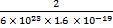
The Avogadro's number is 6  per gm mole and electronic charge is 1.6
  . The Faraday's number is
|
(a) |
(b) |
|
(c) |
(d) |
In the circuit shown here, what is the value of the unknown resistor R so that the total resistance of the circuit between points P and Q is also equal to R

|
(a) 3 ohms |
(b) |
(c) |
(d) 10 ohms |
The ratio of radii of nuclei  and
and  is 3 : 5. The number of neutrons in the nuclei of X will be
|
(a) 52 |
(b) 73 |
(c) 125 |
(d) 13 |
The transfer ratio of a transistor is 50. The input resistance of the transistor when used in the common-emitter configuration is 1 KW. The peak value for an A.C input voltage of 0.01 V peak is
|
(a) 100 mA |
(b) 0.01 mA |
(c) 0.25 mA |
(d) 500 mA |