Question
Let a source of alternating e.m.f. $\text{E} = \text{E}_\circ\sin\omega\text{t}$ be connected to a capacitor of capacitance C. If 'I' is the instantaneous value of current in the circuit at instant t, then $\text{I}=\frac{\text{E}_0}{\frac{1}{\omega\text{C}}}\sin\Big(\omega\text{t}+\frac{\pi}{2}\Big).$ The capacitive reactance limits the amplitude of current in a purely capacitive circuit and it is given by $\text{X}_\text{C}=\frac{1}{\omega\text{C}}.$
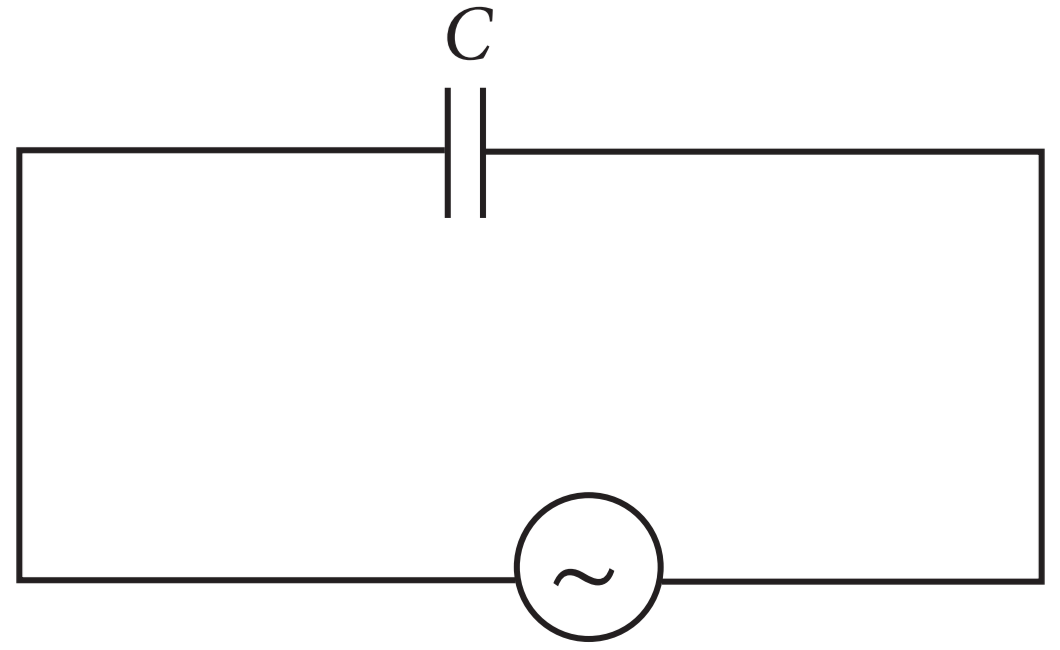
  1. What is the unit of capacitive reactance?
  1. Farad
  2. Ampere
  3. Ohm
  4. Ohm-1
  1. The capacitive reactance of a $5\mu\text{F}$ capacitor for a frequency of 106Hz is:
  1. $0.032\Omega$
  2. $2.52\Omega$
  3. $1.25\Omega$
  4. $4.51\Omega$
  1. In a capacitive circuit, resistance to the flow of current is offered by:
  1. Resistor
  2. Capacitor
  3. Inducto
  4. Frequency
  1. In a capacitive circuit, by what value of phase angle does alternating current leads the e.m.f?
  1. 45º
  2. 90º
  3. 75º
  4. 60º
  1. One microfarad capacitor is joined to a 200V, 50Hz alternator. The rrns current through capacitor is:
  1. 6.28 × 10⁻²A
  2. 7.5 × 10⁻⁴A
  3. 10.52 × 10⁻²A
  4. 15.25 × 10⁻²A

Answer

  1. (c) Ohm

Solution:

Ohm is the unit of capacitive reactance.

  1. (a) $0.032\Omega$

Solution:

Capacitive reactance, $\text{X}_\text{C}=\frac{1}{\omega\text{C}}=\frac{1}{2\pi\mu\text{C}}$

$=\frac{1}{2\pi\times10^6\times5\times10^{-6}}$

$=0.032\Omega$

  1. (b) Capacitor

Solution:

In capacitive circuit, resistance to the flow of current is offered by the capacitor.

  1. (b) 90º
  2. (a) 6.28 × 10⁻²A

Solution:

Current, $\text{l}_\text{v}=\frac{\text{E}_\text{V}}{\text{X}_\text{C}}=\frac{1}{\frac{1}{2\pi\mu\text{C}}}=(2\pi\mu\text{C})\text{E}_\text{V}$

$\text{I}_\text{v}=2\times3.14\times50\times10^{-6}\times200$

$=6.28 × 10^{-2}\text{A}$

Need a full question paper?

Generate a complete, print-ready paper with questions like this in minutes — across 16+ boards, with answer keys.

Start Generating Free

Similar questions

Why do marine animals live deep inside a lake when the surface of the lake freezes?
Microwave oven: The spectrum of electromagnetic radiation contains a part known as microwaves. These waves have frequency and energy smaller than visible light and wavelength larger than it. What is the principle of a microwave oven and how does it work? Our objective is to cook food or warm it up. All food items such as fruit, vegetables, meat, cereals, etc., contain water as a constituent. Now, what does it mean when we say that a certain object has become warmer? When the temperature of a body rises, the energy of the random motion of atoms and molecules increases and the molecules travel or vibrate or rotate with higher energies. The frequency of rotation of water molecules is about 2.45 gigahertz (GHz). If water receives microwaves of this frequency, its molecules absorb this radiation, which is equivalent to heating up water. These molecules share this energy with neighbouring food molecules, heating up the food. One should use porcelain vessels and non-metal containers in a microwave oven because of the danger of getting a shock from accumulated electric charges. Metals may also melt from heating. The porcelain container remains unaffected and cool, because its large molecules vibrate and rotate with much smaller frequencies, and thus cannot absorb microwaves. Hence, they do not get eaten up. Thus, the basic principle of a microwave oven is to generate microwave radiation of appropriate frequency in the working space of the oven where we keep food. This way energy is not wasted in heating up the vessel. In the conventional heating method, the vessel on the burner gets heated first and then the food inside gets heated because of transfer of energy from the vessel. In the microwave oven, on the other hand, energy is directly delivered to water molecules which is shared by the entire food.

(i) As compared to visible light microwave has frequency and energy
(a) Frequency is less but energy is more
(b) less than visible light
(c) more than visible light
(d) equal to visible light

(ii) When the temperature of a body rises
(a) the energy of the random motion of atoms and molecules decreases.
(b) the energy of the random motion of atoms and molecules remains same.
(c) the energy of the random motion of atoms and molecules increases
(d) the random motion of atoms and molecules becomes streamlined.

(iii) he frequency of rotation of water molecules is about
(a) 2.45 THz
(b) 2.45 kHz
(c) 2.45 MHz
(d) 2.45 GHz

OR

In the microwave oven
(a) Energy is directly delivered to the food grains.
(b) The vessel gets heated first and then the water molecules collect heat from the body of the vessel
(c) Energy is directly delivered to water molecules which is shared by the entire food
(d) The vessel gets heated first, and then the food grains inside

(iv) Why should one use porcelain vessels and non-metal containers in a microwave oven?
(a) Because it will prevent the food items to become hot
(b) Because it will get too much hot
(c) Because of the danger of getting a shock from accumulated electric charges
(d) Because it may crack due to high frequency
This energy possessed by a system of charges by virtue of their positions. When two like charges lie infinite distance apart, their potential energy is zero because no work has to be done in moving one charge at infinite distance from the other.
In carrying a charge q from point A to point B, work done W = q(VA - VB). This work may appear as change in $\frac{\text{KE}}{\text{PE}}$ of the charge. The potential energy of two charges q1 and q2 at a distance r in air is $\frac{\text{q}_1\text{q}_2}{1\pi\in_0\text{r}}.$ It is measured in joule. It may be positive, negative or zero depending on the signs of q1 and q2.
  1. Calculate work done in separating two electrons form a distance of 1m to 2m in air, where e is electric charge and k is electrostatic force constant.
  1. ke2
  2. $\frac{\text{e}^2}{2}$
  3. $-\frac{\text{ke}^2}{2}$
  4. Zero
  1. Four equal charges q each are placed at four corners of a square of side a each. Work done in carrying a charge -q from its centre to infinity is:
  1. $\text{Zero}$
  2. $\frac{\sqrt{2}\text{q}^2}{\pi\in_0\text{a}}$
  3. $\frac{\sqrt{2}\text{q}}{\pi\in_0\text{a}}$
  4. $\frac{\text{q}^2}{\pi\in_0\text{a}}$
  1. Two points A and Bare located in diametrically opposite directions of a point charge of $+2\mu\text{C}$ at distances 2m and 1m respectively from it. The potential difference between A and B is:
  1. 3 × 103V
  2. 6 × 10⁴V
  3. -9 × 10³V
  4. -3 × 103V
  1. Two point charges A = + 3nC and B = + 1nC are placed 5cm apart in air. The work done to move charge B towards A by 1cm is:
  1. 2.0 × 10-7J
  2. 1.35 × 10⁻⁷J
  3. 2.7 × 10-7J
  4. 12.1 × 10-7J
  1. A charge Q is placed at the origin. The electric potential due to this charge at a given point in space is V. The work done by an external force in bringing another charge q from infinity up to the point is:
  1. $\frac{\text{V}}{\text{q}}$
  2. Vq
  3. V + q
  4. V
A tangent galvanometer shows a deflection of 45° when 10mA of current is passed through it. If the horizontal component of the earth's magnetic field is BH = 3.6×10⁻⁵ T and radius of the coil is 10cm, find the number of turns in the coil.
50cc of oxygen is collected in an inverted gas jar over water. The atmospheric pressure is 99.4kPa and the room temperature is 27°C. The water level in the jar is same as the level outside. The saturation vapour pressure at 27°C is 3.4kPa. Calculate the number of moles of oxygen collected in the jar.
Draw a graph showing the change in potential corresponding to the change in distance from a point charge. For the charged system shown in the figure, prove that the potential difference between points $A$ and $B$ is
Image
Establish the formula : $\frac{n_{2}}{v}-\frac{n_{1}}{u}=\frac{n_{2}-n_{1}}{R}$ for refraction at single curved surface, where symbols have their usual meanings.
Three capacitors each of capacitance 9 pF are connected in series.
(a) What is the total capacitance of the combination?
(b) What is the potential difference across each capacitor if the combination is connected to a 120 V supply? S