Question
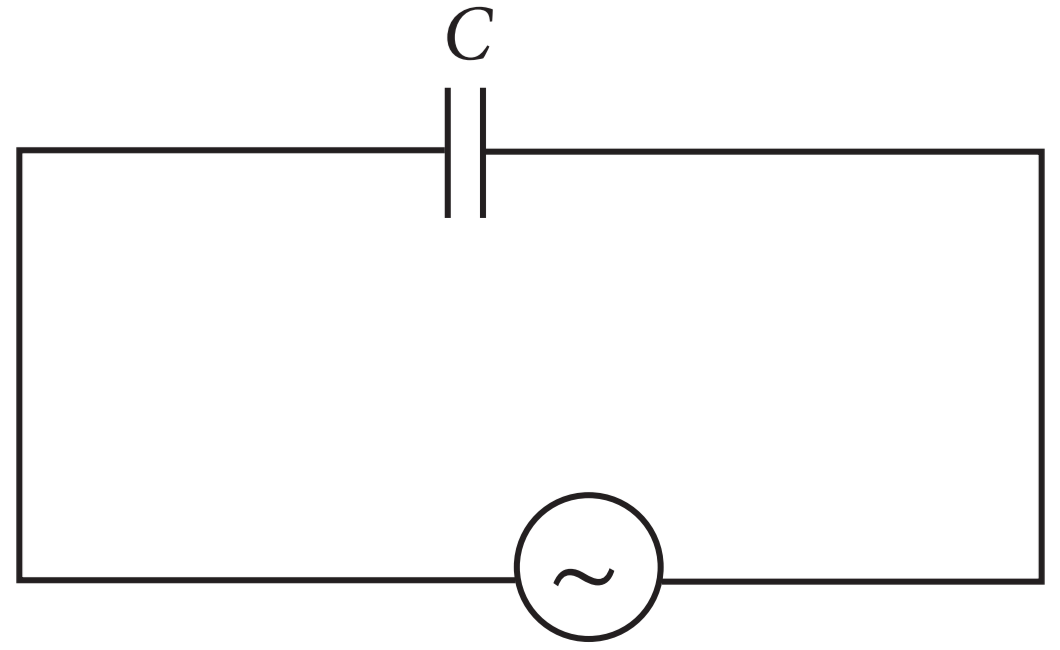
Let a source of alternating e.m.f. $\text{E} = \text{E}_\circ\sin\omega\text{t}$ be connected to a capacitor of capacitance C. If 'I' is the instantaneous value of current in the circuit at instant t, then $\text{I}=\frac{\text{E}_0}{\frac{1}{\omega\text{C}}}\sin\Big(\omega\text{t}+\frac{\pi}{2}\Big).$ The capacitive reactance limits the amplitude of current in a purely capacitive circuit and it is given by $\text{X}_\text{C}=\frac{1}{\omega\text{C}}.$
  1. What is the unit of capacitive reactance?
  1. Farad
  2. Ampere
  3. Ohm
  4. $Ohm^{-1}$
  1. The capacitive reactance of a $5\mu\text{F}$ capacitor for a frequency of $10^6Hz$ is:
  1. $0.032\Omega$
  2. $2.52\Omega$
  3. $1.25\Omega$
  4. $4.51\Omega$
  1. In a capacitive circuit, resistance to the flow of current is offered by:
  1. Resistor
  2. Capacitor
  3. Inducto
  4. Frequency
  1. In a capacitive circuit, by what value of phase angle does alternating current leads the e.m.f?
  1. $45^\circ$
  2. $90^\circ$
  3. $75^\circ$
  4. $60^\circ$
  1. One microfarad capacitor is joined to a 200V, 50Hz alternator. The rrns current through capacitor is:
  1. $6.28 \times 10^{-2}A$
  2. $7.5 \times 10^{-4}A$
  3. $10.52 \times 10^{-2}A$
  4. $15.25 \times 10^{-2}A$

Answer

  1. (c) Ohm
Solution:
Ohm is the unit of capacitive reactance.
  1. (a) $0.032\Omega$
Solution:
Capacitive reactance, $\text{X}_\text{C}=\frac{1}{\omega\text{C}}=\frac{1}{2\pi\mu\text{C}}$
$=\frac{1}{2\pi\times10^6\times5\times10^{-6}}$
$=0.032\Omega$
  1. (b) Capacitor
Solution:
In capacitive circuit, resistance to the flow of current is offered by the capacitor.
  1. (b) $90^\circ$
  2. (a) $6.28 \times 10^{-2}A$
Solution:
Current, $\text{l}_\text{v}=\frac{\text{E}_\text{V}}{\text{X}_\text{C}}=\frac{1}{\frac{1}{2\pi\mu\text{C}}}=(2\pi\mu\text{C})\text{E}_\text{V}$
$\text{I}_\text{v}=2\times3.14\times50\times10^{-6}\times200$
$=6.28 × 10^{-2}\text{A}$

Need a full question paper?

Generate a complete, print-ready paper with questions like this in minutes — across 16+ boards, with answer keys.

Start Generating Free

Similar questions

Derive the formula of electric potential at a point due to electric dipole.
The entering flux from a closed surface is $2 \times 10^3$ Newton-metre ${ }^2 /$ Coulomb and the emerging flux is $8 \times 10^3$ Newton-metre ${ }^2 /$ Coulomb. Find the value of charge enclosed in the surface.
The reduction factor K of a tangent galvanometer is written on the instrument. The manual says that the current is obtained by multiplying this factor to tane. The procedure works well at Bhuwaneshwar. Will the procedure work if the instrument is taken to Nepal? If there is some error, can it be corrected by correcting the manual or the instrument will have to be taken back to the factory?
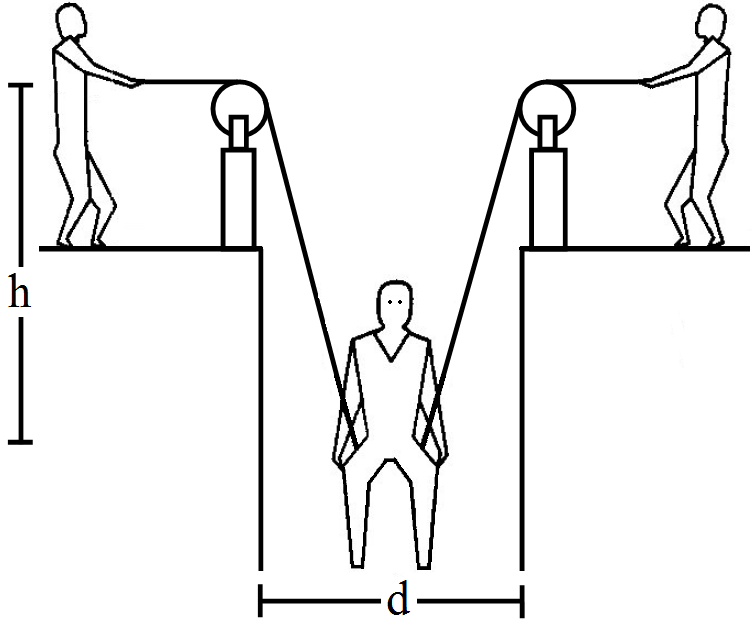
A man has fallen into a ditch of width d and two of his friends are slowly pulling him out using a light rope and two fixed pulleys as shown in figure. Show that the force (assumed equal for both the friends) exerted by each friend on the road increases as the man moves up. Find the force when the man is at a depth h.
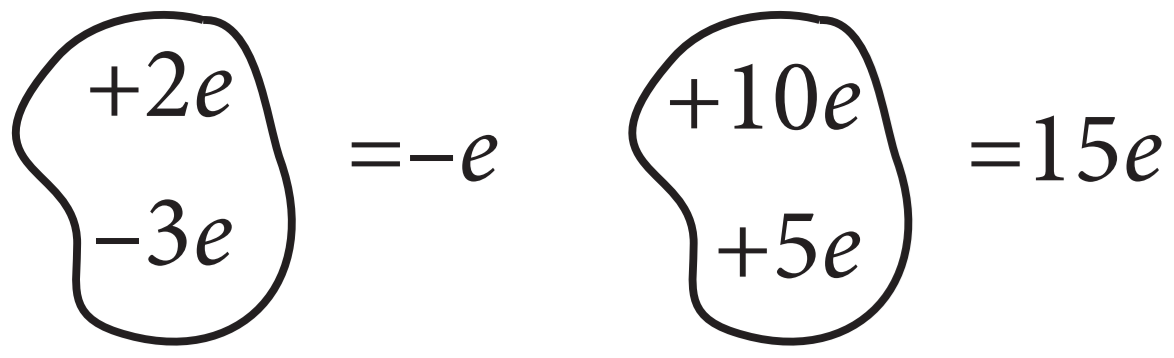
Smallest charge that can exist in nature is the charge of an electron. During friction, it is only the transfer of electrons which makes the body charged. Hence, net charge on any body is an integral multiple of charge of an electron$ [1.6 x 10^{-19}C]$ i.e. q = ± ne Where $n = 1, 2, 3, 4,....$

Hence, no body can have a charge represented as 1.1 e, 2. 7e, $\frac{3}{5}\text{e,}$ etc. Recently, it has been discovered that elementary particles such as protons or neutrons are composed of more elemental units called quarks.
  1. Which of the following properties is not satisfied by an electric charge?
  1. Total charge conservation.
  2. Quantization of charge.
  3. Two types of charge.
  4. Circular line of force.
  1. Which one of the following charges is possible?
  1. $5.8 \times 10^{-18}C$
  2. $3.2 \times 10^{-18}C$
  3. $4.5 \times 10^{-19}C$
  4. $8.6 \times 10^{-18}C$
  1. If a charge on a body is 1nC, then how many electrons are present on the body?
  1. $6.25 \times 10^{27}$
  2. $1.16 \times 10^{19}$
  3. $6.25 \times 10^{28}$
  4. $6.25 \times 10^9$
  1. If a body gives out $10^9$ electrons every second, how much time is required to get a total charge of 1C from it?
  1. 190.19 years
  2. 150.12 years
  3. 198.19 years
  4. 188.21 years
  1. A polythene piece rubbed with wool is found to have a negative charge of $3.2 \times 10^{-7}\ C$. Calculate the number of electrons transferred.
  1. $2 \times 10^{12}$
  2. $3 \times 10^{12}$
  3. $2 \times 10^{14}$
  4. $3 \times 10^{14}$
If you are walking on the moon, can you hear the sound of stones cracking behind you? Can you hear the sound of your own footsteps?
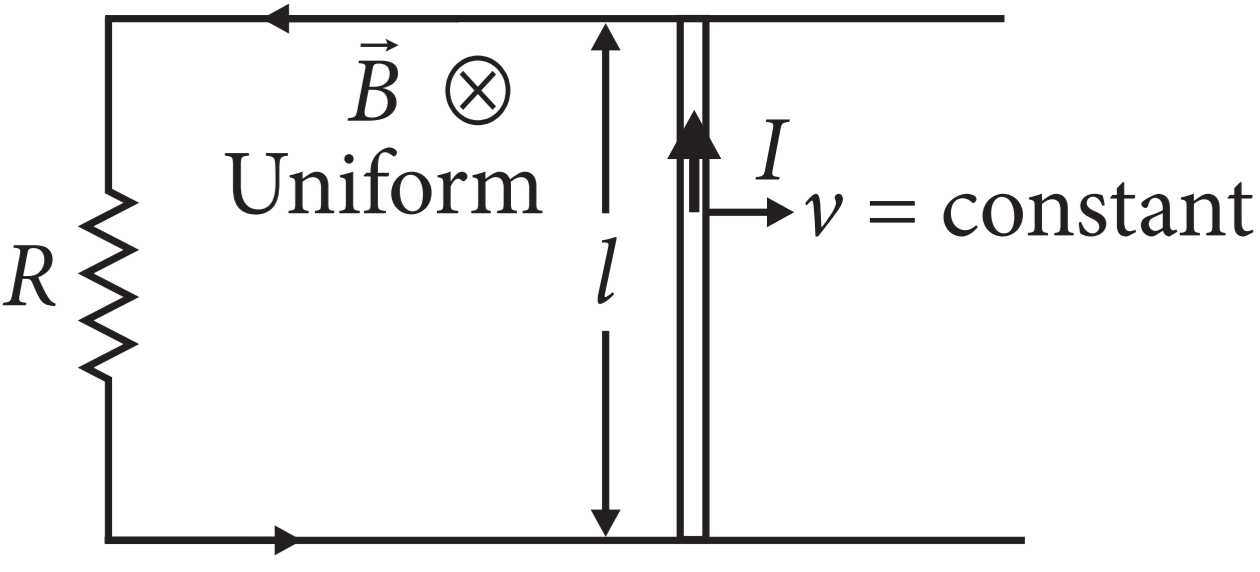
The emf induced across the ends of a conductor due to its motion in a magnetic field is called motional emf. It is produced due to the magnetic Lorentz force acting on the free electrons of the conductor. For a circuit shown in figure, if a conductor of length l moves with velocity v in a magnetic field B perpendicular to both its length and the direction of the magnetic field, then all the induced parametres are possible in the circuit.
  1. Direction of current induced in a wire moving in a magnetic field is found using
  1. Fleming's left hand rule.
  2. Fleming's right hand rule.
  3. Ampere's rule.
  4. Right hand clasp rule.
  1. A conducting rod of length l is moving in a transverse magnetic field of strength B with velocity v. The resistance of the rod is R. The current in the rod is:
  1. $\frac{\text{Blv}}{R}$
  2. $\frac{\text{B}^2\text{v}^2\text{l}^2}{\text{R}}$
  3. Blv
  4. Zero
  1. A 0.1m long conductor carrying a current of SO A is held perpendicular to a magnetic field of 1.25mT. The mechanical power required to move the conductor with a speed of I m $s^{-1}$​​​​​​​ is:
  1. 62.5 mW
  2. 625 mW
  3. 6.25 mW
  4. 12.5 mW
  1. A bicycle generator creates 1.5 Vat 15km/ hr. The EMF generated at 10km/ hr is:
  1. 1.5 volts
  2. 2 volts
  3. 0.5 volts
  4. 1 volt
  1. The dimensional formula for emf E in MKS system will be:
  1. $[ML^2T^{-3}A^{-1}]$
  2. $[ML^2T^{-1}A]$
  3. $[ML^2A]$
  4. $[MLT^-^3A^{-1}]$
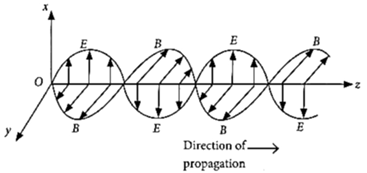
A stationary charge produces only an electrostatic field while a charge in uniform motion produces a magnetic field, that does not change with time. An oscillating charge is an example of accelerating charge. It produces an oscillating magnetic field, which in turn produces an oscillating electric fields and so on. The oscillating electric and magnetic fields regenerate each other as a wave which propagates through space.
Image
$(i).$ Magnetic field in a plane electromagnetic wave is given by $\vec{B}= B _0 \sin ( kx +\omega t ) \hat{j} T$Expression for corresponding electric field will be (Where c is speed of light.)
$(a) \vec{E}= B _0 c \sin ( kx +\omega t ) \hat{k} V / m$
$(b) \vec{E}=- B _0 c \sin ( kx -\omega t ) \hat{k} V / m$
$(c) \vec{E}=- B _0 c \sin ( kx +\omega t ) \hat{k} V / m$
$(d) \vec{E}=\frac{B_0}{c} \sin ( kx +\omega t ) \hat{k} V / m$
$(ii)$ The electric field component of a monochromatic radiation is given by $\vec{E}=2 E _0 \hat{i} \cos kz \cos \omega t$. Its magnetic field $\vec{B}$ is then given by
$(a) -\frac{2 E_0}{c} \hat{j} \sin kz \sin \omega t$
$(b) \frac{2 E_0}{c} \hat{j} \sin kz \sin \omega t$
$(c) \frac{2 E_0}{c} \hat{j} \sin kz \cos \omega t$
$(d) \frac{2 E_0}{c} \hat{j} \cos kz \cos \omega t$
$(iii)$ A plane em wave of frequency $25 \ MHz$ travels in a free space along $x -$direction. At a particular point in space and time, $E =(6.3 \hat{j}) V / m$. What is magnetic field at that time?
$(a) \ 0.089 \mu T$
$(b) \ 0.124 \mu T$
$(c) \ 0.021 \mu T$
$(d) \ 0.095 \mu T$
OR
A plane electromagnetic wave travels in free space along $x-$axis. At a particular point in space, the electric field along $y$-axis is $9.3 V m ^{-1}$. The magnetic induction $(B)$ along $z -$axis is
$(a) \ 3.1 \times 10^{-8} T$
$(b) \ 3 \times 10^{-5} T$
$(c) \ 3 \times 10^{-6} T$
$(d) \ 9.3 \times 10^{-6} T$
$(iv)$ A plane electromagnetic wave travelling along the $x-$direction has a wavelength of $3 \ mm$ . The variation in the electric field occurs in the $y-$direction with an amptitude $66 V m ^{-1}$. The equations for the electric and magnetic fields as a function of $x$ and $t$ are respectively
$ \text { a) } E_y =11 \cos 2 \pi \times 10^{11}\left(t-\frac{x}{c}\right), \text { b) } E_y =66 \cos 2 \pi \times 10^{11}\left(t-\frac{x}{c}\right),$
$B_y =11 \times 10^{-7} \cos 2 \pi \times 10^{11}\left(t-\frac{x}{c}\right) B_z =2.2 \times 10^{-7} \cos 2 \pi \times 10^{11}\left(t-\frac{x}{c}\right)$
$\text { c) } E_x =33 \cos \pi \times 10^{11}\left(t-\frac{x}{c}\right), \text { d) } E_y =33 \cos \pi \times 10^{11}\left(t-\frac{x}{c}\right),$
$B_x =11 \times 10^{-7} \cos \pi \times 10^{11}\left(t-\frac{x}{c}\right) B_z =1.1 \times 10^{-7} \cos \pi \times 10^{11}\left(t-\frac{x}{c}\right)$
An astronomical telescope is an optical instrument which is used for observing distinct images of heavenly bodies libe stars, planets etc. It consists of two lenses. In normal adjustment of telescope, the final image is formed at infinity. Magnifying power of an astronomical telescope in normal adjustment is defined as the ratio of the angle subtended at the eye by the angle subtended at the eye by the final image to the angle subtended at the eye, by the object directly, when the final image and the object both lie at infinite distance from the eye. It is given by, $\text{m}=\frac{\text{f}_0}{\text{f}_\text{g}}.$ To increase magnifying power of an astronomical telescope in normal adjustment, focal length of objective lens should be large and focal length of eye lens should be small.
  1. An astronomical telescope of magnifying power 7 consists of the two thin lenses 40cm apart, in normal adjustment. The focal lengths of the lenses are
  1. 5cm, 35cm
  2. 7cm, 35cm
  3. 17cm, 35cm
  4. 5cm, 30cm
  1. An astronomical telescope has a magnifying power of 10. In normal adjustment, distance between the objective and eye piece is 22cm. The focal length of objective lens is:
  1. 25cm
  2. 10cm
  3. 15cm
  4. 20cm
  1. In astronomical telescope compare to eye piece, objective lens has:
  1. Negative focal length.
  2. Zero focal length.
  3. Small focal length.
  4. Large focal length.
  1. To see stars, use:
  1. Simple microscope.
  2. Compound microscope.
  3. Endoscope.
  4. Astronomical telescope.
  1. For large magnifying power of astronomical telescope.
  1. $f_0 << f_e$
  2. $f_0 << f_e$
  3. $f_0 << f_e$
  4. None of these.
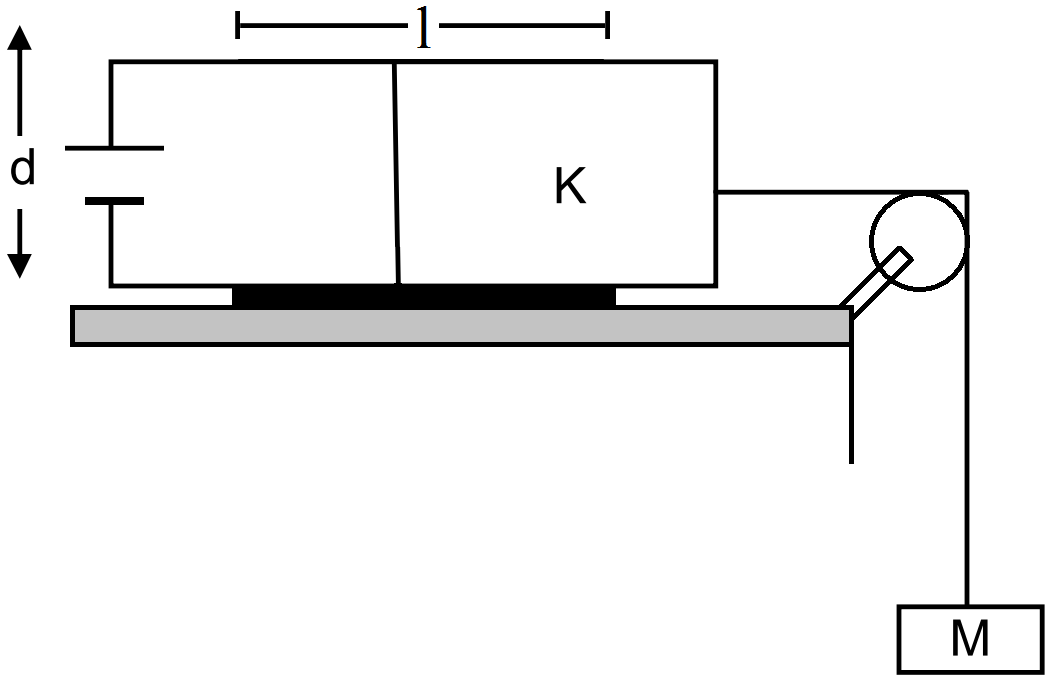
Consider the situation shown in figure. The width of each plate is b. The capacitor plates are rigidly clamped in the laboratory and connected to a battery of emf $\in.$ All surfaces are frictionless. Calculate the value of M for which the dielectric slab will stay in equilibrium.